 MMXXVI
Ægishjálmr, Fáfnir's helm of terror, and what Sigurd answered about it
In the Fáfnismál, the dragon Fáfnir says he wore a helm of terror to frighten men. Sigurd replies that no helm protects whoever faces a brave enemy. After the dragon's death, the helm joins Sigurd's treasure.
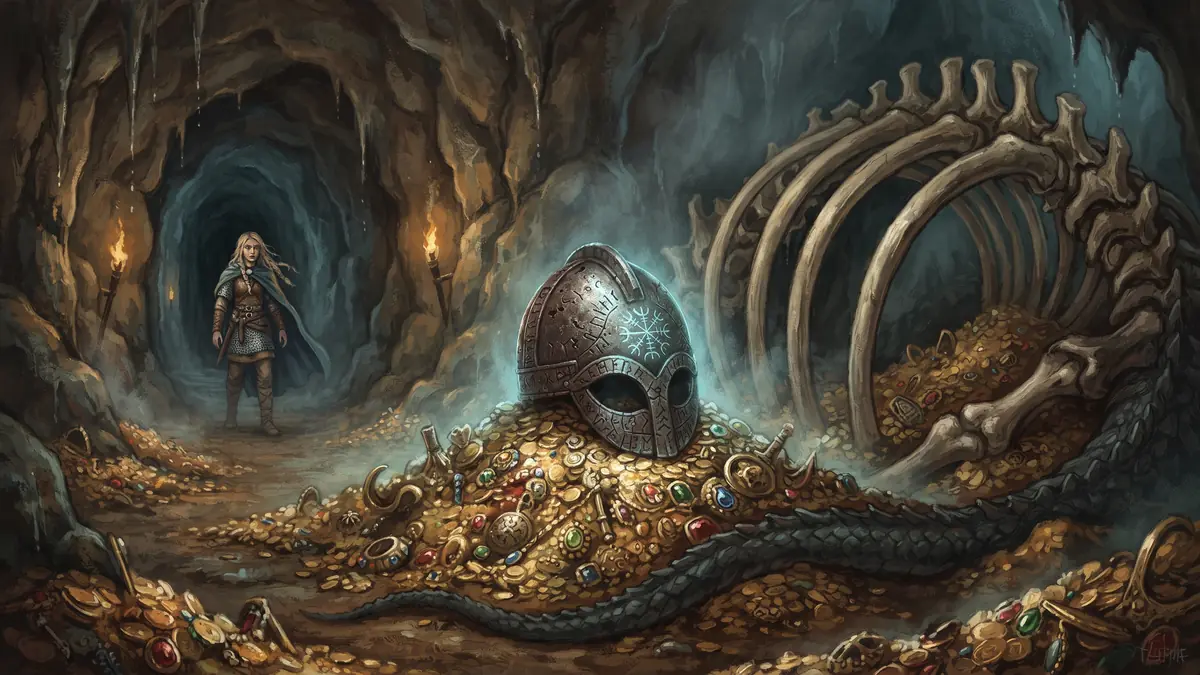
Ægishjálmr comes from ægir, “one who frightens”, and hjálmr, “helmet”. The most common translation is “helm of awe” or “helm of terror”. In the sources it is a helmet that gives its wearer the illusion of being mightier than any man, and that is of no use against a brave enemy.
The dragon’s helm
The helm belongs to Fáfnir, and the prose of the Reginsmál says all living creatures feared it. In the Fáfnismál, the dying dragon talks with Sigurd and says, in Bellows’s translation: “The fear-helm I wore to afright mankind, while guarding my gold I lay; mightier seemed I than any man.”
Sigurd’s answer
Sigurd is not impressed: “The fear-helm surely no man shields” who must face a valiant foe. The poem then refers to the dragon’s hissing and says hatred falls more heavily on whoever owns the helm. The passage is a criticism: the object worked because Fáfnir only met frightened men.
After the dragon’s death
In the Völsunga saga, Sigurd kills Fáfnir and takes the helm from the hoard, the Ægishjálmur in the modern Icelandic form. The saga tells it in the same passage in which Sigurd gathers the gold and the ring, and the helm does not play a prominent part again.
The modern sign
The name was later applied to an Icelandic magical sign, an eight-armed design that is today sold as “Helm of Awe” in jewellery and tattoos. That symbol is a sign from magical manuscripts, much later than the poems, and Wikipedia only says the name was given to it afterwards. There is no drawing of a helm in the medieval sources.
In short
The helm of terror is an object of mockery: the dragon trusts it, and the hero answers that fear does not count against courage. To face the dragon’s blows with the shield, play Fáfnir’s blows.
Sources.
- Poetic Edda, Fáfnismál, stanzas 16 and 17 (Bellows's translation)
- Poetic Edda, the prose that precedes stanza 15 of the Reginsmál
- Völsunga saga, passage where Sigurd takes the helm from the hoard (Byock's translation, 1999)
- English Wikipedia, article "Helm of Awe", with reference to Bauer and Pesch (2023)