 MMXXVI
Aggersborg: the largest Viking ring fortress in Denmark, with 48 longhouses and 240 metres
Near the Limfjord in Denmark, a ring fort of about 980 has an inner diameter of 240 metres and 48 longhouses. See what it was like, what the excavations found and why the barracks idea was dropped.
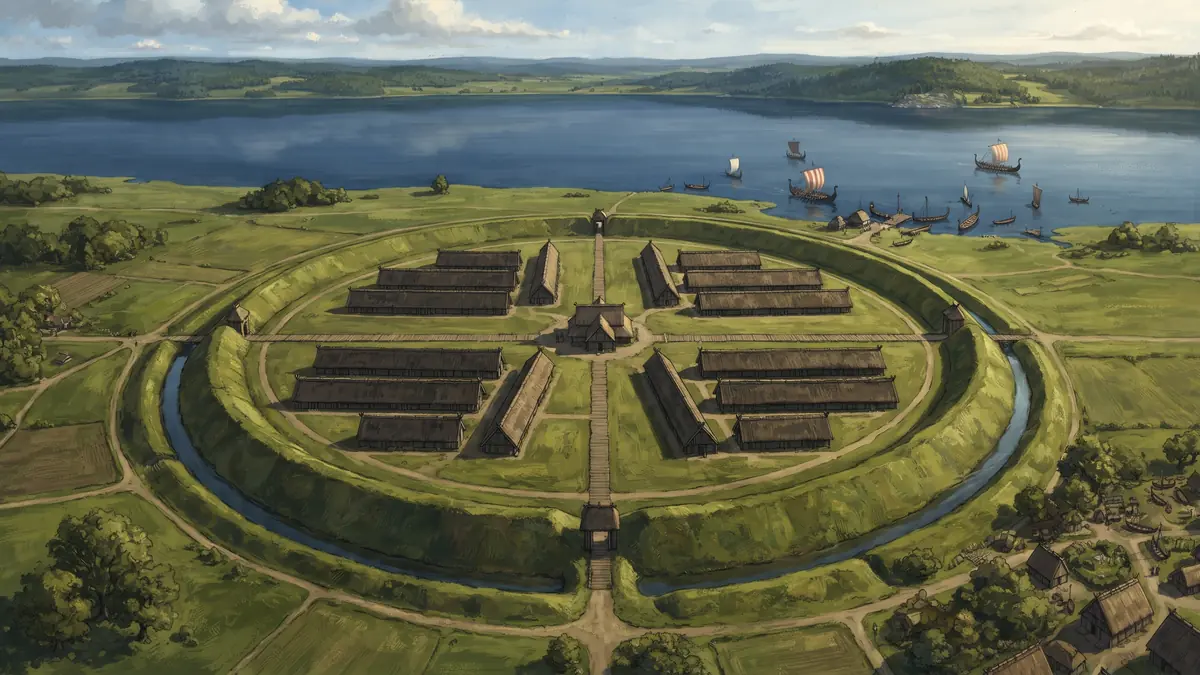
Late tenth-century Denmark has a type of construction that looks like nothing built afterwards: ring fortresses, in perfect geometry. The largest is Aggersborg, beside the Aggersund strait, on the north side of the Limfjord.
The size
The inner diameter is 240 metres. The ditch lies 8 metres outside the rampart and is about 1.3 metres deep. The wall is believed to have been 4 metres tall. Inside there were 48 longhouses, 12 in each quadrant, all aligned north–south or west–east. Each house measured about 32.5 metres by 8.5. The inner hall was about 19 metres, with smaller rooms at the ends.
The plan
Four main roads, in a cross, connected the centre to the outer ring and were tunnelled under the rampart. The fortress has four sections, with smaller streets within each. The page does not describe the gates.
The date
Aggersborg was likely built around 980, during the reign of Harald Bluetooth and/or Sweyn Forkbeard. The Iron Age village beneath it was settled in the late eighth century and destroyed in the tenth century. Five of the six ring fortresses in historical Denmark date to this era.
The excavations
The National Museum of Denmark excavated the site from 1945 to 1954, and additional trenches were studied in 1970 and 1990. In all, more than 30,000 objects, about 13,000 square metres and about 19,500 features were recorded.
The timber
Wikipedia says one house required about 66 large oaks, and that the whole structure needed about 5,000 large oaks. It is a number that gives an idea of what the king could mobilize.
What it was for
There was a theory that it was a barracks or training ground for Sweyn Forkbeard’s armies before the conquest of England in the early 1000s. Dendrochronology disproved that theory. Wikipedia says it was more likely a defensive stronghold on strategic trade routes and/or an administrative outpost of the emerging state. The same page estimates that the fort could hold about 5,000 troops, but states that the exact use remains uncertain.
The numbers
It is worth gathering the numbers in one place: 240 metres of inner diameter, a ditch 8 metres from the rampart, a wall of about 4 metres, 48 houses of about 32.5 by 8.5 metres, 4 main roads, 30,000 objects found in 13,000 square metres excavated. Wikipedia says “about” for several of them, and the values should be read as archaeologists’ estimates, not exact measurements.
In short
Aggersborg is the largest of the ring forts of Viking Denmark: 240 metres of inner diameter, 48 longhouses, four roads in a cross and a construction of about 980. The theory that it was a barracks for the conquest of England was overturned by dendrochronology. The exact purpose remains open.
To assemble the fort, quadrant by quadrant, play The fort, quadrant by quadrant.
Sources.
- English Wikipedia, article "Aggersborg"
- National Museum of Denmark, excavations of 1945 to 1954, cited on Wikipedia