 MMXXVI
Áns saga bogsveigis: Án the Bow-Bender, the dwarf Litr, the five arrows and the war against King Ingjaldr of Naumudalr
Áns saga bogsveigis, an Icelandic legendary saga, tells how Án, thought slow in Hrafnista, received a bow from the dwarf Litr, became an outlaw and was finally avenged by his son. See what the text says and what remains uncertain.
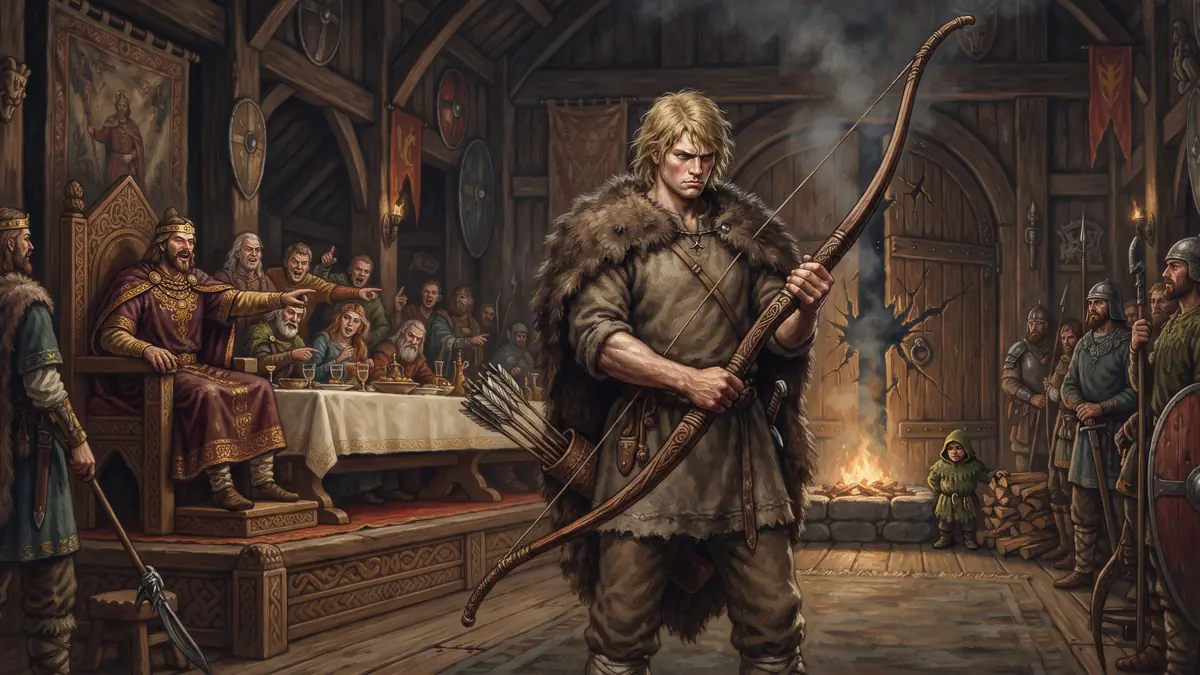
The Áns saga bogsveigis, “the saga of Án the Bow-Bender”, is the last of the Hrafnista sagas. The hero is a classic tale type: a big lad, badly dressed and thought useless, whose strength shows only at the right moment. The saga is usually dated to the fourteenth century, and its style recalls the sagas of Icelanders, although the content is that of a legendary saga.
The slow lad of Hrafnista
Án is the youngest son of Björn, a farmer of Hrafnista. He grows big but seems slow, and his father shows him little affection. At twelve, he vanishes for three days and comes back with an enormous chair made by the dwarf Litr, who also forged a strong bow and five arrows. The dwarf’s promise is that each arrow hits the target Án chooses.
At eighteen, Án wants to go with his brother Þórir, a courtier of King Ingjaldr of Naumdalir. Þórir refuses, and Án uproots a tree to show his strength. They reach the court, and Án’s bow nearly wrecks the hall door. Ingjaldr gives him a ring at Christmas and calls him bogsveigir, “the one who bends bows”. Án loses the ring, the courtiers mock him, and Ketill, the most scornful, leads the laughter.
From the hall to the forest
Án wrestles the strong Björn and throws him in the fire. He refuses the sword Þórir offers him, called Þegn. He accompanies Ingjaldr in the war against Úlfr and his brothers, and shoots two of them from afar. The king is pleased, but irritated that Án does not come forward. Later Án humiliates Ketill and leaves him maimed, as a message to the king.
Ingjaldr declares him an outlaw. Án goes to live with a farmer, whose daughter Drífa he courts, promising to acknowledge any child. He kills the outlaw Garan in a stone-lifting dispute and marries the rich widow Jórunn. He grows wealthy with ships and farms. The king sends Ívarr to kill him; Án cripples him and sends him back. Then Ingjaldr sends twelve men, who ask for shelter; Jórunn sees through the ambush, and the twelve end up hanged.
The son’s revenge
Ingjaldr, in a fit of rage, kills Þórir, Án’s brother. Án flees by boat with his nephew Grímr, is wrecked on an island and is saved by Erpr. On the island, he meets a young man who is his son by Drífa, Þórir hálegg, “long-leg”. Án sends him to avenge his uncle’s death. The young man burns Ingjaldr’s hall, kills the king and takes Ása, his sister. Án gives his lands to his son and goes back to Hrafnista. The saga ends with the descendants, among them Ögmundr and Sigurðr bjóðaskalli.
What is uncertain
Some studies read the saga as an “inverted” version of Egils saga and as another variation on the myth of Þórr at Útgarða-Loki’s house. These are modern readings, and it is not clear how much the medieval author thought of this. Dates, names and the dwarf Litr belong to the tradition of tales. The saga has short verses by Án that mock the courtiers, boast of the bow and curse those who wronged him.
To hit the straw targets without striking your friends’ shields, play Litr’s arrows.
Sources.
- Áns saga bogsveigis, Icelandic legendary saga (fornaldarsaga), in Guðni Jónsson and Bjarni Vilhjálmsson (eds.), Fornaldarsögur Norðurlanda (Reykjavík, 1943–1944)
- Shaun F. D. Hughes (trans.), "The Saga of Án Bow-Bender", in Medieval Outlaws (ed. Thomas H. Ohlgren)
- Ben Waggoner (trans.), The Hrafnista Sagas (The Troth, 2009)