 MMXXVI
Askold and Dir: the first Varangian rulers of Kiev and the trick of the false merchants
Askold and Dir are the first Varangian rulers of Kiev named in the Primary Chronicle. In 882, it says, Oleg killed them with a merchants' trick. See what the chronicle says, what other sources tell and why their historicity is debated.
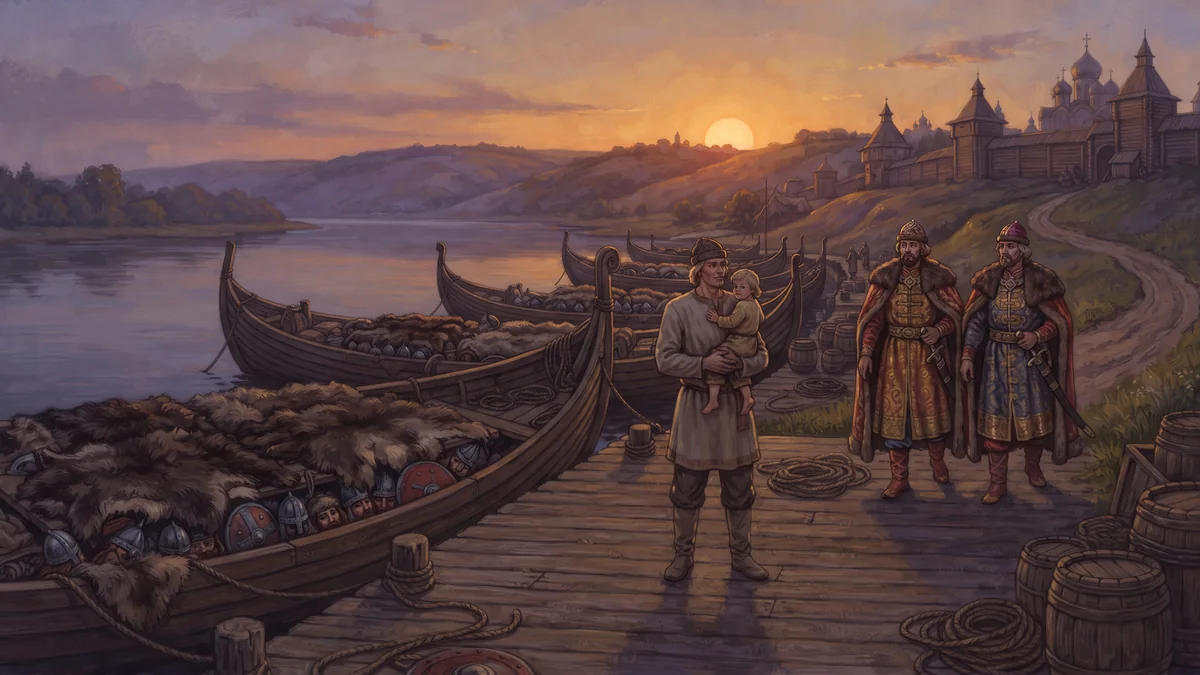
Askold and Dir are, according to the Primary Chronicle, the first Varangian rulers of Kiev. The likely Norse names are Haskuldr or Höskuldr and Dýri. Their historicity is disputed, and the chronicle was written about 250 years after the events.
What the Primary Chronicle says
Rurik sent Askold and Dir toward Constantinople. On the Dnieper, the two settled in Kiev and took power over the Polans, who had been paying tribute to the Khazars. The chronicle was attributed to Nestor, but that is doubted today. It may be a compilation, perhaps by Sylvester of Kiev, in 1116.
The trick of 882
Oleg set out from Novgorod with Varangians, Chuds, Slavs, Merians, Ves and Krivichians. He took Smolensk and Lyubech and reached the hills of Kiev. He hid his warriors in boats and approached the Hungarian hill carrying the child Igor. He sent messengers saying he was a guest, a merchant travelling to Greece.
When Askold and Dir came out to greet their “kinsmen”, the soldiers leaped from the boats. Oleg told them they were not princes, but he was of princely birth, and presented Igor as Rurik’s son. Askold and Dir were killed and buried on the Hungarian hill. Oleg ruled Kiev without resistance and called it the “mother of the cities of Rus’”.
The Novgorod version
The Novgorod First Chronicle, in the Younger Redaction, tells it differently: those who act are Igor and Oleg, and it is Igor, not Oleg, who becomes prince of Kiev. The phrase “mother of cities” does not appear.
Other sources
Patriarch Photius described the Rus’ attack on Constantinople in June 860 as “like a thunderbolt from heaven”. Slavonic chronicles link the expedition to Askold and Dir and date it to 866, but most historians consider the link tenuous. Photius also wrote that he sent a bishop to Rus’, and some link this to Askold’s conversion, but most think the conversion apocryphal.
The Arab historian al-Mas’udi is the only foreign source that names a co-ruler: he calls “king al-Dir” the first of the Slavic kings. Some scholars see him as a separate Slavic ruler, and others think it at least as likely to be Dir himself. If Dir ruled after Askold, in the 870s–880s, Oleg’s men may have killed only Dir.
Doubts
Askold and Dir are generally regarded as semi-legendary. Rurik is treated as largely legendary. Oleg and Igor are better attested, through the treaties with the Greeks. Debates over the origin of the names and the state, between those who defend a Scandinavian origin and those who deny it, are politically charged. It is still uncertain whether Askold was baptised and whether the attacks of 860 and 866 involved the two.
In short
According to the Primary Chronicle, Askold and Dir ruled Kiev until 882, when Oleg, hiding warriors in boats and posing as a merchant, lured and killed them. The Novgorod chronicle gives the role to Igor, and al-Mas’udi names only Dir. The story is semi-legendary.
To tell warriors from merchants on the quay of Kiev, play Warriors and merchants.
Sources.
- English Wikipedia, article "Askold and Dir", with the summary of the Primary Chronicle, the Novgorod First Chronicle and al-Mas'udi