 MMXXVI
Áslaug, "Kráka": the daughter of Sigurd and Brynhildr, the harp and the woman who came neither clothed nor naked
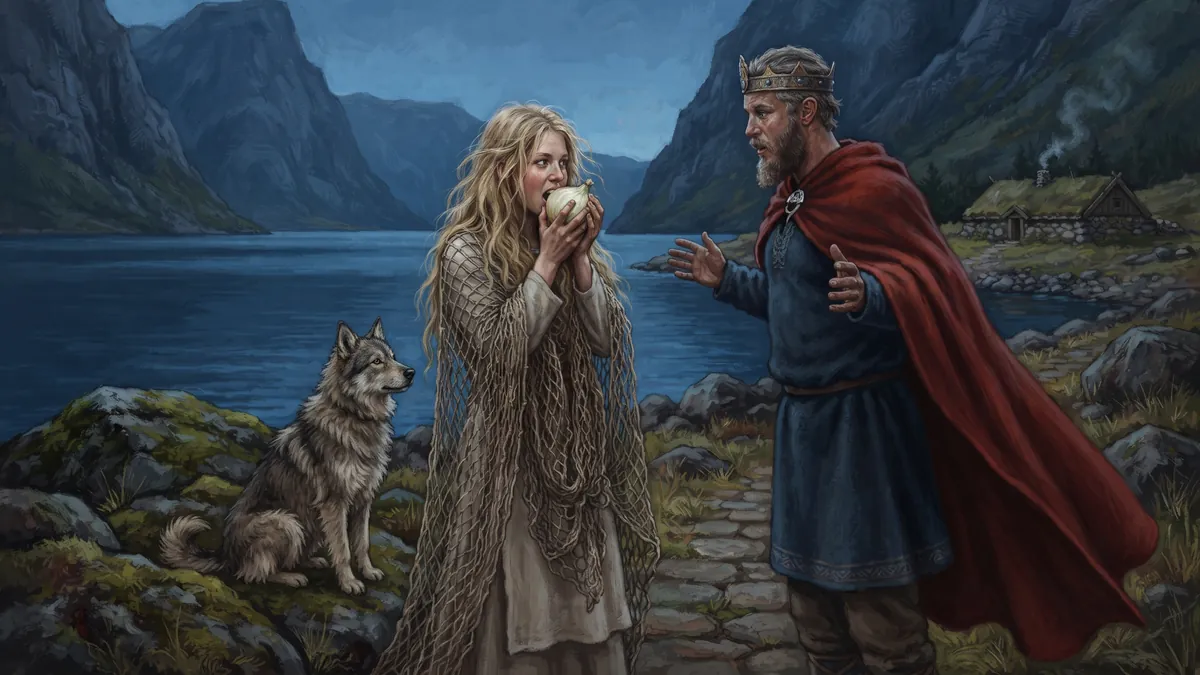
In the saga of Ragnar Lodbrok, Áslaug, daughter of Sigurd and Brynhildr, is raised as a poor peasant girl and called Kráka, "crow". When Ragnar's men see her, he sets her a test of three impossible conditions. See the tale, the sources and the parallel with clever-girl folktales.
Áslaug’s story is in the saga of Ragnar Lodbrok, the Völsunga saga and Snorri’s Edda. It mixes legendary heroes with a clever-girl tale found in many countries.
The child hidden in a harp
According to the saga of Ragnar Lodbrok (thirteenth century), Áslaug is the daughter of Sigurd and the shieldmaiden Brynhildr. After her parents die, Heimir, Brynhildr’s foster-father, builds a harp large enough to hide the girl and travels as a poor harpist, carrying her. At a farm in Spangereid, in Lindesnes, the peasant Áke thinks the harp holds treasure. His wife, Grima, persuades him to kill Heimir in his sleep. When they break the harp open, they find the girl and raise her as their own, under the name Kráka, “crow”.
To hide her beauty, which would betray her noble birth, they smear her with tar and dress her in a long hood.
The bread that burned
Ragnar’s men see her bathing. They are so struck that they let the bread burn. When Ragnar asks why, they tell him about her.
The test
Ragnar sends word that she must come to him neither dressed nor undressed, neither fasting nor fed, neither alone nor accompanied. She arrives wrapped in a net, biting an onion and accompanied by a dog. Wikipedia says “onion”, not leek. Impressed by her wit, Ragnar asks for her hand.
The boneless son
Wikipedia tells that, had Ragnar followed Áslaug’s advice, their son Ívarr would not have been born weak and “boneless”. But Ragnar took her to bed right after the wedding. The article names only Ívarr among the sons.
The parallel with folktales
Marilyn Jurich calls the story the prototype of the “clever peasant girl” tale, Aarne–Thompson type 875. The Brothers Grimm and Johannes Pauli’s Schimpf und Ernst also carry parallels. Later, William Morris took the story up in the poem “The Fostering of Aslaug”, in a more romantic tone, and Fouqué wrote “Aslauga’s Knight” (1810).
In short
It is a story in two tones: the heroic saga, in which Áslaug is the daughter of heroes, and the folktale, in which wit counts for more than birth. That the same plot is found in other countries suggests a common root, not a fact.
To help catch the bread before it burns, play Kráka’s bread.
Sources.
- English Wikipedia, article "Aslaug", with the information from Snorri's Edda, the Völsunga saga and the saga of Ragnar Lodbrok and the analysis by Marilyn Jurich (1998)