 MMXXVI
Ásmundar saga kappabana: the champion-slayer, the sword in Lake Loginn, the duels against Hildibrand and the ending on the Rhine
Ásmundar saga kappabana, an Icelandic legendary saga, tells how Ásmundr recovered a sword from the bottom of a lake, beat Hildibrand's champions in duels and faced his own half-brother on the Rhine. See what the text says and what remains uncertain.
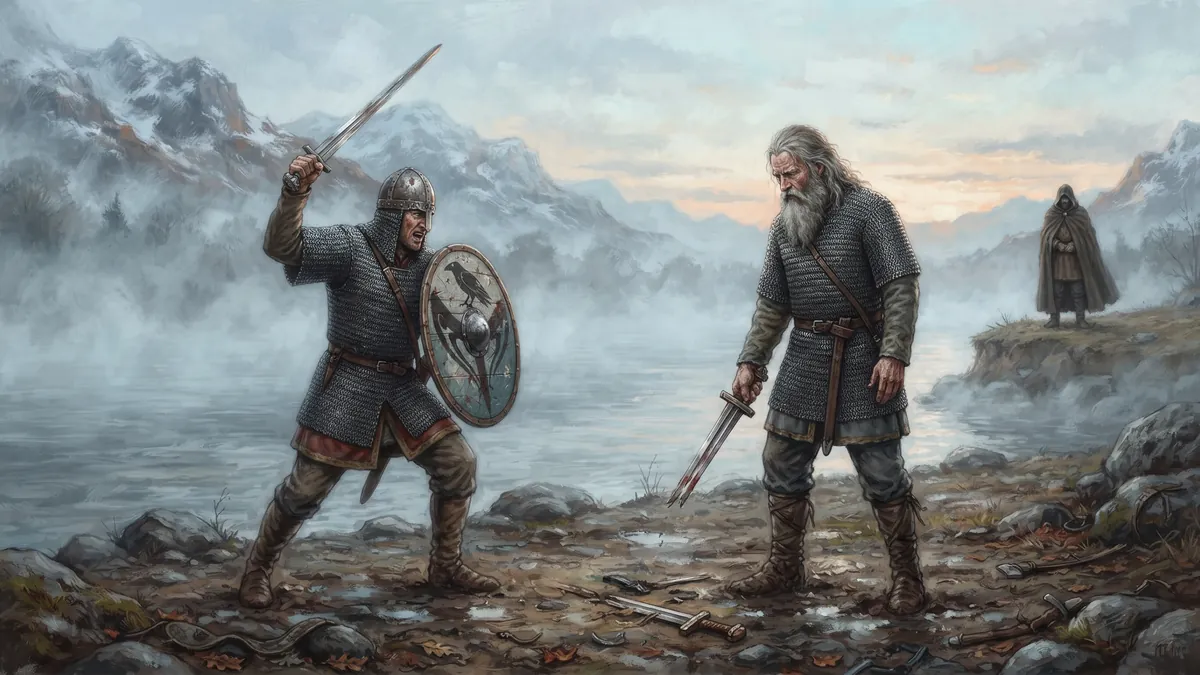
The Ásmundar saga kappabana, “the saga of Ásmundr, the champion-slayer”, is one of the fornaldarsögur, the “sagas of ancient times”. It stands out because it tells, in a Norse version, the story of a father and son who face each other, the same one Germany knows from the old poem Hildebrandslied. The oldest manuscript is Stockholm, Holm perg. 7 4to, from the first half of the fourteenth century; there is also AM 586 4to, from the fifteenth.
The sword of Lake Loginn
The saga begins with a Swedish king, Budli, and two smiths, Olius and Alius, who outdo the court smiths. Olius’s first sword breaks at the hilt, and he prophesies that the fragment will kill the king’s nephews. Budli has the sword encased in lead and sunk in Lake Loginn, by Agnafit.
Then come the generations. Helgi, Budli’s son-in-law, marries Hilda, and their son, Hildibrand, is raised by his grandfather, Hildibrand the Powerful, who rules Hunaland. Alf, king of Denmark, and his champion Aki raid Sweden, kill Budli and carry off Hilda; Aki marries her, and Ásmundr is born. The young Hildibrand grows in power and kills Alf to avenge Budli.
Ásmundr and the two quests
Æsa the Fair, Alf’s daughter, chooses Ásmundr after a contest over whose hands are finer, and sends him to Lake Loginn. With the help of an old farmer, he dives three times, breaks the lead with an axe and recovers the sword. Then Æsa sends him to the Saxon dukes, who lived harassed by Hildibrand: he forced them into duels, and they had lost farms, with only twelve left.
Ásmundr takes over the duels. He kills Hildibrand’s champions in succession: one, then two, four, and so on, up to berserkers in groups of eight. One night a dream of prophetic women encourages him, and he finishes off the eleven who were left. Furious, Hildibrand kills his own son and rides to the Rhine to face Ásmundr.
The duel on the Rhine
The two fight for a long time. Hildibrand’s sword breaks at the hilt against Ásmundr’s helmet. Wounded, Hildibrand speaks in verse about the sword, the dead men and his son, and asks a favour for after his death. According to one account of the saga, he reveals that they are half-brothers, since both are sons of Hilda. Ásmundr gives him an honourable burial, goes to his mother’s town, where Æsa is, tells his fights in verse, and the two marry. He kills a suitor of Æsa and becomes known as Ásmundr kappabani.
What is uncertain
The saga is basically an adaptation of the story of the Hildebrandslied, but it absorbed material from the Tyrfingr cycle. The German poem, copied in the early ninth century, survives incomplete, and the saga gives an ending, the father’s death, that the poem does not show. Saxo Grammaticus, in the Gesta Danorum (book 7), tells an almost identical story with different names: the Hildibrand figure there is Hildigerus. This shows the legend circulated in several countries. The classic study of the theme is Marlene Ciklamini’s, from 1966. Dates, numbers of champions and speeches should be read with caution.
To practise your shield against the blows of Hildibrand’s champions, play Hildibrand’s champions.
Sources.
- Ásmundar saga kappabana, Icelandic legendary saga (fornaldarsaga), manuscript Stockholm, Holm perg. 7 4to (first half of the fourteenth century)
- George L. Hardman (trans.), Ásmundar saga kappabana (2011), with the Old Norse text on facing pages
- Marlene Ciklamini, "The Combat Between Two Half-Brothers", Neophilologus 50 (1966)