 MMXXVI
Avaldsnes: the "oldest capital of Norway" on the Karmsund strait, with buried ships, a stone needle and a 13th-century church
At Avaldsnes, on the island of Karmøy, tradition places the main residence of Harald Fairhair around 870, and the place holds the oldest ship burial of the Nordic countries, a 7.2 m stone and a 13th-century stone church.
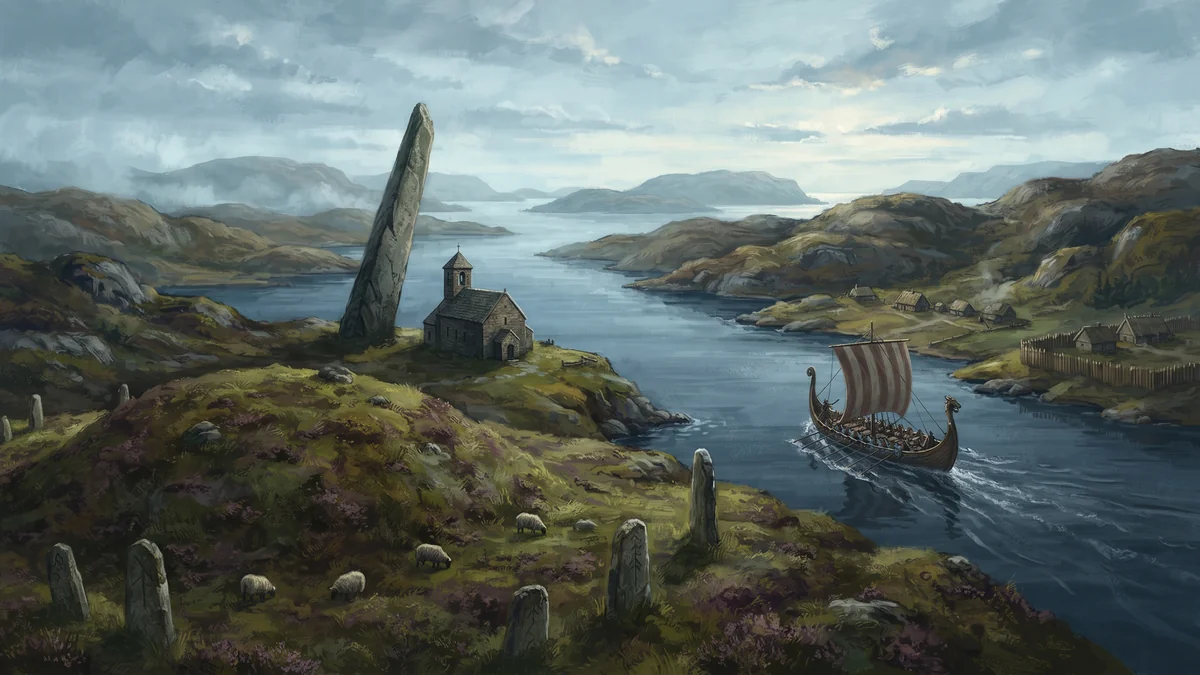
Avaldsnes is a village in the municipality of Karmøy, in Rogaland, Norway, on the northeast of the island of Karmøy, just south of Haugesund. It lies on the Karmsundet strait, which forces ships through a narrow channel. It is called “Norway’s oldest capital” because Harald Fairhair is said to have made it his main residence.
The king and the legend
Harald is said to have chosen Avaldsnes for his main royal estate around 870. The name is believed to come from the legendary King Augvald, who is said to have had his seat in the area. Legend says that Olav Tryggvason built an early church there, probably a small stave church, as a chapel of the royal residence. In 953 Haakon the Good won the battle of Blodeheia against the sons of Eirik Bloodaxe, and reigned until 961.
St Olav’s Church
Construction of the present stone church began around 1250, under King Håkon Håkonsson, and was not finished until nearly 1320. It was one of only four royal collegiate churches in Norway and a stop on the coastal pilgrim route to Nidaros Cathedral. Beside it stands Mary’s Needle, 7.2 metres tall, the second largest stone of its kind in Norway, leaning toward the church wall. A saga says Judgement Day will come when it touches the wall.
What the ground holds
There are ship burials at Storhaug, excavated from 1886, and at Grønhaug, examined by Haakon Shetelig in 1902. A ship burial of the Merovingian period, from about 680 to 750, is the oldest found in the Nordic countries. There is also a row of Bronze Age burial mounds, the only one of its kind in Norway. Flagghaugen was levelled in 1835 and revealed the richest Roman-period grave in Norway, with a gold neck ring of about 600 grams. Dendrochronological studies of 2009 linked the ships of Oseberg, Grønhaug and Storhaug to oaks from the same area of southwest Norway.
The centre and the farm
The Nordvegen History Centre, opened in 2005, is mostly underground beside the church. There is also a replica Viking Age farm, with a 25-metre longhouse and replica boathouses.
In short
It is a place where power, sea and graves come together, in the same strait. To take the fleet through the channel, play The Karmsund strait.
Sources.
- Reference work in English, article "Avaldsnes"
- Nordvegen History Centre, Avaldsnes