 MMXXVI
Bergbúa þáttr: the tale of two men who sheltered in a cave in a storm and heard a giant recite twelve stanzas
The Bergbúa þáttr, "the tale of the mountain dweller", tells how Þórðr and his servant, lost in a snowstorm on the way to church, hear a giant named Hallmundr recite a poem three times in a cave. See what the text says and what scholars debate.
The Bergbúa þáttr, “the tale of the mountain dweller”, is one of the strangest short Icelandic tales. It is not found in the great kings’ saga manuscripts, the Flateyjarbók and the Morkinskinna. It reached us in fragments of the manuscript AM 564a 4to and in paper copies made by Árni Magnússon from a codex lost in the Copenhagen fire of 1728. Scholars probably place it in the thirteenth century.
The snowstorm and the cave
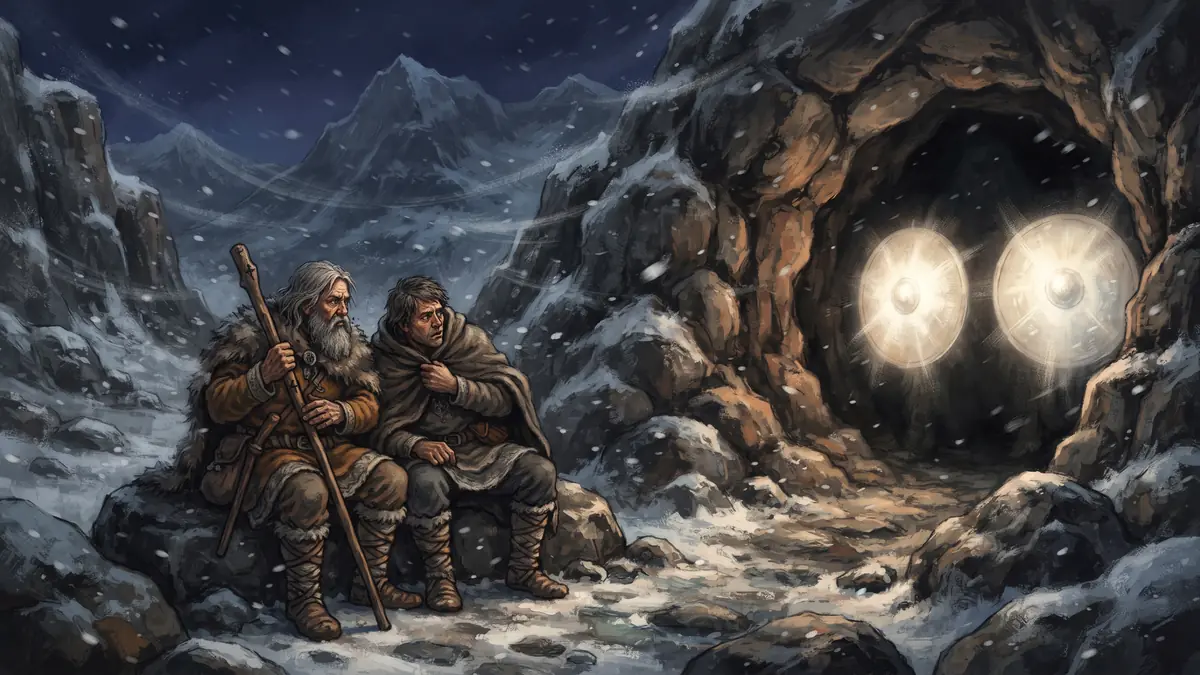
The tale begins in Djúpifjörðr, a fjord in western Iceland. Þórðr, a wealthy man in his prime, sets out on a winter day with a servant to attend a religious celebration. The road is long, and in the afternoon a snowstorm falls and makes them lose the path. Þórðr fears walking at night near cliffs. The two find shelter under a tall rock, where there is no snow, and enter a cave. Þórðr plants in the entrance a staff marked with a cross and tipped with iron. They sit near the mouth, without going deeper.
What comes from the depths
In the first part of the night, they hear something move inside and come toward them. The servant wants to run, but Þórðr orders him to stay and pray, because anyone who runs out at night may get lost. The two cross themselves and ask for God’s mercy. In the dark, they see two huge lights, like full moons or big shields, with something immense between them. They understand that these are eyes.
Then a voice loudly recites a poem of twelve stanzas, and each ends with a refrain in which the speaker’s name appears: Hallmundr. The poem, now called Hallmundarkviða, is a giant’s speech full of storm, rocks, ice and fire. The recitation is repeated three times, once in each third of the night, and each time the two see the lights again.
The morning
After the third time, the inside of the cave and its sounds withdraw, and they see daylight. As he leaves, Þórðr trips over the staff he had left in the entrance. They reach the church, but the service is over, and they go home. Later, at the place where they sheltered, there is no cave at all. Þórðr kept the whole poem, and the servant remembered nothing. About a year later, the servant dies.
What scholars debate
The name Hallmundarkviða is only attested from 1844. Because the poem speaks of falling rocks, fire and glaciers, several authors have linked it to volcanic eruptions. Guðmundur Finnbogason proposed the 1262 eruption at Sólheimajökull, and Pál Bergþórsson and, later, Árni Hjartarson associated it with the eruption that formed the Hallmundarhraun lava field in the tenth century. These links are hypotheses. John Lindow treats the tale in his study of trolls, and Ármann Jakobsson discusses it within the wider frame of the medieval Icelandic short story.
To recite each stanza at the right time, play Hallmundr’s poem.
Sources.
- Bergbúa þáttr, in Guðni Jónsson (ed.), edition of Old Icelandic texts (Old Norse text available at heimskringla.no)
- John Lindow, Trolls: An Unnatural History (Reaktion Books, 2014)
- Ármann Jakobsson, "The life and death of the medieval Icelandic short story", Journal of English and Germanic Philology 112:3 (2013)