 MMXXVI
Birka: the Viking trading town on the island of Björkö in Lake Mälaren
Birka was a Viking Age trading town, founded around 750 on an island in Lake Mälaren. See what the excavations and the Life of Ansgar say, and what remains disputed.
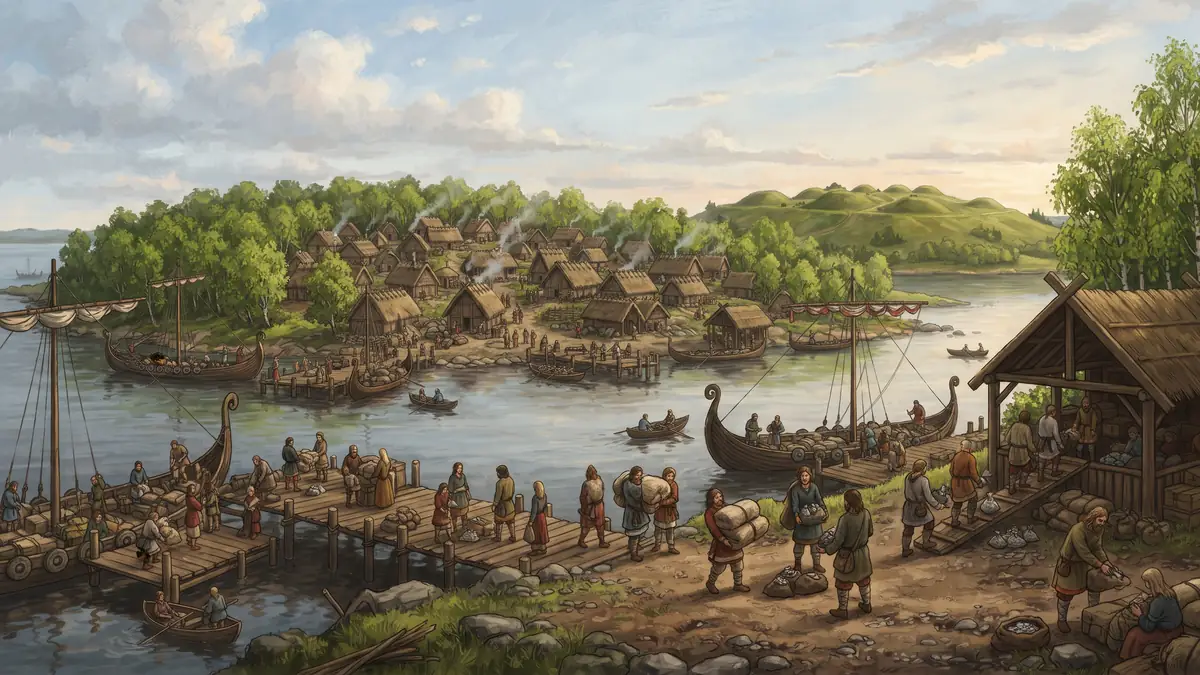
Birka stood on Björkö, “Birch Island”, in Lake Mälaren, about 30 kilometres west of Stockholm. It was founded around 750 and flourished for more than 200 years. It is one of the few Viking Age places that combine an excavated town and a text that describes it.
A town that lasted two centuries
The population was, according to Wikipedia, between 500 and 1000 people, with about 700 at its peak. There are more than 3,000 graves on the island. The town was abandoned around 975 according to one passage, or seems to have died out around 960 according to another, based on the coins, and the two dates are not reconciled. Sigtuna became the main trading centre of the Mälaren at about the same time. The reasons for the decline are disputed.
The excavator
The entomologist Hjalmar Stolpe excavated the island for about two decades from 1871 (one passage gives 1872 for the start), until 1895.
Ansgar and Rimbert
In 829, according to Wikipedia, Swedish ambassadors asked for Christian preachers, and Ansgar came to Birka. A Christian congregation is said to have been founded in 831. Rimbert’s Vita Ansgarii, around 865, is the first known description of Birka, and Wikipedia itself notes that Rimbert’s descriptions are approximate at best. Ansgar’s first attempt at conversion was unsuccessful.
The objects
In 27 graves small Thor’s hammer pendants were found, from about the 10th century, and in ten, small silver crosses. Among the textiles are fragments described as Chinese silk, with the caveat that the origin of some is Agnes Geijer’s theory. Most of the coins are silver dirhams from the Middle East. One is attributed to a mint at al-Shash, modern Tashkent.
Hovgården
On the neighbouring island of Adelsö lies Hovgården, an estate that housed the king’s retinue on visits. Birka’s administration is supposed to have been there. Birka and Hovgården together form the site “Birka and Hovgården”, inscribed by UNESCO in 1993 (reference 555).
What remains disputed
The end of the town, the dates of abandonment, the size of the population and the accuracy of Rimbert are points on which the sources differ.
In short
Birka is a long-distance trading town, with graves of Christians and of worshippers of Thor, eastern coins and a description written by a missionary. What brought it to an end is still not settled.
To dock the trading boats at the right moment, play The boats at the quay.
Sources.
- English Wikipedia, article "Birka"
- Rimbert, Vita Ansgarii (Life of Ansgar, around 865), the first known description of Birka
- UNESCO, "Birka and Hovgården", World Heritage (1993, reference 555)