 MMXXVI
Bisclaretz ljóð: the baron who became a wolf three days a week and the Norse version of Marie de France's lai
The Bisclaretz ljóð, from the Strengleikar, is the Norwegian version of Marie de France's Bisclavret, the story of the baron who turns into a wolf, the wife who steals his clothes and the wolf who kneels before the king. See the plot and what is known of the Norse text.
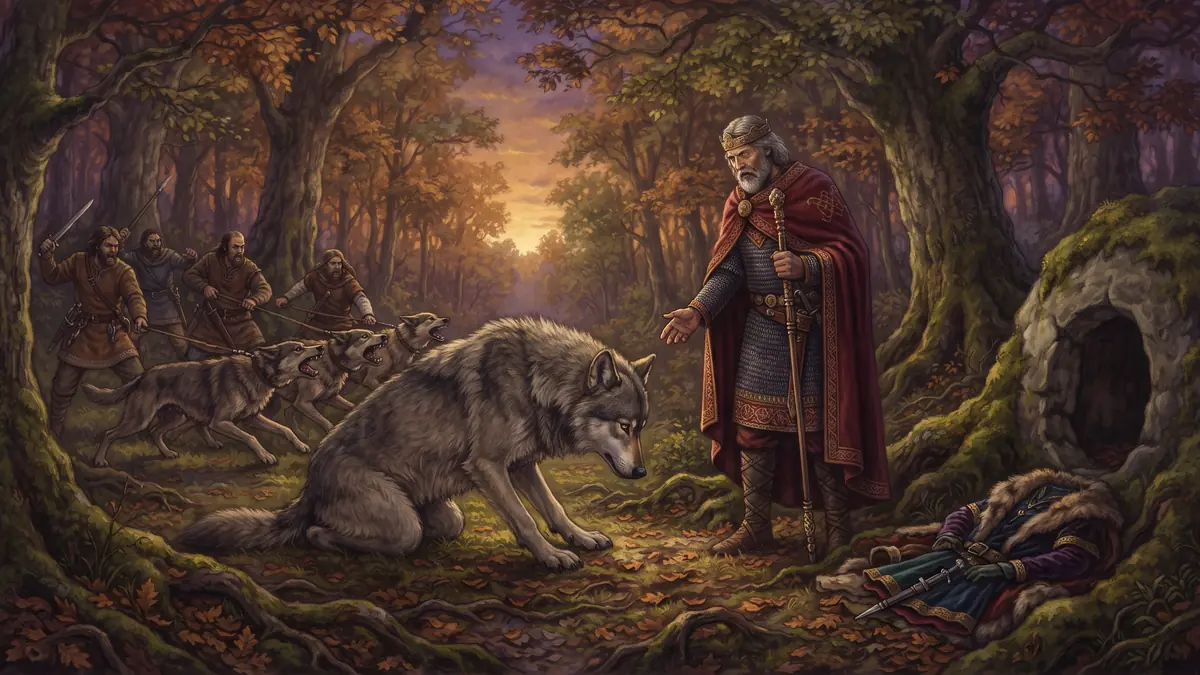
The Bisclaretz ljóð is one of the twenty-one texts of the Strengleikar, the collection of Breton lais rendered into Norse at the court of King Hákon Hákonarson. Its original is Marie de France’s Bisclavret, and the Norse translator, as in nearly the whole collection, follows the sense of the French closely. The name comes from Breton and means the werewolf. The text also circulated in Iceland.
The baron who vanished
A baron, good and loved by the king, disappears from home three days a week, and no one knows where. His wife insists, and he finally confesses: on those days he becomes a wolf and lives in the forest, on prey. To return to human form he needs his clothes, which he leaves hidden by a stone. If anyone takes them, he will be a wolf forever. He tells her the secret out of love, and she, frightened, betrays him.
The betrayal
The wife tells the secret to a knight who had been courting her and promises to marry him if he steals the clothes. The knight takes them, the baron does not return, and the marriage takes place. More than a year passes.
The wolf and the king
The king hunts in the forest, and the hounds corner the wolf. As the king approaches, the animal runs to him, kneels, kisses his stirrup and begs mercy in a way that seems human. The king calls off the hounds and takes the wolf to court. There it is gentle with everyone. One day, when the knight who married his wife arrives at court, the wolf attacks him. When the wife comes, he bites her and tears off her nose.
The confession
The courtiers are puzzled, and an adviser suggests the woman be questioned. She confesses. The clothes are brought, but the wolf does not change in front of everyone. Only after being taken to a room, alone, does the baron become a man again, and the king finds him asleep on the king’s own bed. His land is restored, and the wife and the knight are banished. According to Marie’s poem, some of this woman’s daughters were born without noses.
What is known of the Norse text
In Marie’s poem the contrast is clear: the wolf keeps reason and loyalty to the king, and it is the human wife who acts like a beast. Like all the Strengleikar, the Norse text is in prose and, across the collection, follows the French closely, with the exception of Milun. It is in the manuscript De la Gardie 4-7, of 1250 to 1270, in Uppsala.
To recover the baron’s clothes by running through the forest, play The baron’s clothes.
Sources.
- Robert Cook and Mats Malm (eds. and trans.), Strengleikar: An Old Norse Translation of Twenty-One Old French Lais (Uppsala, 2006)
- Marie de France, Bisclavret, in Les Lais de Marie de France, ed. Karl Warnke (Halle, 1925), and in modern translations
- Marianne E. Kalinke and P. M. Mitchell, Bibliography of Old Norse-Icelandic Romances (Cornell University Press, 1985)