 MMXXVI
Björn Ironside and Hastein: the Viking expedition to the Mediterranean of 859 to 862 and the fake funeral trick at Luni
Frankish annals name Björn on the Seine in 855 and 858, and several sources record the great Mediterranean expedition. Hastein's trick at Luni comes from a Norman chronicle of the 11th century.
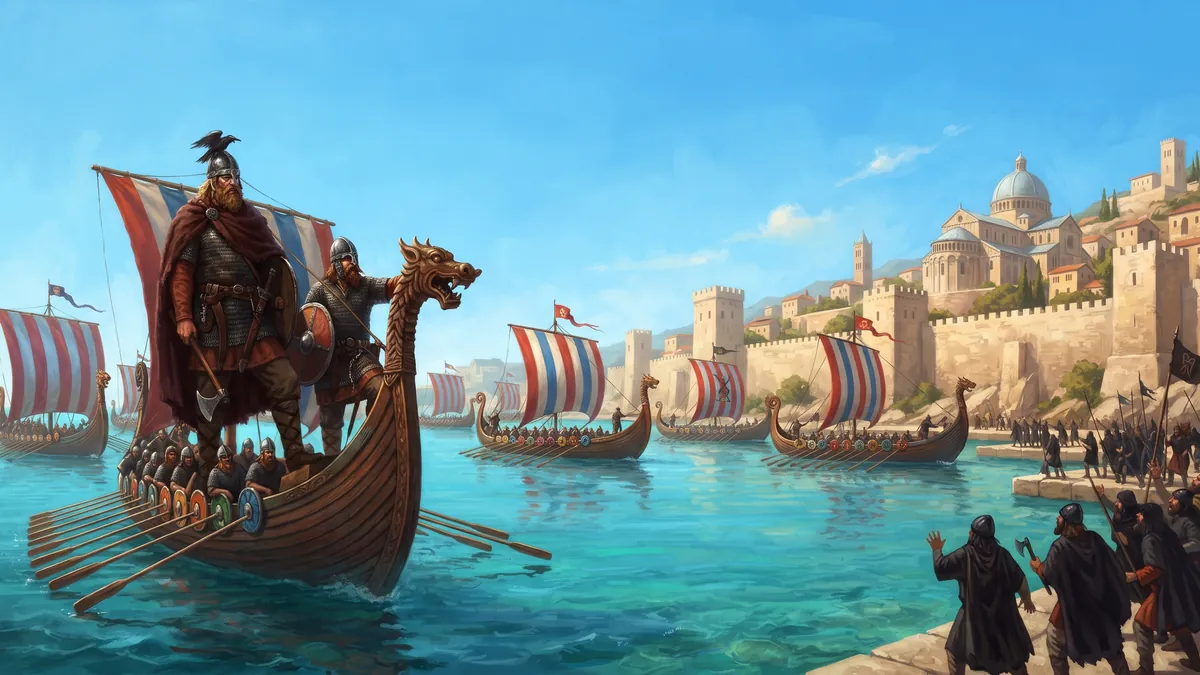
Björn Ironside (Swedish Björn Järnsida) is known from two kinds of source. According to the sources, contemporary Frankish annals, such as those of Saint-Bertin, name a Viking leader called Björn in West Francia in 855 and 858. Later accounts supply almost all of the family story: William of Jumièges (c. 1070) is the oldest text to describe his origins, and Saxo Grammaticus (c. 1200) makes him a king of Sweden.
The sons of Ragnar
Late medieval texts make Björn a son of Ragnar Lodbrok, with brothers such as Ivar the Boneless. But the Anglo-Saxon and Irish sources name Ivar, Ubbe and Halfdan in the invasion of England after 865, and do not name Björn. Whether these brothers existed as told is not established.
The Seine, 855 to 862
The annals show Björn with a Viking named Sigtrygg sailing up the Seine in 855. Charles the Bald defeated them in Champagne, without settling anything. Björn stayed on the Seine, wintered there and helped plunder Paris around the turn of 856 to 857. He built a fortification on the island of Oissel, above Rouen. In 858 he swore fealty to Charles at Verberie, but the siege of Oissel in July failed. After that Björn disappears from contemporary sources.
The Mediterranean
Frankish, Norman, Arab, Scandinavian and Irish sources record a great expedition into the Mediterranean in 859–861, led by Hastein and Björn. The fleet went down the Iberian coast, passed the Strait of Gibraltar and plundered southern France, where it wintered. Then it took Pisa, and there were victories in Sicily and North Africa. A storm cost 40 ships. On the way back, Andalusian forces surprised the Vikings and destroyed two ships with fire catapults, leaving 20. The survivors returned to France in 862.
Luni
William of Jumièges’s chronicle says Hastein, Björn’s foster-father, wanted to make him Roman emperor. They reached Luni, which they thought was Rome, but its walls held. Hastein sent word to the bishop that he was dying and wanted baptism and burial in the church. Carried in on a stretcher, he sprang up, seized the clerics, and his men opened the gates. Historians see problems in the story, and it depends on later sources.
To row in time with the waves of the Mediterranean and bring the fleet to Luni, play Rowing to Luni.
Sources.
- Reference work in English, article "Björn Ironside"