 MMXXVI
Brattahlíð: Erik the Red's farm in Greenland, and the small church of Þjóðhildr found in 1961
At Brattahlíð, today Qassiarsuk, Erik the Red's farm, a small turf-and-timber church was found in 1961 with 144 burials, and the place still has some of Greenland's best pasture.
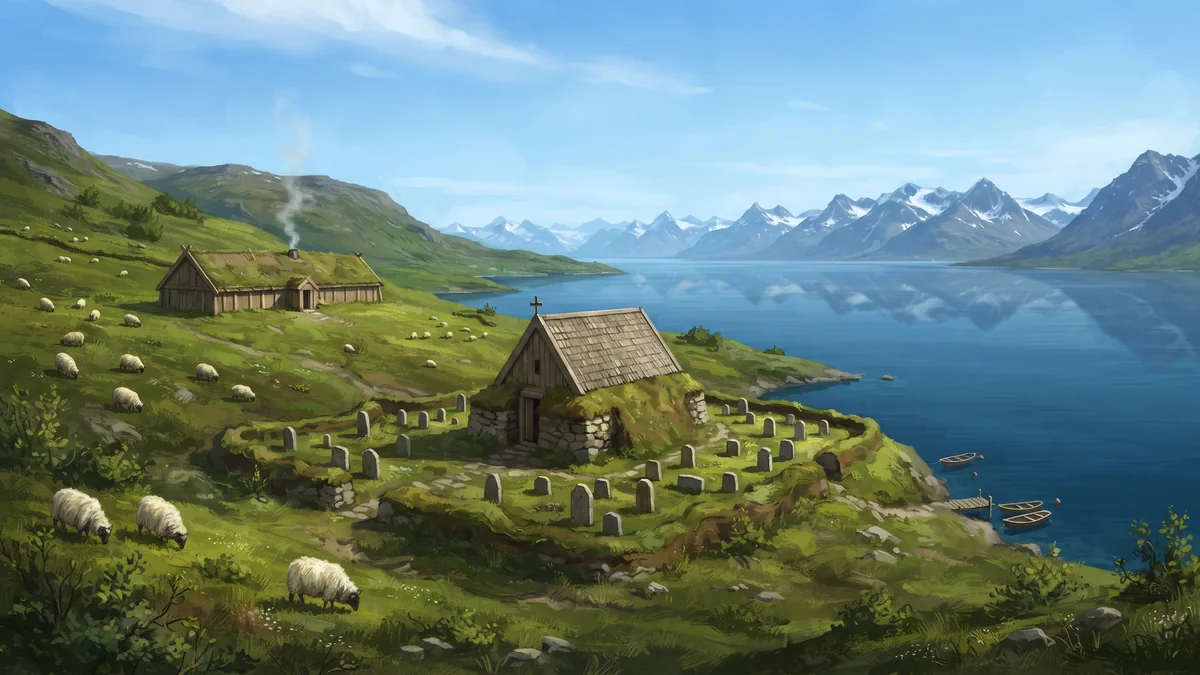
Brattahlíð, “the steep slope”, was Erik the Red’s farm in the Eastern Settlement, in southwest Greenland, founded toward the end of the 10th century. Today the place is called Qassiarsuk and lies about 5 km southwest of Narsarsuaq, at the head of the Tunulliarfik fjord, the Eiríksfjörður.
The place
It lies about 96 km inland, and the fjord shelters it from ocean storms. Erik and his descendants lived there until about the middle of the 15th century. UNESCO included the farm in 2017 as part of the Kujataa site in Greenland. It still has some of the country’s best farmland.
Þjóðhildr’s church
Þjóðhildarkirkja, “Þjóðhildr’s church”, is the oldest of the three Norse churches found at Brattahlíð and perhaps the first church in the Americas. It was discovered in 1961, when the community began building a school and a human skull appeared. The skull went to the National Museum of Denmark, which led to an excavation, whose report is by Jørgen Meldgaard, from 1982.
What it was like
It was a U-shaped building, with wooden walls and an insulating shell of turf. The interior measured about 2 m by 3.5 m. The graveyard around it held the remains of 144 people, with no grave goods and no runic markers on the graves. For the celebrations of the Leif Eriksson millennium, in 2000, a replica of the church and a Norse longhouse were built, at some distance from the original site.
The stone church and the other buildings
In the 13th century a stone church was raised over an older one, near the main longhouse. It is suggested that Thorkell, Leif Eriksson’s son, may have built the first. It measured 12.5 m by 4.5 m, with two entrances and a central hearth, and seems to have been destroyed by fire. Fragments of melted bell metal and possible remains of a forge were found. In the graveyard there are tombstones, one with a cross and another with runes reading “Ingibjørg’s Grave”. A neighbouring building measured 53 m by 14 m, with stone walls about 1.5 m thick and stalls made of slabs, one of them using a whale’s shoulder blade.
Assembly and bishopric
Brattahlíð hosted the first Þing of Greenland, modelled on Iceland’s Althing. Scholars see possible assembly sites at Brattahlíð and at Garðar, the bishopric founded in the 12th century, near by. The causes of the end of the settlement remain unproven: the Little Ice Age, soil erosion and competition from the Inuit.
In short
It is a farm with a tiny church and a big graveyard, in the same meadow. To gather the hay and the livestock of the fjord pasture, play The hay of the fjord.
Sources.
- Reference work in English, article "Brattahlíð"
- Jørgen Meldgaard, report on the Brattahlíð excavation (1982)
- Eiríks saga rauða and Grænlendinga saga