 MMXXVI
Dannebrog: the flag that, says the legend, fell from the sky in 1219, and what historians know of it
The Danish flag has a famous legend, that of a red flag with a white cross said to have fallen from the sky in a battle in Estonia, but the oldest texts that tell it are from the 16th century.
The flag of Denmark, the Dannebrog, is red with a white cross. The best-known legend about it says it fell from the sky during a battle, and it is one of the most remembered flag origin stories in Europe.
The legend
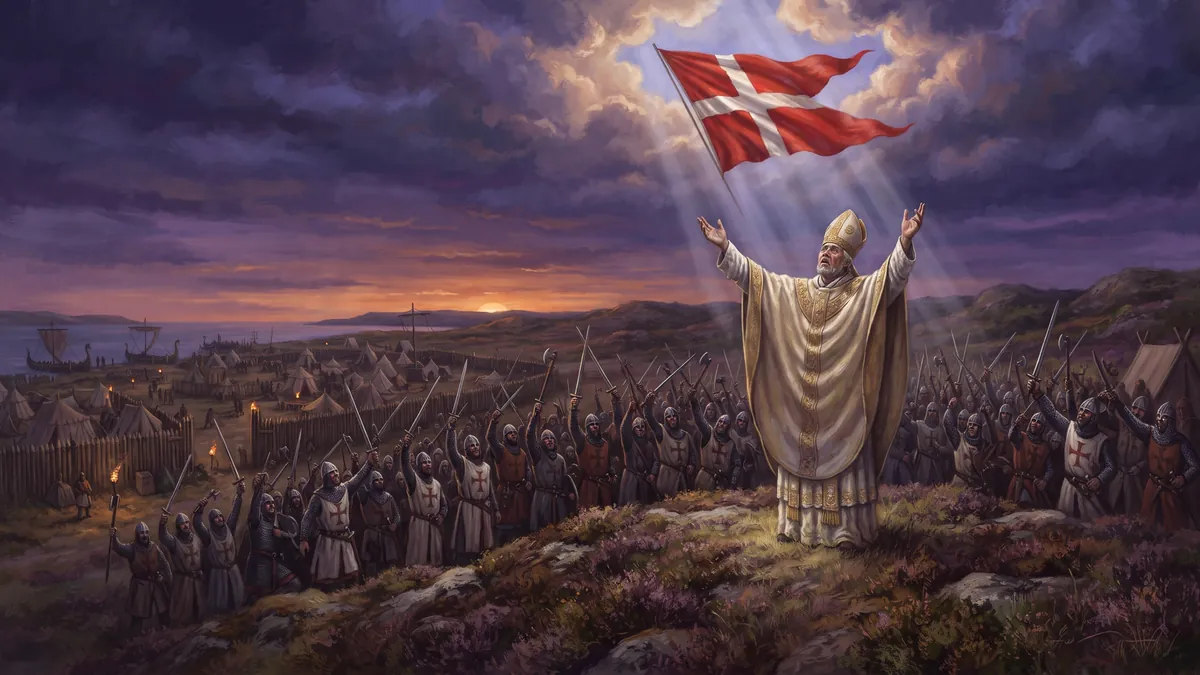
In the most widespread version, the battle is that of Lindanise, near present-day Tallinn, in Estonia, on 15 June 1219, under King Valdemar II. The Danes are losing, while Bishop Anders Sunesen prays on a hill with his arms raised. When he lifts his arms, the Danes advance; when he lowers them, they fall back. Then a flag falls from the sky and the Danes win. The episode recalls a passage of Exodus, chapter 17, verses 11 and 12, in which Moses raises his arms during a fight.
When the story appears in writing
The oldest texts are from the 16th century. Christiern Pedersen tells of a flag fallen from the sky in his “Danske Krønike”, written between 1520 and 1523, but without naming the battle of 1219. Petrus Olai, a Franciscan friar, tells the story twice: in one version the flag falls in a battle of 1208, near Fellin, today Viljandi, in Estonia, and in the other, in “Danmarks Tolv Herligheder”, it is dated to 1219. It is not known whether either rests on older material.
What historians propose
Scholars disagree. L. P. Fabricius, in 1934, argued that the origin lay in the battle of 1208. A. D. Jørgensen, in 1875, suggested that Bishop Theoderich carried a banner of the Knights Hospitaller and that attackers mistook his tent for the king’s. None of this is proven.
What can be documented
The oldest undisputed colour image appears in the Gelre Armorial, of about 1340 to 1370. The historian Inge Adriansen says that only from the early 15th century can it be documented with certainty that the Dannebrog was the flag of the realm. In 1625 it was recognised as a national flag, and Guinness regards it as the oldest continuously used national flag in the world. Its proportions were fixed in 1748, and private use, banned in 1834, was allowed again in 1854.
In short
The flag is real and old, and the scene from the sky is legend, set down in writing only more than three hundred years later. To raise and lower the bishop’s arms in time with the battle, play The rhythm of the bishop’s arms.
Sources.
- Reference work in English, article "Flag of Denmark"
- Petrus Olai, "Danmarks Tolv Herligheder" (16th century)
- Christiern Pedersen, "Danske Krønike" (1520-1523)