 MMXXVI
Egils saga einhenda ok Ásmundar berserkjabana: the kidnapped princesses, the one-handed warrior, the giants' wedding and the cloak that does not burn
Egils saga einhenda ok Ásmundar berserkjabana, an Icelandic legendary saga, tells how Egill the One-Handed and Ásmundr the Berserk-Slayer rescued two princesses carried off by giants. See what the text says and what remains uncertain.
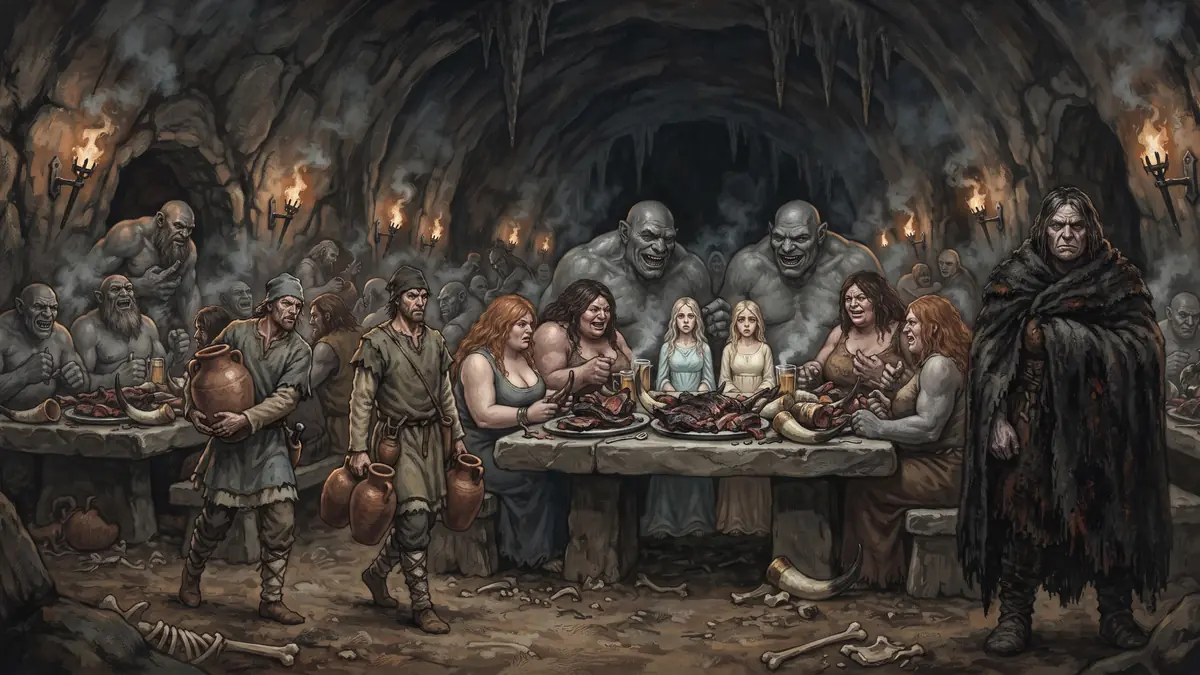
The Egils saga einhenda ok Ásmundar berserkjabana, “the saga of Egill the One-Handed and Ásmundr the Berserk-Slayer”, is one of the fornaldarsögur. It mixes sea adventure, giants, dwarves and a journey to Jötunheimr, the world of the giants. The date of composition is uncertain, and the text should be read as a tale, not as history.
Two princesses vanish
King Tryggvi rules a kingdom in the East, which the saga places in Russia, and has two daughters, both called Hildr. The elder, Brynhildr, is gathering nuts in the forest when an enormous creature, a hjasi, snatches her. The next Christmas, the younger, Bekkhildr, is taken from the street by a great bird. The king promises a third of the kingdom to whoever finds them.
Then Ásmundr arrives, sixteen years old, on a ship loaded with gold, with thirty men. He is called berserkjabani, “berserk-slayer”, and the king welcomes him. Soon after, Rögnvaldr, a border guard, returns wounded and speaks of Egill, a one-handed raider who carries a dwarf-made sword strapped to his arm. Ásmundr challenges Egill. They fight for several days, and end up swearing foster-brotherhood.
The journey to Jötunheimr
The two set out in search of the princesses and reach Jötunheimr. There they meet Skinnnefja, daughter of the giantess Arinnefja, who takes them to her mother’s home. During the stay, each tells his story. Ásmundr, son of King Óttarr of Hálogaland, swore mutual revenge with Árán, a king’s son. Árán died and came back as a revenant, eating the animals in his grave, and Ásmundr beheaded him and burned the body. Then he beat the berserkers Hrærekr and Siggeirr, who wanted to sacrifice him to Óðinn.
Egill, son of a king of Smáland, was enslaved by a giant, who set him to herd goats with stones tied to his legs. He blinds the giant with a spear, escapes hidden among the goats and takes a gold ring after cutting off the giant’s hand. Later he loses his right hand in an attack by giants, and a dwarf heals the stump and forges the long-hilted sword for use with one arm.
The giants’ wedding
Arinnefja, for her part, tells of a quest in the world of the dead for three treasures: a cloak that does not burn, a horn that never empties and a board that plays by itself. With a herb, she gives Egill his hand back. The princesses were given to two sons of giants, Gautr and Hildir, and the wedding will be at Christmas.
Egill and Ásmundr, disguised as servants, enter the banquet. At the right moment, the cloth around the brides lifts them into the air, and the escape begins. The servant Skröggr kills giants at one door, Skinnnefja blinds others with a glass, and Ásmundr and Egill kill Gautr and Hildir. The saga says some ninety giants die, and the rest leap from the cliffs.
The ending
Back home, Egill marries Bekkhildr and Ásmundr marries Brynhildr. Egill becomes king in the East after Tryggvi’s death. Ásmundr, once a widower, marries a princess of Serkland and has an enormous ship built, the Gnóð, which gives him the nickname Gnóðar-Ásmundr. The saga says the ship sinks near Hlésey with about three thousand men, and that Óðinn pierces him with a spear as he falls into the water.
What is uncertain
There are two figures called Ásmundr in the legendary sagas, and this one is distinct from the hero of the Ásmundar saga kappabana; the name Gnóðar-Ásmundr also appears in the Illuga saga Gríðarfóstra. The saga repeats folktale motifs, such as the hero enslaved by a giant and the rescue of princesses, and has no known historical basis. Numbers, place names and the link to Óðinn are part of the narrative tradition.
To see whether you can hold your shield against the giants’ blows, play The giants’ feast.
Sources.
- Egils saga einhenda ok Ásmundar berserkjabana, Icelandic legendary saga (fornaldarsaga), in Guðni Jónsson and Bjarni Vilhjálmsson (eds.), Fornaldarsögur Norðurlanda (Reykjavík, 1943–1944)
- Hermann Pálsson and Paul Edwards (trans.), Gautrek's Saga and Other Medieval Tales (London, 1968)
- C. C. Rafn (ed.), Fornaldar sögur Nordrlanda (Copenhagen, 1829–1830)