 MMXXVI
Éljúðnir: Hel's hall, the plate called Hunger, the knife called Famine, the slow-footed servant and the threshold that is a precipice
In the Gylfaginning, Hel's hall is called Éljúðnir, "sprayed with snowstorms". Snorri lists its furnishings with names of suffering: the threshold is a precipice, the bed is a "sick-bed" and the curtains "gleaming misfortune".
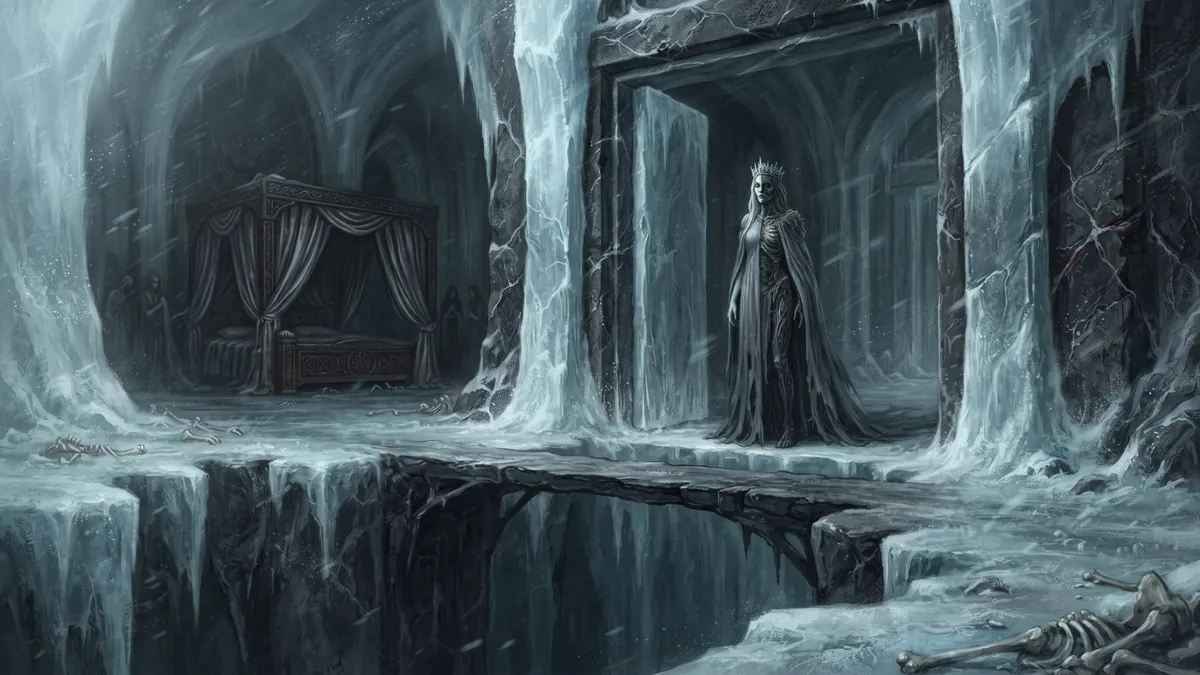
Éljúðnir appears in a single chapter, chapter 34 of Snorri Sturluson’s Gylfaginning. It is the hall of Hel, daughter of Loki, and lies in Niflheim. The name, in Old Norse, means “sprayed with snowstorms” or “damp with sleet and rain”. Snorri describes it after telling how Odin cast Hel into Niflheim and gave her power over nine worlds, to apportion lodgings to those who come to her.
The furniture of suffering
Snorri names each object in the house, and every name is of ill. The plate is called Hungr, “Hunger”. The knife, Sultr, “Famine”. The male servant is Ganglati and the maidservant Ganglöt, names that suggest slow walking. The threshold of the door is Fallanda forað, “falling to peril”, and the usual translation is “precipice”: it is a pitfall in the shape of a step. The bed is Kör, “sick-bed”, and the bed curtains are Blíkjanda böl, “gleaming misfortune”.
What the chapter says of Hel
Hel is half black and half flesh-coloured, which makes her easy to recognise, and has a grim and fierce look. She deals with the dead who come through sickness or old age. Snorri’s text is the only source for Éljúðnir and the names of the furnishings.
How to read these names
Read together, the names speak of hunger, famine, slowness, sickness and a fall. The reading that Hel lives in a house of suffering is natural, but it is interpretation: it is not known how much of this portrait comes from pagan tradition and how much from the pen of Snorri, who writes in the 13th century, centuries after paganism ended in Scandinavia.
What can be said is that Éljúðnir is a place of one passage only, with eight names, and all of them describe lack.
To keep the slow pace of Ganglati and Ganglöt, neither rushing nor lagging, play Ganglati’s slow step.
Sources.
- Gylfaginning by Snorri Sturluson (Iceland, around 1220), chapter on Hel and her dwelling
- Jesse Byock's translation of the Prose Edda (Penguin Classics, 2006)
- Studies of the geography of the dead in Norse mythology and of the name Éljúðnir