Stamford Bridge, 1066: the man who held the bridge and the battle tradition calls the end of the Viking Age
On 25 September 1066, King Harald Hardrada was killed by an arrow in England. Of some 300 Norwegian ships, only 24 went home, according to the Anglo-Saxon Chronicle.
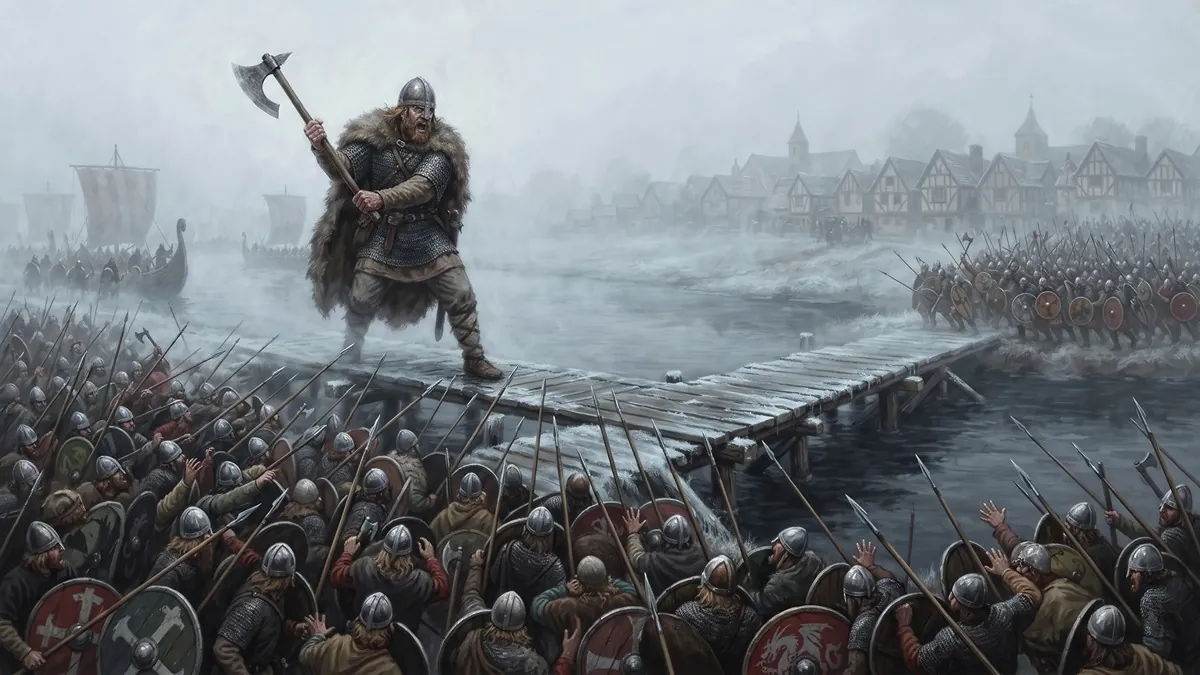
On 25 September 1066, near York, in England, a Norwegian army was defeated by an English one. The king of the Norwegians, Harald Hardrada, died in the battle. Many English and Norwegian historians take this date as the end of the Viking Age, although the Vikings went on acting longer elsewhere. Three weeks later, an invasion from Normandy would put an end to the kingdom of Harold Godwinson.
Why the Norwegians were there
Harald Hardrada, king of Norway, had earlier served in the Varangian Guard of Constantinople and had returned very rich. In 1066, he took advantage of the dispute over the English throne. He allied himself with Tostig Godwinson, exiled brother of the English king Harold, and crossed the North Sea with a fleet of more than 300 ships, according to the Anglo-Saxon Chronicle.
The Norwegians landed in the north and on 20 September beat the English earls Edwin and Morcar at Fulford. But Harold Godwinson, who was expecting an invasion from the south, marched from London to Yorkshire in a few days, with the soldiers of his guard and of his nobles, and surprised the invaders.
No armour, in the heat
The Norwegians were far from their ships, and many had left their mail shirts by the vessels, because of the heat of the day. In the haste to form a shield wall, they fought without them. The battle was fought by the bridge over the river Derwent, at Stamford Bridge.
The man on the bridge
The most famous episode is that of a single Norwegian with a great axe who blocked the bridge and held up the English advance for a long time. Tradition says he killed dozens of men. An English soldier is then said to have got into a barge or a tub beneath the bridge and pierced him with a spear, through the planks.
This scene appears in sources written after the battle, such as Henry of Huntingdon’s Historia Anglorum, in the 12th century. Historians treat it as tradition, not as certain record.
The death of the king
Harald Hardrada was struck by an arrow in the neck and died. Tostig died too. The Norwegians kept their ships at Riccall, some distance from the battlefield, and the reinforcements that came from there, led by Eystein Orre, were beaten.
Harold Godwinson granted a truce. Olaf, Harald’s son, and the earl of Orkney, Paul Thorfinnsson, were allowed to leave after swearing not to attack England again. The Anglo-Saxon Chronicle says that, of more than 300 ships, only 24 were needed to carry the survivors.
After the battle
On 28 September, three days later, William, duke of Normandy, landed at Pevensey, in the south. Harold had to march back, and the battle of Hastings, on 14 October, decided the English throne.
To hold the bridge, play Stamford Bridge.
Sources.
- *Anglo-Saxon Chronicle*, versions C, D and E, entries for the year 1066
- Snorri Sturluson, *Heimskringla*, *Haralds saga Sigurðarsonar* (c. 1230)
- Henry of Huntingdon, *Historia Anglorum* (12th century)