Thor dressed as a bride: the poem in which the hammer is stolen and the giant Thrym expects to marry
In the Poetic Edda, the giant Thrym hides the hammer Mjölnir and returns it only in exchange for Freyja. The gods' plan is one of the funniest episodes in Norse mythology.
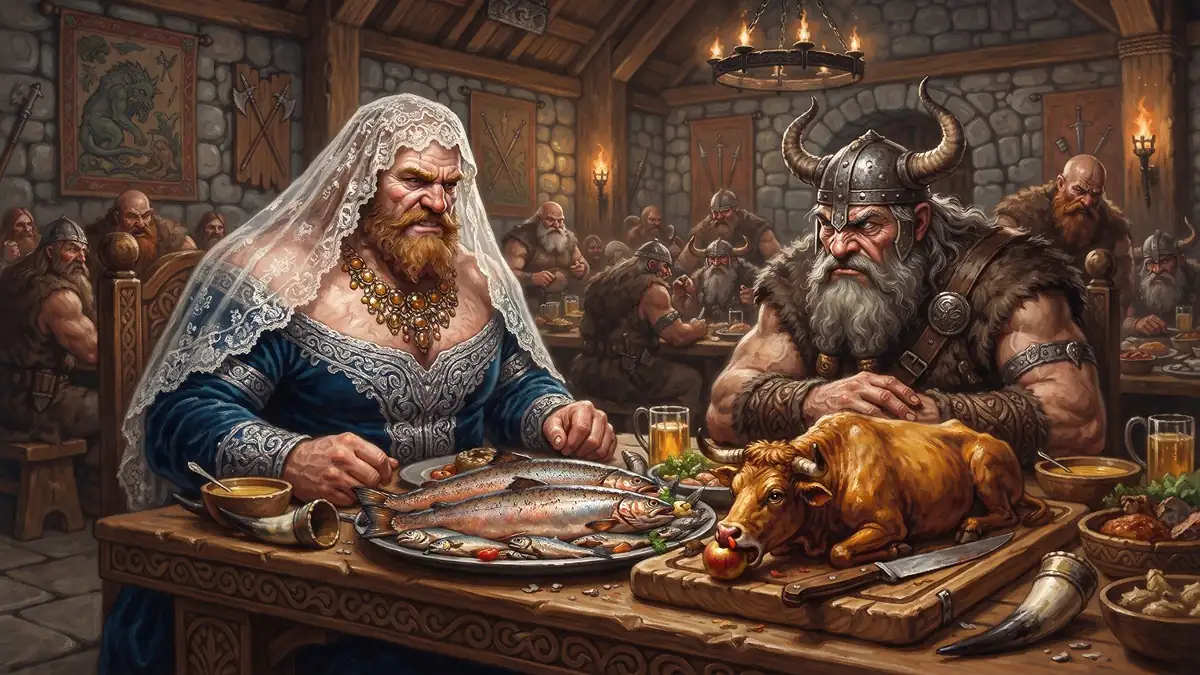
Thor wakes up, and the hammer Mjölnir is gone. That is how the Þrymskviða, the “Lay of Thrym”, begins, one of the funniest poems of the Poetic Edda. It survives in a 13th-century manuscript, the Codex Regius, and scholars debate when it was composed. The plot, at any rate, fits in a few lines: a giant steals the thunder god’s weapon and demands a bride in return.
The theft
Thor shouts to Loki that he has lost the hammer. Loki borrows Freyja’s feathered cloak and flies to Jotunheim, the land of the giants. There, Thrym tells him he has hidden Mjölnir “eight leagues deep in the earth” and will return it only if he gets Freyja as his wife.
Loki returns with the news. Freyja is furious: the halls shake and the necklace Brísingamen, the goddess’s jewel, breaks. She will not go.
The plan
The gods meet. Heimdall proposes dressing Thor as a bride, with Freyja’s necklace, keys, jewels and a veil. Thor protests: the gods will call him womanish. Loki answers that, without the hammer, the giants will take Asgard. Thor gives in, and Loki goes along, as the bride’s maid.
The feast
The two arrive in Jotunheim in a chariot pulled by goats. Thrym is already preparing the feast. At the table, the bride eats a whole ox and eight salmon and drinks three measures of mead. Thrym finds the appetite strange. Loki, as the maid, explains: Freyja had not eaten for eight nights, so eager was she to arrive.
Thrym lifts the veil to kiss the bride and leaps back: why do her eyes seem to burn? Loki answers that Freyja had not slept for eight nights, so anxious was she. A giantess, Thrym’s sister, asks the bride for gold rings as a wedding gift.
The hammer
Thrym orders Mjölnir brought in to bless the bride, and the hammer is laid in her lap, in the name of Vár, goddess of oaths. It is what Thor was waiting for. He takes the weapon, kills Thrym and then the other giants, including the old woman who had asked for the rings. The poem ends almost without comment: Thor had won back his hammer.
What remains
Nothing indicates the poem was recited as a rite. It reads as a humorous story, in which the strongest god must go through what he fears most, ridicule, to save the others. Some see in it a gentle critique of the warrior’s image, and some read it as plain fun. The source does not say. What can be stated is what is in the text: the theft, the disguise and the hammer in the lap.
To find where the hammer was hidden, play Where is the hammer?.
Sources.
- Þrymskviða (Lay of Thrym), in the Poetic Edda, Codex Regius manuscript (c. 1270)
- D. L. Ashliman, retelling of "The Lay of Thrym", University of Pittsburgh