Skaði chooses a husband by his feet: the mountain goddess who wanted Baldr and got Njörðr
To make up for her father's death, the gods let the giantess Skaði choose a husband, but only by looking at feet. She believes she has picked the handsome Baldr and has chosen the sea god.
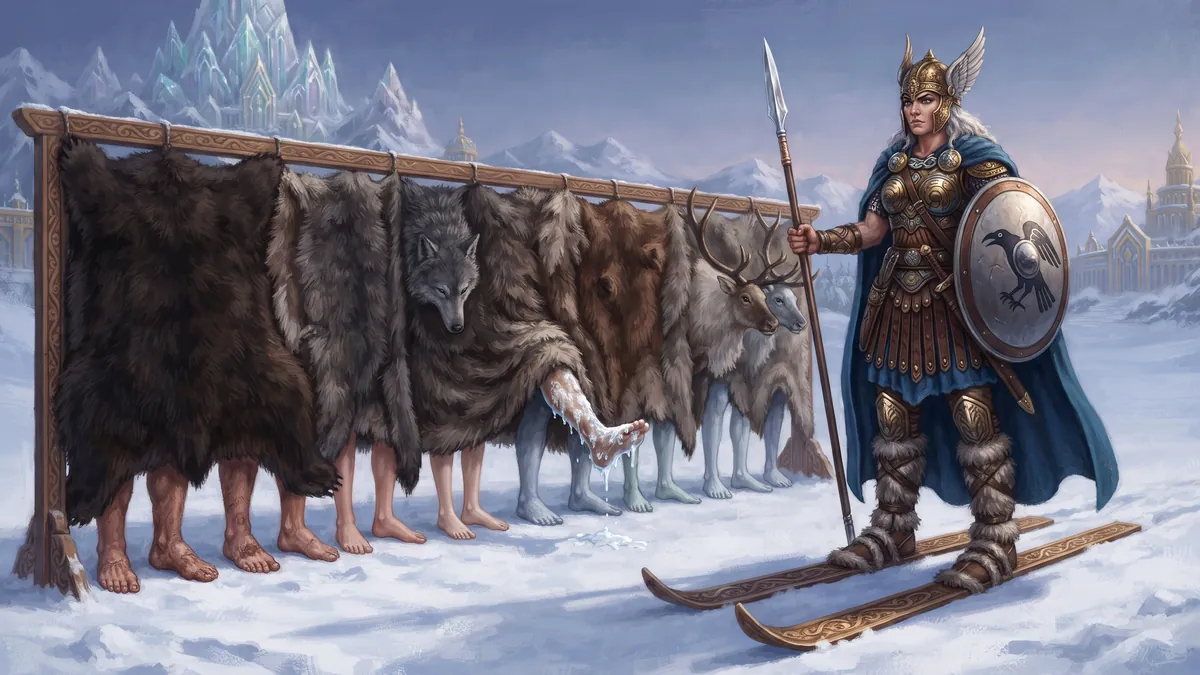
Among the Norse goddesses, Skaði is one of the few who arrive armed. She is the daughter of the giant Þjazi, whom the gods killed, and she goes to Asgard dressed for war to avenge her father. The way out the gods offer her is one of the strangest and funniest scenes in mythology.
The compensation
The gods preferred to pay rather than fight. They offered Skaði a husband from among them, but with a rule: she would choose looking only at the feet, which showed beneath a curtain. She also asked for a second condition, that the gods make her laugh, which at that moment seemed impossible.
The laughing scene is Loki’s. He tied a rope to the beard of a goat and to his own private parts, and the two pulled and shrieked until he fell into Skaði’s lap. She laughed. To complete the compensation, Odin set Þjazi’s eyes in the sky, where they became stars, and that pleased her.
The choice
Skaði looked at the feet in a row and chose the most beautiful. She was sure they were Baldr’s, the most handsome god, Odin’s son. They were Njörðr’s, the god of the sea and the winds. The choice by feet, which looked like justice, turned into a prank by the gods.
The marriage that did not work
The union showed the clash of two worlds. Njörðr wanted to live by the sea, at Nóatún, where he heard the gulls. Skaði wanted to live in the mountains, at Þrymheimr, her father’s former home, where she heard the wolves. According to the texts, the two tried to divide their time between the two places, but soon tired of it, and each ended up staying in his or her own. The sources do not say the marriage ended in a quarrel: they only tell that the two could not get along.
What she stands for
The sources link Skaði to winter, hunting and skiing, and describe her hunting with a bow in the mountains. For this reason she is sometimes called the goddess of skiing. Scholars see in the story of Skaði and Njörðr the union of two landscapes, the coast and the mountains, which do not fit in one home.
The story is told mostly by Snorri Sturluson, in the 13th century, from older poems. Some parts, such as the laughter provoked by Loki, appear only in that version, and it is not known how much comes from oral tradition and how much is the author’s own work.
To repeat the goddess’s choice, play Choose by the feet.
Sources.
- Gylfaginning, chapter 23 (Prose Edda, by Snorri Sturluson)
- Skáldskaparmál (Prose Edda, by Snorri Sturluson)
- Grímnismál (Poetic Edda)
- Entries in Nordic museums and encyclopedias on Skaði