Svolder, the year 1000: the last battle of King Olaf Tryggvason and the ship Long Serpent
Eleven Norwegian ships faced three enemies in the year 1000. The battle of Svolder ended with a missing king, the biggest ship in enemy hands and a divided Norway.
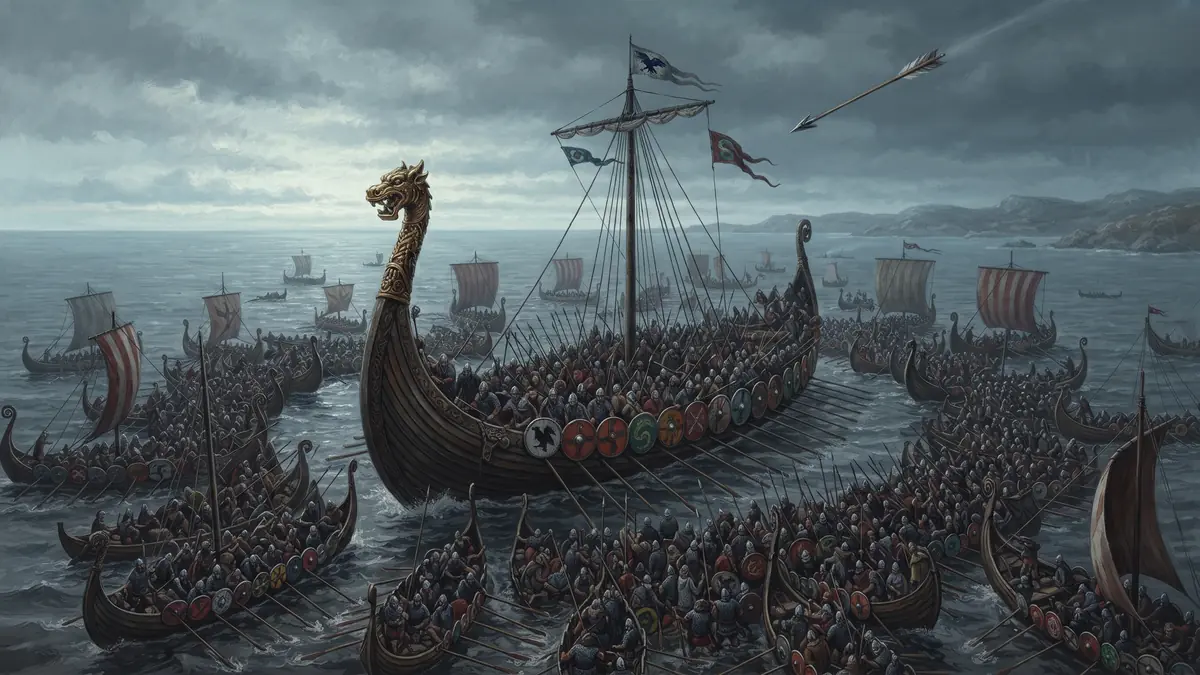
The battle of Svolder was one of the great naval fights of the Viking Age, and its result changed the political map of the North. It took place in September of the year 1000, although some researchers consider the year 999 possible. The exact place is disputed: the sources suggest the Øresund strait or near the island of Rügen, and the choice depends on which source one accepts.
Who fought whom
On one side was Olaf Tryggvason, king of Norway, with eleven ships. On the other, an alliance of three enemies: Sweyn Forkbeard, king of Denmark, Olof Skötkonung, king of Sweden, and Eirik Hákonarson, a Norwegian noble with personal reasons against Olaf. The sources agree that the enemies were far more numerous.
Olaf was returning from an expedition to the south, and the trap was set so that he would pass the place. Accounts vary on how it was planned, and some versions give Queen Sigrid the Haughty a part in it, tied to her refusal to marry Olaf.
The Long Serpent
Olaf’s pride was his ship, the Ormen Lange, the Long Serpent, described by the sagas as the largest and finest ever built in Norway. In the battle, Olaf’s ships were tied to one another, and the enemies attacked them one by one. As the smaller ships fell, the Long Serpent was left more and more exposed, until Eirik captured it.
The arrow that broke the bow
The Heimskringla keeps a famous episode. Einarr Þambarskelfir, one of Olaf’s archers, was drawing his bow when an arrow from an enemy called Fin hit it and split it in two. The king, hearing the crack, asked what had broken, and Einarr answered: Norway, from your hands. The broken bow became, in tradition, a symbol of the king’s fall.
The fate of the king
There are different versions of Olaf’s end. Danish sources say he leapt into the sea with his shield. The sagas are ambiguous: some suggest he may have survived, and no body was ever found. Either way, Norway did not see him again.
Consequences
The kingdom was divided among the victors. Eirik and his brother Sveinn ruled the territory under the authority of Sweyn and Olof. The rule lasted a short time, but Svolder marked the end of Olaf’s attempt to unify Norway as a Christian kingdom, at least for that moment.
What the sources say
The oldest account is by Adam of Bremen, around 1080, and there are others in Oddr Snorrason, in the Fagrskinna, the Ágrip and the Historia Norwegie. The most detailed version is Snorri’s, in the 13th century, long after the events, and that makes it wise not to take every detail as certain.
To hit the targets without breaking the bow, play The battle of Svolder.
Sources.
- Heimskringla, Óláfs saga Tryggvasonar (Snorri Sturluson)
- Adam of Bremen, Gesta Hammaburgensis ecclesiae pontificum (c. 1080)
- Oddr Snorrason, Fagrskinna, Ágrip and Historia Norwegie
- Encyclopedia entries on the battle of Svolder