Thor in Útgarðr: the giant's challenges that were all illusions
In the Prose Edda, Thor and his companions lose every test at Útgarða-Loki's castle. In the end, the giant reveals that each defeat hid a trick, and that the god nearly beat the impossible.
Few stories in Thor’s cycle are as subtle as his visit to Útgarðr. The strongest god of the Norse loses every test, and only at the end finds out that he was not fighting what he thought. The account is in the Gylfaginning, part of Snorri Sturluson’s Prose Edda, from the 13th century.
The journey
Thor sets out with Loki and two humans, Þjálfi and his sister Röskva, toward Jötunheimr, the territory of the giants. On the way they meet an enormous giant, Skrýmir, who later turns out to be the same lord of the castle of Útgarðr, Útgarða-Loki. Later the giant confesses he used magic, for example tying the food bag shut with an enchanted wire, so that no one could open it.
The tests
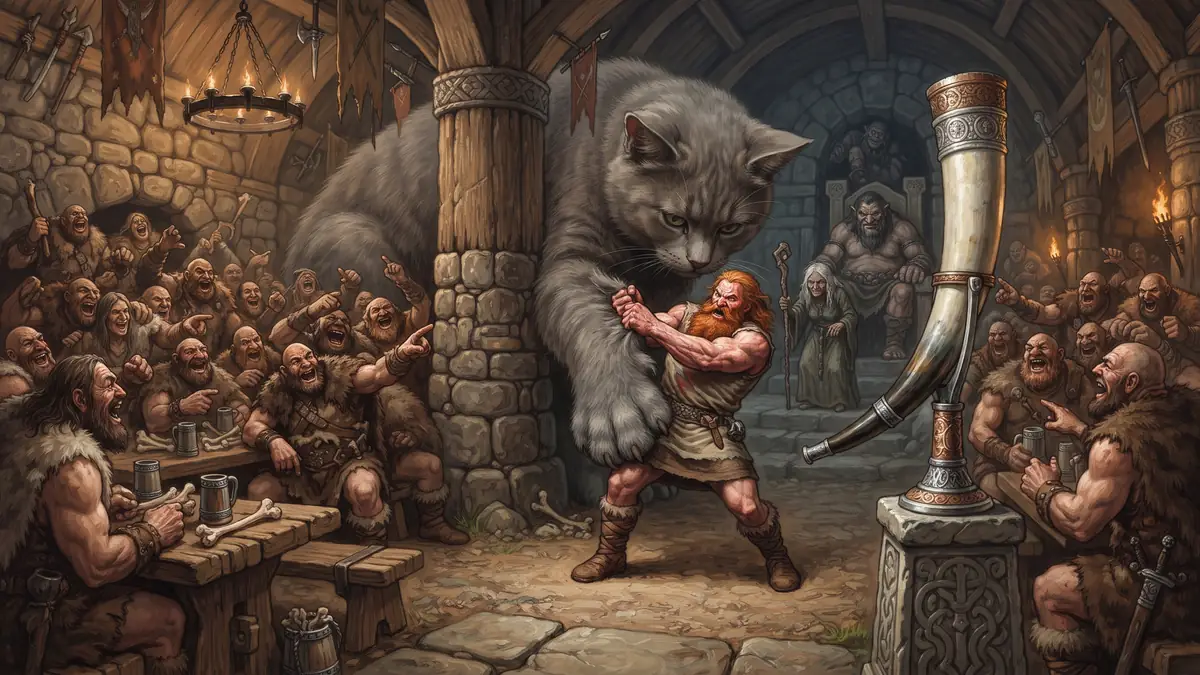
In the castle, Útgarða-Loki proposes challenges. Loki bets that he eats faster than anyone and loses to an opponent called Logi. Þjálfi runs three times against a lad called Hugi and loses all three. Thor, for his part, tries to empty a drinking horn and, even after three big gulps, cannot. Then he tries to lift a grey cat and only manages to raise one paw. Finally, he wrestles an old woman, Útgarða-Loki’s nurse, who forces him to his knees.
What they were
Only afterwards does the giant explain. Logi was fire, which consumes everything, so Loki could not beat it. Hugi was thought, which runs faster than any body. The other end of the horn was in the ocean, and Thor’s gulps lowered the level of the sea, which would explain the tides. The cat was Jörmungandr, the world serpent, and Thor had lifted it close to the sky. The old woman, Elli, was Old Age, who brings everyone down.
The giant also confesses that, if Thor’s hammer blows had landed, the first would have killed him. Furious, Thor raises the hammer against him, but the castle and the giant vanish, and only an empty plain remains.
A lesson or a joke?
Scholars read the story as a reflection on limits, on what strength cannot defeat, and on the power of illusion. It is also a comic tale, with a mighty god beaten by tricks. Like much of the Prose Edda, it has reached us only through Snorri’s text, and it is hard to separate what comes from oral tradition from the author’s literary invention.
To face the tests, play Útgarða-Loki’s challenges.
Sources.
- Gylfaginning, chapter 44 (Prose Edda, by Snorri Sturluson)
- Encyclopedia entries on Útgarða-Loki and Skrýmir
- Academic analyses of Thor's journey to Jötunheimr