Gunnlaug Serpent-Tongue and Helga the Fair: a love triangle that ended in a duel
In the Icelandic saga, the poet Gunnlaug and his rival Hrafn compete for Helga's love. A broken agreement, a forced marriage and a duel in Norway seal the fate of all three.
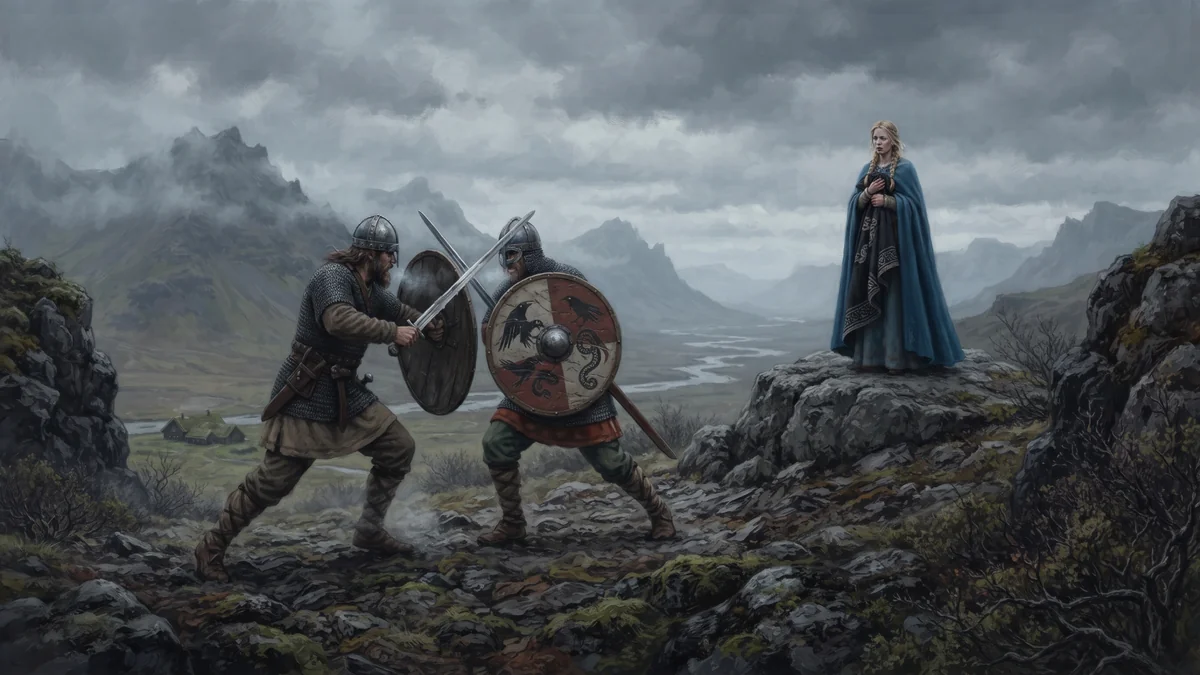
Gunnlaug Serpent-Tongue’s Saga is one of the shortest and saddest of Iceland’s sagas. It tells a simple story: two men want the same woman. But the saga shows how pride and the rules of the age can make love deadly.
The poet and the poet’s daughter
Gunnlaug is a young Icelander of proud character and poetic talent, hence the nickname Serpent-Tongue. Helga’s father, Thorstein, is a son of the poet Egil Skallagrímsson. Gunnlaug spends a season at Thorstein’s house and falls in love with Helga, who the saga says was the fairest in the land.
The father, however, hesitates to marry his daughter to an impulsive young man. Gunnlaug wants to see the world before settling down, and it is agreed that Helga will wait three years for him.
Three years become more
Gunnlaug travels to Norway, England, Ireland and Sweden, and serves several kings as a court poet. Meanwhile, in Iceland, a rival named Hrafn Önundarson, also a poet, seeks Helga’s hand.
Gunnlaug prolongs his absence, and when the three years pass he does not return. Under pressure, Thorstein marries his daughter to Hrafn. The saga says Helga accepts unwillingly and never stops loving Gunnlaug.
The return
Gunnlaug comes back and finds Helga married. At a feast he gives her a precious cloak he received from a king, and the saga says the gesture causes great resentment in Hrafn. The two men trade insults and verses.
In Iceland, duelling was regulated by law, the holmgang, but shortly afterwards the practice was banned in the country. So the two decide to fight abroad, and the saga places the combat in Norway, at the end of a long journey.
The duel
On the appointed day, Gunnlaug and Hrafn face each other at a place called Dingenes. Details of the fight vary, but the saga tells how Gunnlaug cuts off one of Hrafn’s legs. Wounded, Hrafn asks for water. Gunnlaug, out of compassion, brings it in a helmet. Hrafn then strikes Gunnlaug on the head, wounding him gravely. Both men die.
The water episode is famous. In the saga it shows that a gesture of mercy can cost dearly, and that Norse heroism is not always rewarded.
Helga’s end
According to the saga, Helga eventually marries a second time, but is not happy. She used to look at the cloak she had received from Gunnlaug. One day, while gazing at it, she fell into her husband’s arms and died.
What the saga shows
The narrative was written around the 13th century, well after the time in which it is set, the early 11th century. It is hard to know how much history it holds. The main characters seem to have existed, and several appear in other sources, but the details of the love triangle may be the author’s invention.
For readers today, the story shows how much medieval Icelanders cared about honour, one’s given word and fate, and how well they could tell such things in a lean style.
To try to win the duel at Dingenes, play Gunnlaug’s duel.
Sources.
- Gunnlaugs saga ormstungu (Saga of Gunnlaug Serpent-Tongue), 13th century, author unknown
- Encyclopedia entries on the saga and the holmgang
- Studies on the Icelandic sagas and regulated duelling