Why trolls turn to stone in the sun: the Nordic belief that teaches how to read the landscape
In Scandinavian folk tales, trolls live by night and, if the sun reaches them, turn to rock. The idea explains oddly shaped stones and has been used in many stories.
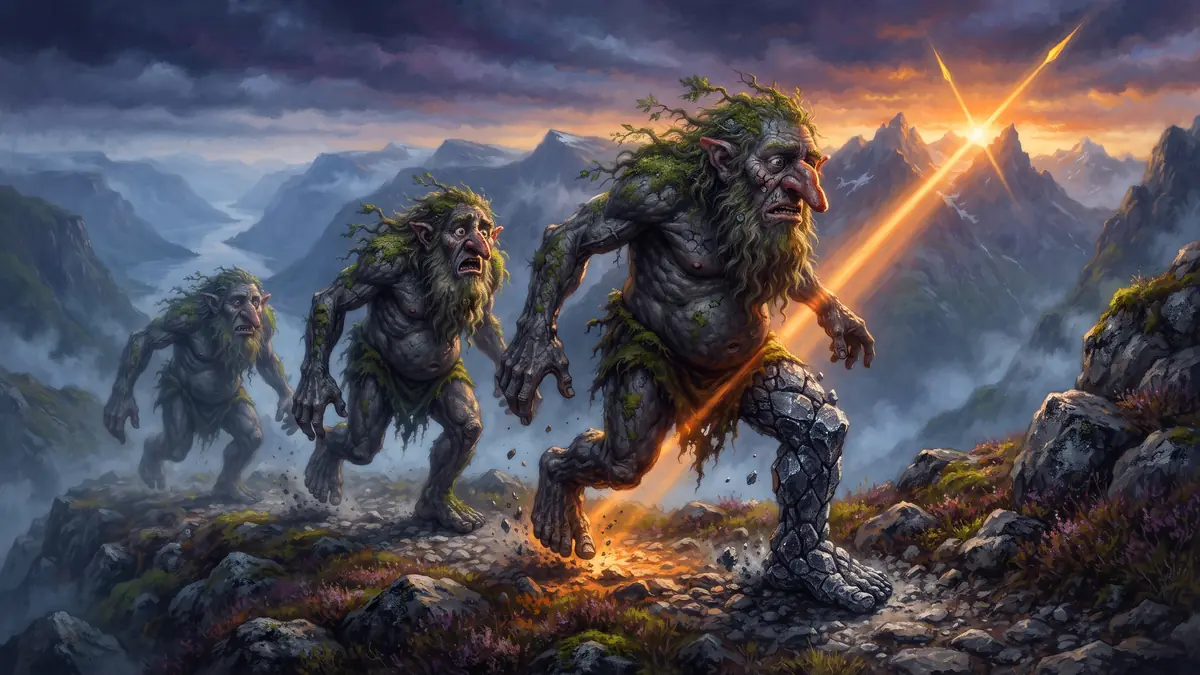
Anyone walking in Scandinavia comes across rocks of curious shapes: one that looks like a face, another that recalls a seated man, a group of stones lined up as in a procession. Popular tradition gave many of them an explanation, and it involves trolls.
The troll in the tales
In Scandinavian tradition the troll appears in many forms. There are huge trolls who live in mountains and eat cattle, and smaller trolls who dwell in hills and look more like country folk. They are generally ugly, long-nosed, and have frightening strength. In folk tales they are rather slow of thought and are tricked by cunning heroes.
The word troll is old, and already appears in medieval sources, where it denoted magical and dangerous beings, sometimes sorcerers. The image of the dim-witted country giant is later, and was consolidated by the collectors of the 19th century.
The rule of the sun
A common motif in the tales is that the troll cannot bear daylight. If caught by the sun, he may turn to stone or burst. So he lives in the night and withdraws before dawn.
The motif is used to add humour to the stories. A clever hero prolongs a conversation with the troll until the sun rises. The troll, distracted, does not notice the hour, and the light turns him to rock. The structure appears in several tales, in different variants.
There is no single rule, and it is not possible to say that every such Scandinavian tale is one story. It is a common motif, not a doctrine.
Stones with names
In several regions, rock formations have names linked to trolls, and local stories are told about how each was formed. Some accounts say a family of trolls was caught by the sun. Others speak of a troll punished for coveting a girl.
These names are generally jokes or local traditions. None of them is documented history. Geologists explain the shapes otherwise, with ice, water and wind, but the legend teaches something different: to look at the landscape as a living place.
The sun as protection
The idea that light defeats the creatures of the night is universal. In Scandinavian cultures, where winter brings very short days and summer endless ones, the sun carries special weight. Trolls are therefore also a way of speaking about the fear of darkness and the relief of light.
Today trolls appear in books, films and games. The rule of the sun remains useful to storytellers: it gives the hero a deadline and the reader a reason to hurry.
To guide the trolls to their caves before the sun rises, play Before the sun rises.
Sources.
- 19th-century collections of Scandinavian folk tales, such as Norske Folkeeventyr by Asbjørnsen and Moe
- Encyclopedia entries on trolls and Scandinavian folklore
- Studies on stone legends and landscapes in Scandinavia