Thor against Hrungnir: the duel with the stone-hearted giant and the shard that stayed in the god's head
According to Snorri, the giant Hrungnir got drunk in the gods' hall and challenged Thor to a duel. See how it ended and why a piece of stone stayed in the god's head.
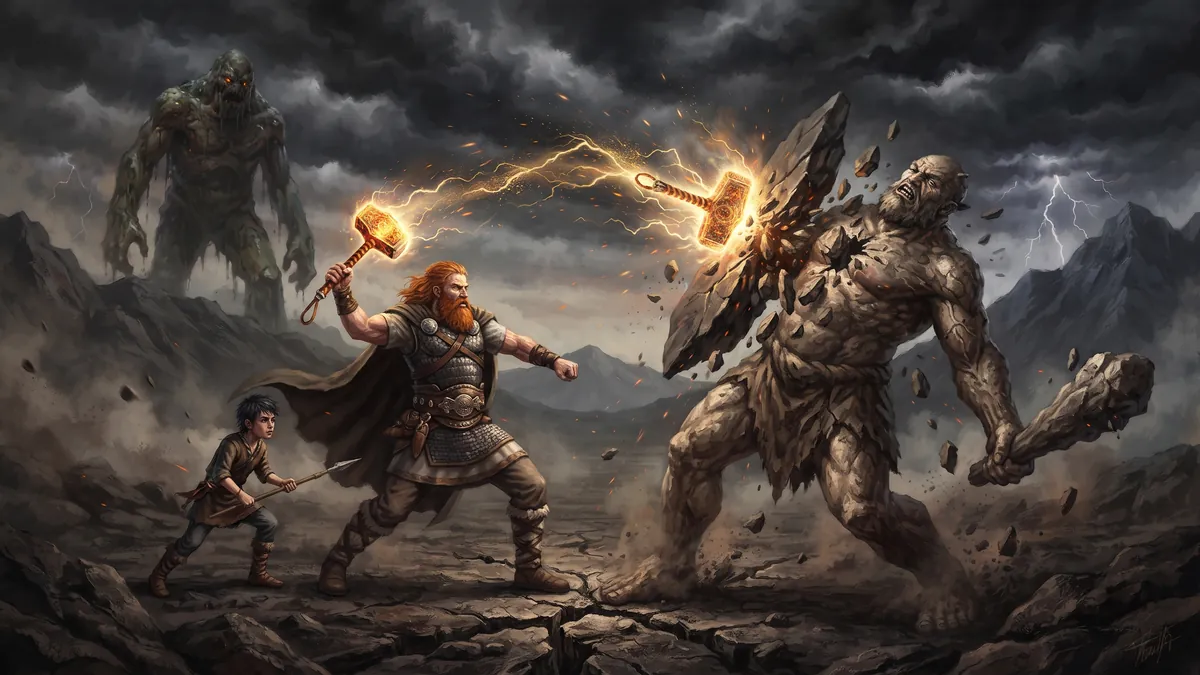
Thor is the god who faces giants, and the story of Hrungnir is one of his best-known duels. It mixes bragging, a trap, a stone and a lapse of memory.
The giant in the gods’ hall
The main source is the Skáldskaparmál, the part of the Prose Edda in which Snorri Sturluson explains skaldic poetry. Hrungnir is described as the strongest of the giants, with a head and heart of stone. One day he raced Odin on horseback and, losing, rode in after him into the gods’ hall in Asgard.
There the gods gave him drink in Thor’s cup. Hrungnir got drunk and began to boast: he said he would carry Valhalla to Jötunheimr, bury Asgard and kill all the gods except Freyja and Sif. When Thor arrived and saw the giant he was furious, and Hrungnir, suddenly sobering, claimed he was unarmed and that killing him like this would be shameful. They agreed on a duel at a place called Grjótúnagarðar.
The duel
The giants were frightened. To help Hrungnir they made a clay giant, Mökkurkálfi, nine leagues tall, but there was no heart big enough, so they gave him a mare’s. The clay giant trembled with fear when Thor arrived and wet himself in terror, according to Snorri’s version.
Thor came with the lad Þjálfi, who ran ahead and told Hrungnir to hold his shield beneath his feet, because Thor would attack from under the earth. The giant believed it, put the shield on the ground and stood on it, gripping the whetstone in both hands. Thor then arrived from above, amid thunder and sparks, and hurled the hammer, Mjölnir.
Hrungnir threw the whetstone. The two weapons met in the air. The hammer shattered the stone and went on to the giant’s head, and he fell dead. A shard of the stone, however, lodged in Thor’s head, and he fell too.
The shard and the seeress
Þjálfi felled Mökkurkálfi. The gods tried to lift the dead giant’s leg, which pinned Thor, and only the god’s son, Magni, who was three nights old, managed it. The seeress Gróa was called to remove the shard from Thor’s head with her charms. When the shard began to loosen, Thor, wanting to please her, told her he had carried her husband Aurvandil on his back and brought him home. Gróa got distracted, forgot her charms, and the shard stayed. Snorri concludes that this is why one must not throw a whetstone across the floor.
An old story
The episode is often cited because Snorri leans on a skaldic poem, the Haustlöng, by Þjóðólfr of Hvin, from the late 9th or the 10th century, which describes scenes painted on a shield. This suggests that the legend circulated for centuries before it was written in the Edda. Details such as the clay giant appear only in Snorri, and scholars do not know whether they are old.
To help Thor break the stone shards before they fall, play Hrungnir’s shards.
Sources.
- Snorri Sturluson, *Prose Edda* (*Skáldskaparmál*, c. 1220)
- Þjóðólfr of Hvin, *Haustlöng* (skaldic poem of the 9th or 10th century, quoted by Snorri)
- Studies of skaldic poetry and the mythology of Thor