Skogsrå: the lady of the Swedish forest, who gives luck to hunters and leads charcoal burners into the woods
In Swedish folklore, the skogsrå is a female forest spirit who lures hunters and charcoal burners. See how she was described in 19th-century collections and which rules men followed.
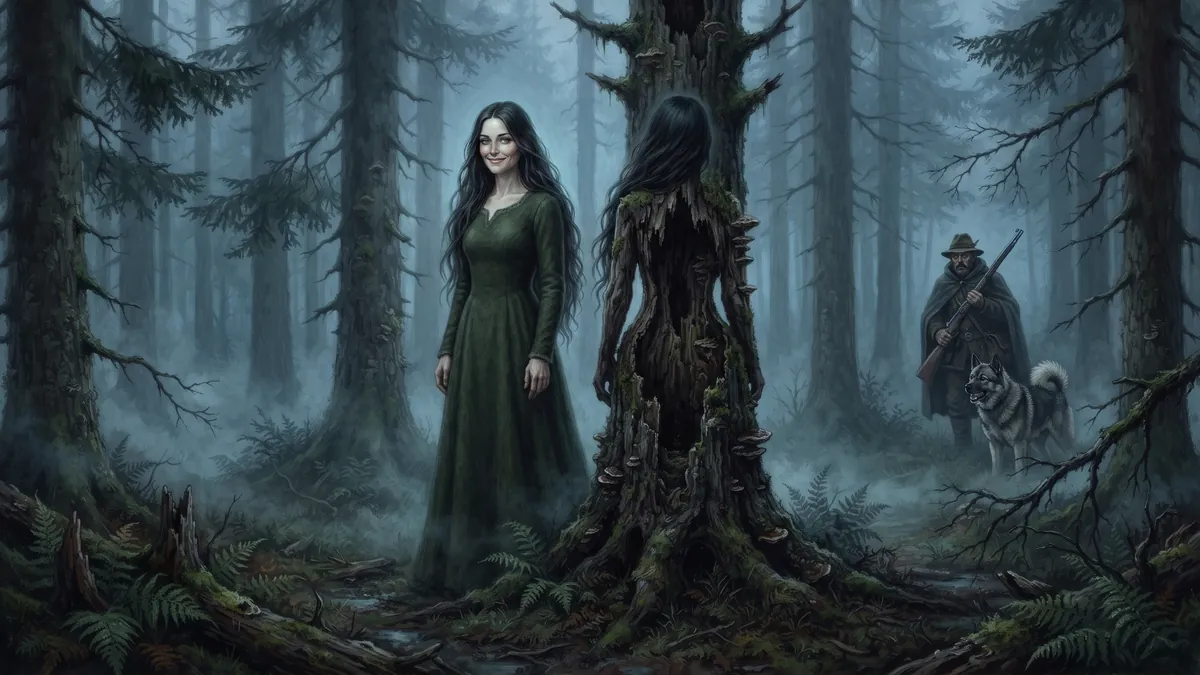
In the forests of Sweden, folk tradition says there is someone who looks after the woods. They call her the skogsrå, which means something like “the lady of the forest”, and she is one of the best-known beings of Swedish folklore.
Who the skogsrå is
In the recorded descriptions, the skogsrå is an attractive woman with long hair who shows herself to hunters, charcoal burners, herders and travellers, usually alone and at night. From the front she is beautiful. From behind, her body is hollow like a rotting trunk, and in some versions she has a cow’s or a fox’s tail. This trait also appears in Norwegian folklore of the huldra, and researchers see kinship between them.
The word rå has the sense of “mistress”, “owner”, and is the same root as other guardian spirits of places. This suggests the skogsrå was seen as the owner of a part of the woods, with whom a man had to come to terms in order to work there.
The hunter’s luck
The stories give the skogsrå a double power. She can help the hunter, sending him game, and she can harm him, leading his steps astray, exhausting his ammunition or seducing him until he is lost. In some accounts, the hunter who accepts her invitation receives luck for a while, but pays with his health or his wits.
To have the goodwill of the lady of the woods, say the accounts, the hunter had to be respectful, not boast of his catch and leave an offering, such as a little food or a coin, at an agreed place. Charcoal burners, who spent weeks isolated watching the burning of the wood, had their own precautions.
Sources and reading
The skogsrå appears in 19th-century collections, such as that of Gunnar Olof Hyltén-Cavallius, published between 1863 and 1868 on the region of Småland, and in folklore archives that gathered testimony in the 19th and 20th centuries. These records show a living belief then, but do not say where it came from. The origin is uncertain, and scholars link the skogsrå to medieval ideas of woodland spirits without being able to fix a lineage.
A common reading is that the stories served to make sense of real dangers. Someone who got lost in the forest, who was left without game or fell ill in isolation could explain the fact by an encounter with the lady of the woods. The moral warning is also clear: whoever enters another’s territory should ask permission.
What remains
Today the skogsrå appears in children’s books, illustrations and games, usually gentler than in the old collections. What is known, and should be said, is that these stories are legends and that belief in them varied a great deal from place to place.
To see how much you know about the lady of the forest and other beings of Nordic folklore, play The lady of the forest.
Sources.
- Gunnar Olof Hyltén-Cavallius, *Wärend och Wirdarne* (1863–1868, record of folk traditions from Småland)
- Swedish folklore archives (collections of oral tradition from the 19th and 20th centuries)
- Folklore studies on the forest beings of Scandinavia