Ladby: the Danish ship grave that left only marks and rivets in the earth
At Ladby, on the island of Funen, a ship about twenty metres long was buried with a chieftain, horses and dogs, and the timber vanished. See how archaeologists read what remained and what is still unknown.
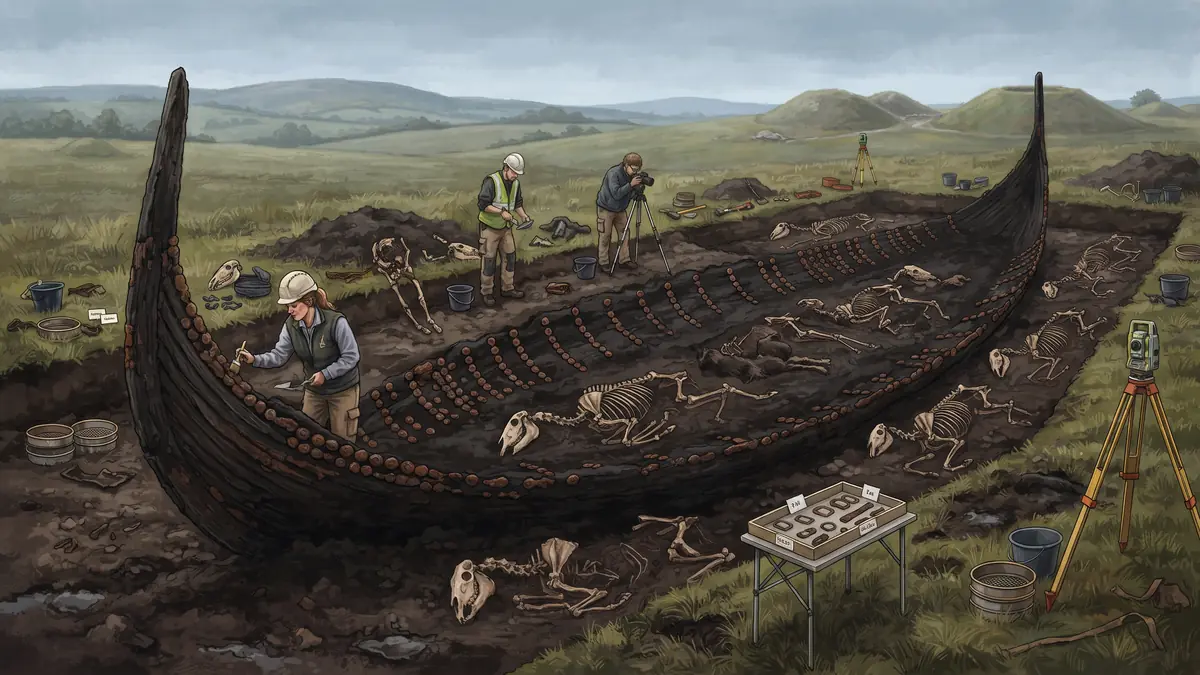
In the village of Ladby, on the island of Funen, in Denmark, lies one of the most extraordinary graves of the Viking Age. There, in the 10th century, a ship about twenty-two metres long was buried, and inside it an important man, horses and dogs. The timber rotted, but the earth kept the mark of the hull.
The discovery
The grave was found in 1934, when a farmer, digging, struck remains of iron. The following year, the archaeologist Poul Helweg Mikkelsen directed the excavation. He saw that, under the soil, there was a dark, elongated stain with hundreds of iron rivets in rows. They were the rivets that had once joined the planks of the hull, and that stayed in their original position when the wood vanished.
This kind of trace is called a “ghost ship”. The archaeologists did not find the boat, but its outline. From the position of the rivets, they managed to reconstruct the shape, the length and the number of planks.
What the ship held
The grave is dated to about 925. In the ship there was a chamber, near the stern, for the dead man, and the rest of the hull was used to deposit objects and animals. The records speak of more than a dozen horses and a few dogs, sacrificed and placed around the ship. Chains, ironwork, an anchor and remains of metal and cloth objects also appeared.
An important point is that the grave was broken into soon after the burial. Someone opened the ship and removed the body and much of the goods, which explains why the site has so few valuable objects. The motives are debated: it may have been robbery, or an act tied to political disputes.
Who the dead man was
The man’s identity is not known. From the size of the ship and the number of animals, historians think he was a chieftain of high rank, perhaps linked to the royal family or to a local magnate. But this is a deduction, and no inscription confirms it.
The site matters because it shows a kind of burial rare in Denmark, in which the ship itself serves as the grave. Today, the Ladby Viking Museum protects the place and presents a reconstruction of the ship.
The Ladby case is useful for understanding how the archaeology of perishable materials works. When the wood disappears, the earth can record the shape of the object, and the excavation must be done with great care so as not to erase that record. The technicians used drawings, photographs and measurements, and these data still allow new studies.
It is also worth noting that ship burial appears in other places in Scandinavia, as in Norway and Sweden, with ships very different from one another. At Oseberg and Gokstad, for example, the wood was preserved, which makes the ships there far more complete. Ladby shows that the custom existed in Denmark too, but left a much more discreet mark in the soil.
To take the rivets off the board one by one, jumping over a neighbour until only one is left, like someone reading the marks of the Ladby ship, play Ladby’s rivets.
Sources.
- Poul Helweg Mikkelsen, excavation reports on the Ladby ship, 1935 (National Museum of Denmark)
- Vikingemuseet Ladby (Ladby Viking Museum), documentation and catalogue of the ship-grave site
- Else Roesdahl, *The Vikings* (Penguin, 1991, chapter on burial customs)