Lindholm Høje: the Danish cemetery of stone ships covered by sand
Near Aalborg, in Denmark, about seven hundred Iron Age and Viking Age graves were preserved under the sand. See what the excavations say about the stone ships.
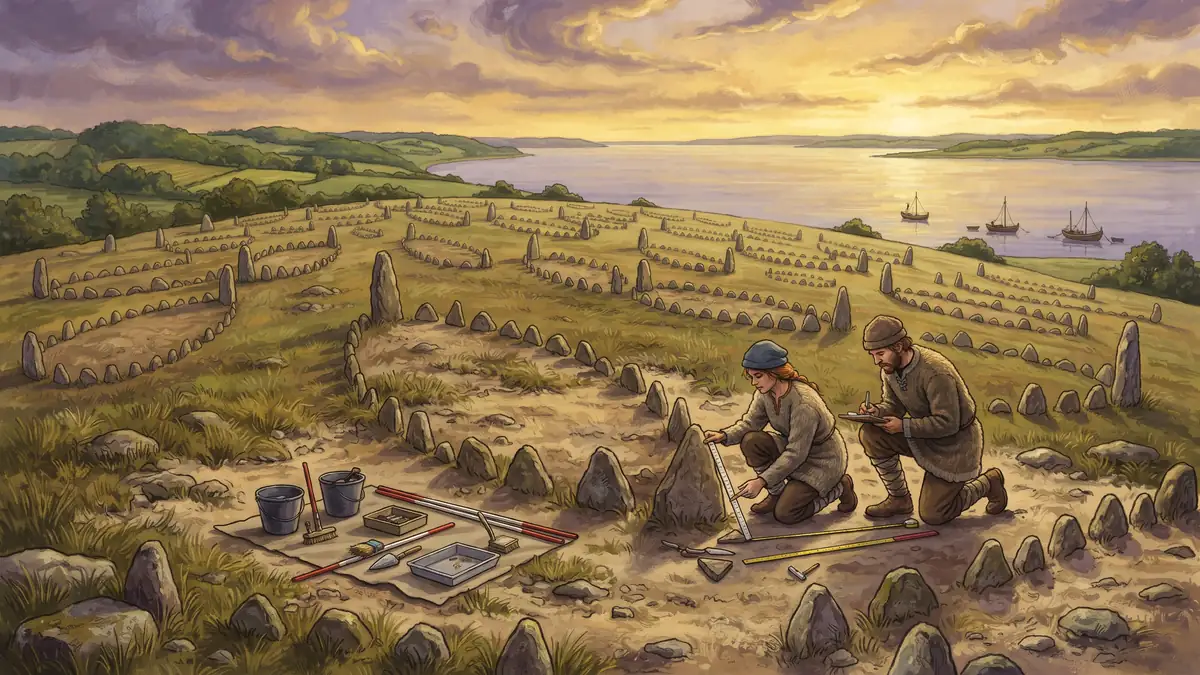
On a hill near Aalborg, in northern Denmark, there is a cemetery that looks like a drawing made on the ground. Dozens of standing stones form outlines of ships, among other stone figures, and the whole is called Lindholm Høje. The place drew attention because a layer of sand, carried by the wind over centuries, covered and protected what was there until the 20th century.
A long-lived cemetery
The cemetery was used for a long time. According to archaeologists, the first graves date from the period before the Viking Age, around the 5th century, and use continued until about the year 1000 or a little later. About seven hundred graves were excavated, and most contain cremation remains, with few objects. The excavations took place in the 1950s, under the direction of Thorkild Ramskou, of the Danish National Museum.
After a time, wind-blown sand gradually covered the cemetery, and the thick layer preserved it. That is why the stones were in place when archaeologists arrived, instead of having been moved by farmers. This kind of preservation is rare: in other cemeteries of the same period, ploughing and erosion wiped out the surface marks, and the graves are found only by excavation, without the stone outlines that marked them.
Ships, triangles and ovals
What impresses is the variety of stone shapes that mark the graves. There are outlines of ships, with pointed bow and stern, but also triangular, oval and circular figures. The stone ships, called skibssætninger in Danish, appear in several parts of Scandinavia, and many researchers link them to the idea of a journey of the dead, although no one can say so with certainty, because the ancient texts do not explain the rite.
At Lindholm Høje, archaeologists noticed that the stone ships and the other shapes are related to the date of the graves, and that the size of each outline may have to do with the prestige of the person buried. These points are still debated. Because cremation left few objects, it is hard to say who was rich and who was poor from the contents of the graves alone.
Life beside the dead
Near the cemetery, researchers found traces of a village, with houses, and of fields that had been ploughed, and the plough marks were preserved under the sand. This shows that the living and the dead occupied the same stretch of land, and that the community lived from farming, herding and trade along the fjord.
Today the place is an open-air museum, where visitors walk among the stones. Archaeology reminds us, however, that the image of a “field of ships” is what remained after centuries, and that the original graves may have had signs of timber and earth that have since vanished.
To trace the outline of a stone ship, passing through each stone only once, play The ship’s outline.
Sources.
- Thorkild Ramskou, *Lindholm Høje Gravpladsen* (Nordiske Fortidsminder, 1976)
- Else Roesdahl, *The Vikings* (Penguin, 1991, revised edition 1998)
- Lindholm Høje Museet / Nordjyllands Historiske Museum, documentation on the site and the excavations