The Lewis chessmen: walrus ivory, warriors biting their shields and a hoard from the Hebrides
In 1831, on the island of Lewis, in Scotland, a set of medieval chess pieces in walrus ivory turned up. See what is known about who made them and why they ended up there.
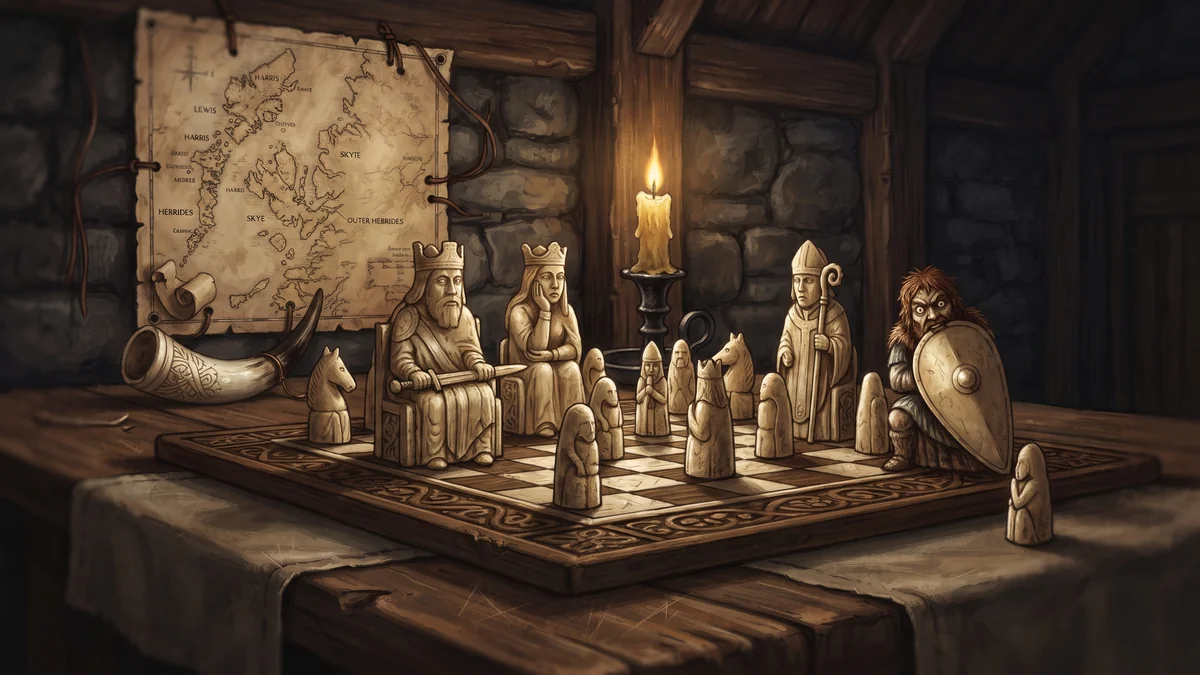
In 1831, on the beach at Uig, on the island of Lewis, in the Outer Hebrides, a curious treasure turned up: ninety-three gaming pieces, made of ivory. Among them were seventy-eight chess pieces, fourteen pieces of a board game of the tafl type and a belt buckle. Today most are in the British Museum, and eleven pieces belong to the National Museum of Scotland.
A game in walrus ivory
The pieces were carved, for the most part, from walrus tusk, a material that came from the North Atlantic. Specialists date them to about 1150 to 1200. The kings sit on thrones, with the sword across their knees, the queens rest a hand on the cheek, and the bishops wear mitres. The knights appear mounted, and the rooks are standing warriors, with shield and sword.
One figure draws attention: some of these warriors bite the rim of the shield, with wide eyes. Many scholars associate it with the berserkers of the sagas, the warriors who went into a frenzy. The link is plausible, but it is an interpretation, and the makers of the pieces left no text on the subject.
Who made them
The style of the carvings, and a similar piece found in Trondheim, in Norway, lead many researchers to think the pieces were made there, around the end of the 12th century. At that time the Hebrides belonged to the Norwegian crown, and the territory would pass to the king of Scotland only after the Treaty of Perth, in 1266. It is therefore natural that luxury objects circulated between Norway and the islands. The name of the carver, or carvers, is not known. Scholars recognise at least a few different hands, because details such as the folds of clothing and the eyes vary from one piece to another, and the workshop probably brought together several craftsmen.
Researchers observe that the variety of the pieces suggests more than one set, which raises the idea of a merchant carrying them to sell, rather than a player who had lost them. But no one knows how the hoard came to the beach, and some versions of the discovery, heard in the 19th century, have been revised by recent studies.
A museum piece and popular culture
Although they date from the 12th century, and so from the end of the Viking period, the pieces are remembered as a sample of medieval Scandinavian culture. Chess, a game that came from the East across Europe, already appeared in Norse courts, and tafl, a king-hunting game, was still known.
The Lewis pieces became famous outside museums, and today appear in books and films. Their interest lies in showing that northern art, even after the Viking Age, continued to combine craft, humour and a certain ferocity.
To go round, as a knight, every square of a board exactly once, without stepping twice on the same place, play The knight’s tour.
Sources.
- David Caldwell, Mark Hall and Caroline Wilkinson, "The Lewis hoard of gaming pieces", *Medieval Archaeology* 53 (2009)
- Neil Stratford, *The Lewis Chessmen and the Enigma of the Hoard* (British Museum Press, 1997)
- James Robinson, *The Lewis Chessmen* (British Museum Press, 2004)