Skuldelev: the five Viking ships deliberately sunk in Roskilde Fjord
At Skuldelev, in Denmark, five ships were sunk in a narrow channel around 1070. The 1962 excavation revealed what Viking vessels were like.
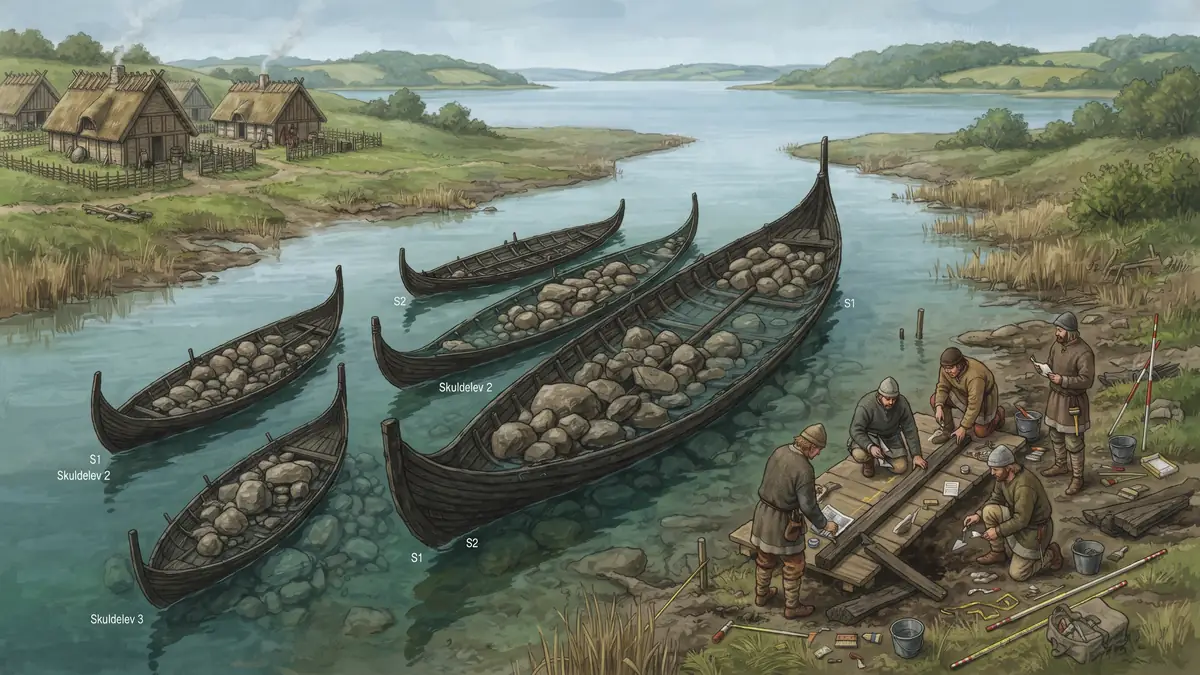
In Roskilde Fjord, in Denmark, five ships were sunk on purpose, and today they can be seen in a museum. The discovery at Skuldelev showed, better than any saga, what the vessels used in the Viking Age were like, and gave Scandinavian nautical archaeology a unique collection. What we know comes from modern excavations, carried out with techniques that make it possible to date the timber.
A blockade in the channel
Around 1070, according to the datings, five ships were taken to a narrow channel of the fjord, near the village of Skuldelev, filled with stones and sunk. Researchers think the intention was to block the passage, to protect Roskilde, then an important town, from attacks coming from the sea. The exact reason is not known, and the blockade hypothesis is the most accepted, but other explanations are discussed.
The hulls lay under water, protected by layers of sediment, and so survived for almost nine hundred years. In 1957 the site was identified, and in 1962 a team from the Danish National Museum built a dam around it, pumped out the water and excavated the remains. Thousands of fragments were recovered, later treated and mounted on metal frames.
Five ships, five functions
The ships are quite different from one another. One of them, called Skuldelev 1, was an ocean-going cargo ship, of the type the sagas call a knarr, built of pine, probably in Norway. Another, Skuldelev 2, was a warship about thirty metres long, made of oak, and tree-ring analyses point to timber from the Irish region, around 1042. There was also a small trading ship, a small warship and a fishing or cargo boat, of smaller sizes.
The set shows that a single people used different hull forms for different purposes, and that timber travelled: the longest ship was made far from Denmark, which suggests wide maritime contacts.
Replicas and experiments
The reconstructed hulls served as models for replicas. The most famous is the Havhingsten fra Glendalough, a copy of Skuldelev 2, which in 2007 sailed from Roskilde to Dublin and returned in 2008. The voyage made it possible to test how the ship behaved on the open sea, with its crew, sail and oars. The results showed a flexible, fast hull, but demanding for the sailors. The Roskilde museum, opened in 1969, still keeps the hulls on display and workshops where new replicas are built with old techniques.
Experiments like these help archaeologists separate what the material proves from what is merely imagination. For the visitor, what remains is the sight of the real hulls, and the reminder that the Vikings, besides being warriors, were naval builders of great skill.
To find, shot by shot, the five ships sunk in the fjord, before your shots run out, play The fjord’s five ships.
Sources.
- Ole Crumlin-Pedersen and Olaf Olsen (eds.), *The Skuldelev Ships I* (Viking Ship Museum / Danish National Museum, 2002)
- Ole Crumlin-Pedersen, *Archaeology and the Sea in Scandinavia and Britain* (Viking Ship Museum, 2010)
- Vikingeskibsmuseet in Roskilde (Viking Ship Museum), documentation on the Skuldelev ships