Sverre Sigurdsson: the priest raised in the Faroes who became king of Norway and had his own saga written
Sverre, raised in the Faroe Islands, arrived in Norway in 1176, led the Birkebeiners and won at Fimreite. The *Sverris saga* is a rare account written during the king's lifetime.
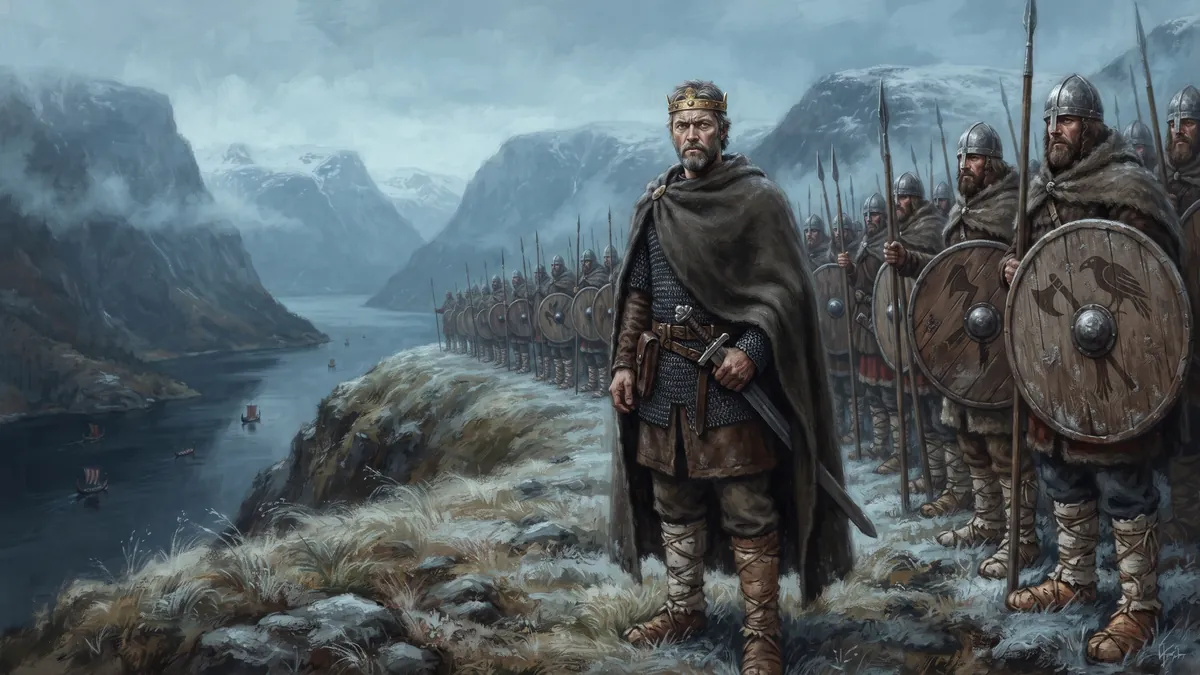
Sverre Sigurdsson, king of Norway from 1177 to 1202, is one of the most curious figures of the Norse Middle Ages. According to the saga that bears his name, he was raised in the Faroe Islands, far from the disputes of the kingdom, and only in his twenties learned that he was the son of a king. His road to the throne is therefore a story of ambition and organisation.
A king from the islands
The Sverris saga says that Sverre was born in Norway, but was taken as a child to the Faroes, where he studied and was trained as a priest under the protection of the local bishop. In 1176, he claimed to be the son of King Sigurd Munn and went to Norway, where there was a civil war between several groups disputing the throne. It must be remembered that his origin is debated, because the only direct source is the saga itself, written to support his cause.
He came to lead a group of poor and hungry men who lived in the forests of the border with Sweden. They became known as Birkebeiners, “birch legs”, because, according to tradition, they wrapped their legs in birch bark. With discipline and inventive tactics, Sverre turned this band into an army.
Fimreite and the reign
In 1177, Sverre was acclaimed king by an assembly. His main rival was Magnus Erlingsson, supported by the Church and part of the nobility. The war lasted years, and the decisive point was the naval battle of Fimreite, in the Sognefjord, in 1184, in which Magnus died. After that, Sverre governed more securely, although revolts continued.
His reign was marked by a conflict with the Church, which considered him illegitimate. Archbishop Eirik Ivarsson challenged him, and Sverre was excommunicated. Tradition attributes to him a text of defence, the Speech Against the Bishops, but scholars debate its authorship. He died in 1202, in Bergen.
A saga written in his lifetime
What makes Sverre special is the saga. According to the text itself, the early part was written by the Icelandic abbot Karl Jónsson, under the king’s supervision. It is rare for the account of a ruler to have been composed while he was still alive, and this gives the source a special interest, because it shows how Sverre wanted to be seen. Historians use the saga with care for that very reason: it defends the king.
The context helps in understanding the text. Norway at the end of the 12th century was living through civil wars caused by the lack of a clear rule of succession, and several candidates could claim royal blood. In this setting, having a narrative of one’s own, which asserted the king’s origin and justified his acts, was a political weapon as useful as an army.
Sverre’s reign is also seen as a step in the formation of the Norwegian state, with an organised army and a stronger administration, although this point is debated.
To fit piece upon piece, forming compact rows like those of a well-disciplined army, play Sverre’s ranks.
Sources.
- *Sverris saga*, ed. Gustav Indrebø (Det Norske Historiske Kildeskriftfond, 1920)
- Sverre Bagge, *From Viking Stronghold to Christian Kingdom* (Museum Tusculanum Press, 2010)
- *Norsk biografisk leksikon*, entry "Sverre Sigurdsson" (Norsk biografisk leksikon, online)