Völuspá, the seeress's prophecy that tells Odin of the beginning and end of the world
The poem *Völuspá* has a seeress tell Odin of creation, the war of the gods and the end of the world. See what the manuscripts say and what scholars debate.
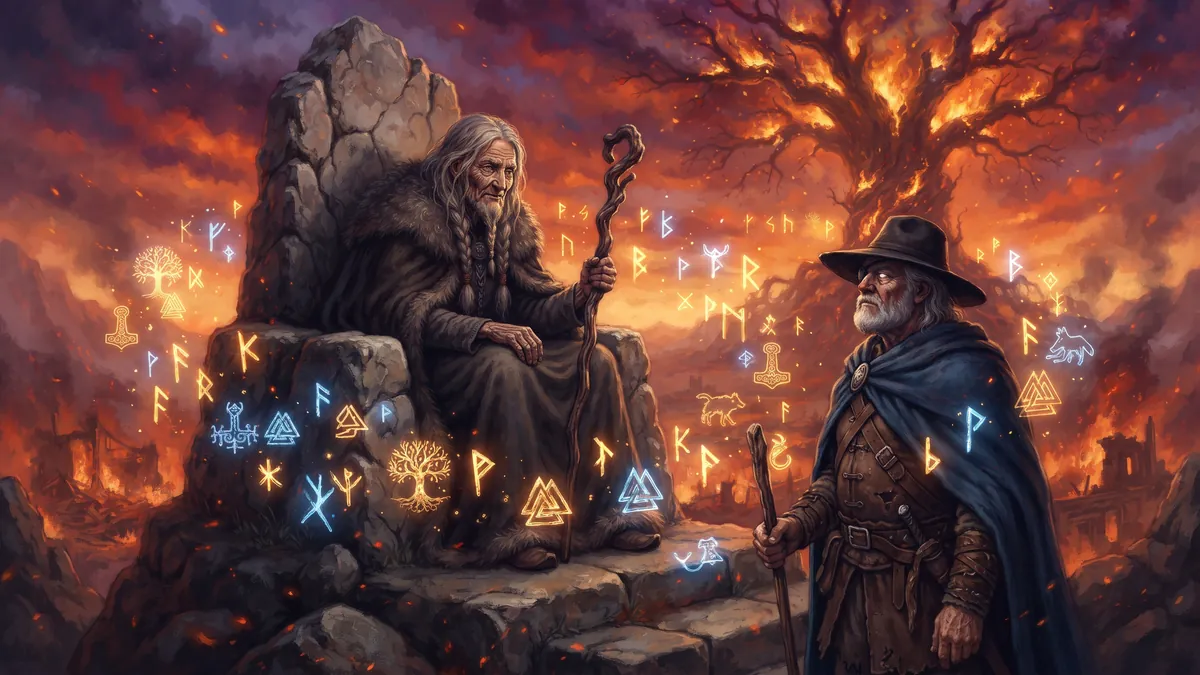
Völuspá, “the seeress’s prophecy”, is the first poem of the Codex Regius, the Icelandic manuscript of the Poetic Edda, and one of the most important texts for anyone studying Norse mythology. In it, a seeress, called a völva in Old Norse, speaks before Odin, the one-eyed god, and tells what she knows of the past and the future. The poem has about sixty stanzas, depending on the version, and was preserved in more than one manuscript.
What the poem tells
The seeress begins by asking silence of all the holy beings, and says that Odin wanted her to recite the ancient stories. She recalls the time when neither sand, nor sea, nor cold waves existed, and speaks of the primordial abyss. Then she shows the gods organising the world, building temples and forges, and finding on the shore two tree trunks, which are given life and become the first humans. The manuscripts give them the names Askr and Embla.
Next, the poem speaks of the war between the groups of gods, of broken pacts and of the death of Baldr, the most beloved. The best-known point is the end of the world, Ragnarök, with wolves unleashed, the sea rising, the sky darkened and the gods in combat. The final part says that, after the destruction, a green land rises again from the sea, and that some gods and a new generation of people inhabit it. One line is repeated several times: “Do you still understand, or not?”
A text with layers
Scholars debate when the poem was composed. Some place it around the year 1000, at a time when Christianity was approaching Iceland. Others see in it a mixture of older traditions with ideas from the time when it was written down. The most discussed question is whether the final scene, of the world’s renewal, reflects Christian influence or comes from an older belief. The sources do not allow a secure answer.
There are also differences between the versions. The Hauksbók, copied in the early 14th century, has stanzas that are missing from the Codex Regius, and vice versa. Snorri Sturluson quotes the poem in his Gylfaginning, which shows that it circulated in 13th-century Iceland.
The seeress in Norse society
The figure of the völva also appears in sagas, where a seeress is invited to visit a farm and foretell the community’s future. These accounts are late and literary, and it is hard to know how far they reflect real practices. Even so, archaeology has found graves of women with iron staffs, which some researchers associate with this tradition, although the interpretation is debated.
What the poem makes clear is the importance of the spoken word: the seeress knows because she recites, and what she recites sustains the memory of a people who kept their myths in the voice before writing them down.
To throw coloured runes and make every group of three vanish before they reach the seeress, play The seeress’s runes.
Sources.
- *Völuspá*, in the *Poetic Edda* (Codex Regius, c. 1270) and in the *Hauksbók* version (early 14th century)
- Carolyne Larrington (trans.), *The Poetic Edda* (Oxford University Press, 1996)
- Snorri Sturluson, *Gylfaginning* (c. 1220), which quotes stanzas of the poem