Ansgar: the monk who took Christianity to Denmark and Birka, and saw Hamburg burn
In the 9th century the monk Ansgar accompanied a converted Danish king and was sent to Birka, in Sweden. Later he lost his see to a Danish attack. See what the sources say and what they leave unsaid.
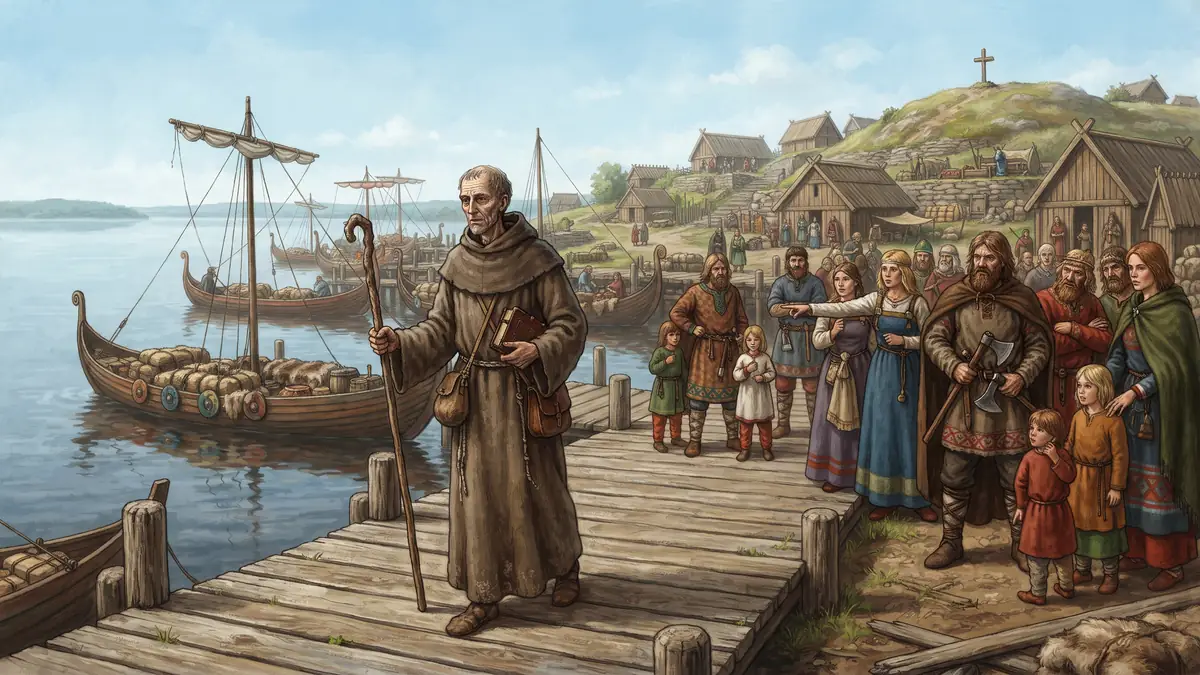
The conversion of Scandinavia to Christianity was a long process that lasted centuries. One of its first documented episodes has as its protagonist a Frankish monk, Ansgar, who in the 9th century tried to found churches in Denmark and Sweden. What we know of him comes mainly from a book written by his successor, and that calls for care.
From Corbie to the north
Ansgar was born around 801, near Amiens according to most accounts, although the date and place vary. He was raised in the Benedictine monastery of Corbie, in present-day France, and in 822 he was among the monks sent to found a new monastery in Westphalia, Corvey. Soon afterwards he accompanied to Denmark King Harald Klak, who had converted to Christianity at the Frankish court. The monks opened a school for the sons of courtiers, but Harald’s fall in 827 ended the initiative, and Ansgar returned to Germany.
Birka
In 829 the emperor Louis the Pious sent Ansgar to Sweden, at the request of King Björn. The journey was risky, and the Vita Anskarii tells that he was attacked by pirates on the way and lost part of his books. At Birka, the great trading port on Lake Mälaren, he spent about six months, won some converts and organised a small Christian community. Birka was a suitable place for this: it received merchants from many regions, among them Christians.
The archbishop and the attack on Hamburg
In 831 Ansgar returned to the court and was appointed archbishop of the new see of Hamburg-Bremen, with the mission of evangelising Denmark, Norway and Sweden. He was consecrated bishop that year and received the pallium in Rome. But in 845 the Danes attacked Hamburg and destroyed the church, the books and the treasures. Ansgar lost his see and his revenues. In 847 he was named to the vacant see of Bremen, where he came to live in 848. He returned to Sweden in the following decade and obtained from a Danish king permission to build a church at Schleswig, or Hedeby, the great port of the region.
The source and its limits
Ansgar died in Bremen on 3 February 865. The Vita Anskarii was written by his successor, Rimbert, with the aim of showing the sanctity of its subject. For that reason it gives much space to visions, miracles and signs, and plays down failures. As a historical source it is precious because it speaks of Birka, Hedeby and of kings such as Björn and Horik, but it must be read with care. Some historians think the account exaggerates the reach of the mission and that, in practice, Christians were a small minority.
What remains
Ansgar did not convert Scandinavia. The process was much slower and was consolidated only in the 10th and 11th centuries, with kings such as Harald Bluetooth in Denmark and Olaf in Norway. But his story shows that, already in the 9th century, there was contact between the Frankish Church and the Nordic kingdoms, and that Christians had some presence in centres such as Birka and Hedeby. By tradition he came to be called the “apostle of the North”.
To flip your rival’s pieces with your own, on a six-by-six board, play Birka’s board.
Sources.
- Rimbert, *Vita Anskarii* (c. 870), English transl. by Charles H. Robinson, *Anskar, the Apostle of the North* (1921)
- Adam of Bremen, *Gesta Hammaburgensis ecclesiae pontificum* (c. 1075)
- Ian Wood, *The Missionary Life: Saints and the Evangelisation of Europe, 400–1050* (Longman, 2001)