The picture stones of Gotland: carved sailing ships and colours that hardly survive
On the Swedish island of Gotland, hundreds of stone slabs were raised over centuries with images of ships, riders and scenes from legends. What they mean remains open. See what the museums know.
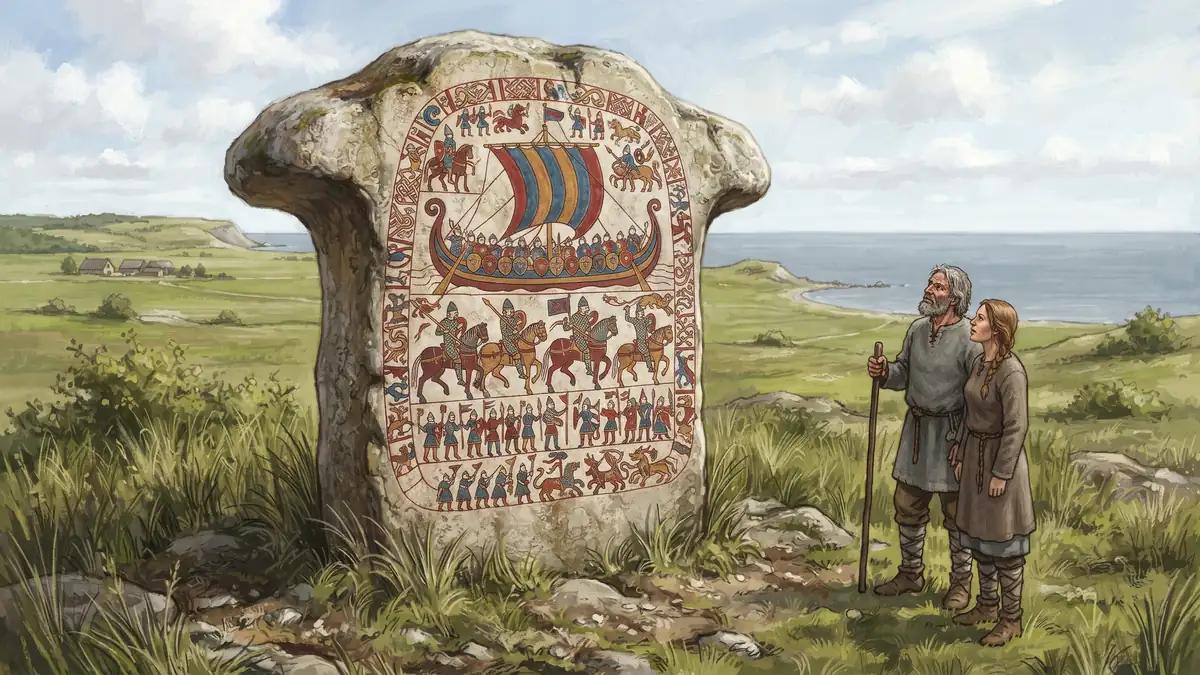
On the island of Gotland, in the Baltic Sea, there is a group of stones with no equivalent elsewhere in Scandinavia. They are tall limestone slabs covered with carved images: ships, riders, warriors, women with drinking horns, animals and scenes from legends. The so-called “picture stones” (bildstenar) began to be raised around the 5th century and continued for more than six hundred years. Almost everything said about what they mean is, in fact, a hypothesis.
Stones that look like runestones, without runes
The stones resemble the runestones of other regions, but instead of texts they carry images. The images are usually arranged in panels. Some of the oldest stones, of the 5th and 6th centuries, have simple forms, with circles and spirals, and figures of rowing boats. Later, in the Vendel and Viking periods, the ships with a large sail appear, which became Gotland’s most famous motif. They are also divided into types: the Gotland Museum separates them, for example, into “dwarf” stones, dated to about 500 to 700, and “cist” stones, from about 500 to 1100.
The lost colours
The images were probably painted, and very faint traces of paint remain on a few stones. Modern photographs and replicas show intense reds and blacks, but the Gotland Museum warns that this paint was applied in the 20th century, to make the figures visible, and does not come from the Viking Age. The scholar Sune Lindqvist, who published the stones in 1941 and 1942, traced the faint figures with paint in order to read them, and for that reason his images have a modern colouring. He himself warned that a result obtained in this way should not be taken as exact in every detail.
Reading the images
One of the best-known stones, that of Ardre, shows the legend of Völund, the smith captured by a king, and gives an idea that the images were linked to known narratives. But in many cases the figures are worn, effaced or were reused in buildings, and what can be read is debatable. Older drawings, such as Sörling’s of 1911, sometimes differ greatly from Lindqvist’s. The Swedish History Museum sums up: what these images actually mean remains unknown.
What remains
The stones of Gotland are a reminder that not every record of the Viking Age was written. The sailing ships, in particular, interest scholars because they show how Gotlanders saw the sea. But care is needed in drawing conclusions: a single stone, poorly preserved and restored several times, is a fragile source. That is why researchers compare many stones, excavations and texts before proposing a reading.
To paint a whole stone in a single colour, changing the colour of the patch from the corner, in a few moves, play The Gotland picture.
Sources.
- Gotland Museum, *Gotlandic Picture Stones* (database and iconographic text)
- Sune Lindqvist, *Gotlands Bildsteine* (Stockholm, 1941–1942)
- Swedish History Museum (Historiska museet), *Picture stones and rock carvings*