The temple at Uppsala: what Adam of Bremen told and what archaeologists found
Around 1075 the chronicler Adam of Bremen described a golden temple at Uppsala, with three gods and a great sacrifice every nine years. See the account, the scholars' doubts and what the excavations show.
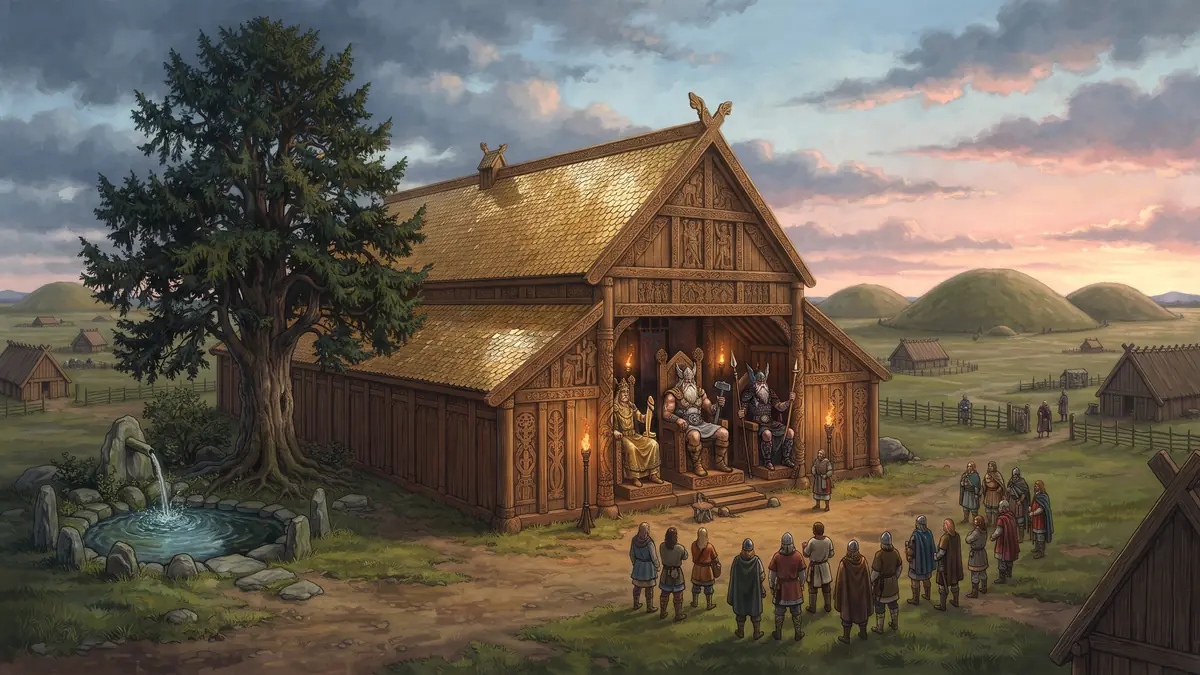
Near the present Swedish city of Uppsala, at the place now called Gamla Uppsala (“Old Uppsala”), there are three great burial mounds, a medieval church and an open plain. In the centuries before Christianity the site was an important centre. And it is from there that the most famous account of a pagan Norse temple comes, written by a German chronicler who was never there.
Adam of Bremen’s account
Adam wrote, in Bremen, around 1075, a history of the archbishops of Hamburg-Bremen. In book IV he speaks of the “very famous temple” of Uppsala, which was supposedly “made entirely of gold”. Inside, three statues are said to sit on thrones: Thor, in the centre, with a hammer, Wodan (Odin), in armour, and Fricco (Freyr), with an exaggerated fertility sign. Each god had a priest. In times of famine or plague one sacrificed to Thor, in war to Odin and at weddings to Freyr.
Adam says that every nine years there was a great festival for all of Sweden. At it, nine males of every kind were sacrificed, humans included, and the bodies were hung in the trees of a neighbouring sacred grove. He also describes a great evergreen tree beside a spring, into which a living man was thrown, and a golden chain hanging from the temple gables. His source, he says, was a seventy-two-year-old Christian who had witnessed these things.
The doubts
Scholars debate how much of this is real. The text was written decades after what it describes, by someone who had not seen the place, and with a clear purpose: to show the need to convert the Swedes. Some, such as Rudolf Simek, note that the golden chain may be an exaggeration, since chains like it appear in churches of the 8th and 9th centuries. Another researcher, the historian Henrik Janson, even suggested that the “temple” was a Christian church. A similar account, by Thietmar of Merseburg, speaks of the cult centre at Lejre in Denmark, but refers to the early 10th century.
What archaeology shows
In 1926 the archaeologist Sune Lindqvist found postholes under the church of Gamla Uppsala and proposed that they were the remains of the temple. Later research contested this reading, showing that there are several phases of construction. More recently, ground-penetrating radar revealed a timber structure under the north transept of the cathedral, a Bronze Age building and a possible Viking Age feasting hall. The great burial mounds show that the place was important. But no excavation has revealed anything on the scale of the temple Adam describes.
What remains
There are two lessons. The first is that the place was, without doubt, a political and religious centre. The second is that a single account, written from outside and with a purpose, must be read with care. Much of what is said today about “sacrifices every nine years” repeats Adam, with no other source to confirm it. Later, medieval sources said that King Inge the Elder had destroyed the temple in the 1080s, but no source of the time says so.
To put in order nine sliding tiles on a three-by-three grid, play The temple at Uppsala.
Sources.
- Adam of Bremen, *Gesta Hammaburgensis ecclesiae pontificum*, book IV, chaps. 26–27 (c. 1075)
- Henrik Janson, *Templum Nobilissimum: Adam av Bremen, Uppsalatemplet och konfliktlinjerna i Europa* (Gothenburg, 1998)
- Rudolf Simek, *Dictionary of Northern Mythology* (D. S. Brewer, 1993), entry "Uppsala"