Assandun, 1016: the battle in which Cnut defeated Edmund Ironside
On 18 October 1016 the Danish king Cnut defeated Edmund Ironside's English at Assandun, and months later he ruled all England. See what the sources say and where the battle may have been.
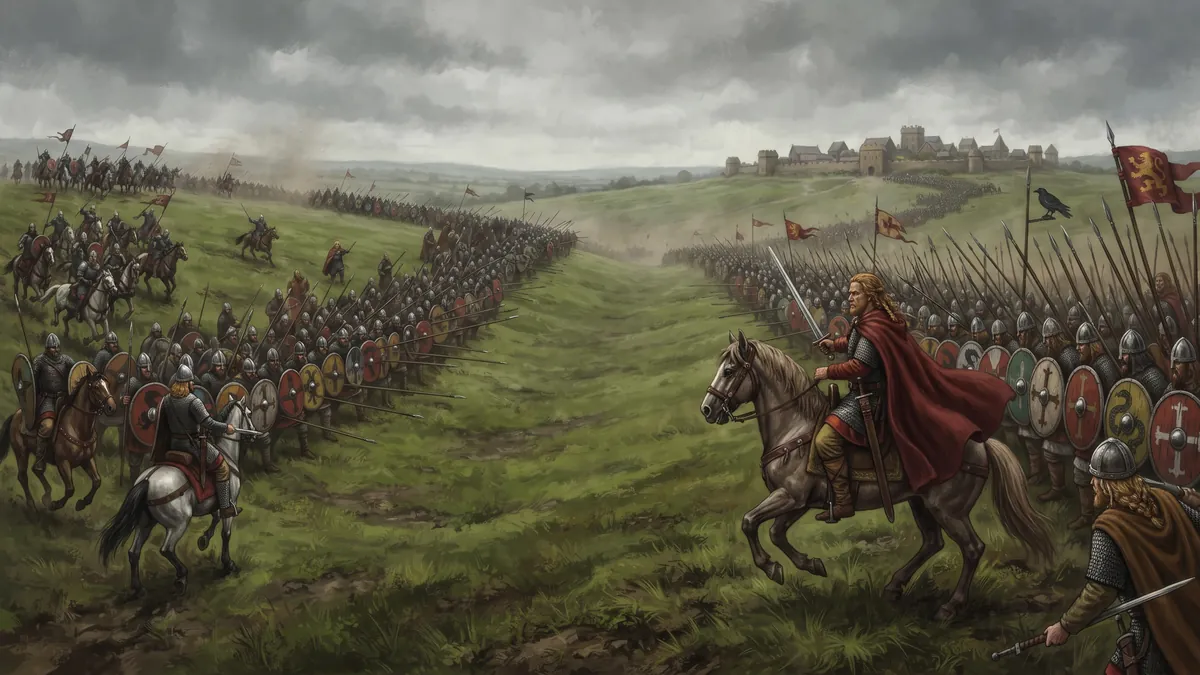
The Danish conquest of England was not a single blow. It was a long campaign, lasting years and involving king after king. The best-known battle is that of Assandun, in October 1016. It was there that the Danish king Cnut defeated the Englishman Edmund, nicknamed “Ironside”, and the road to the English throne lay open.
The adversaries
Cnut was the son of Sweyn Forkbeard, who had conquered a good part of England in 1013. Edmund Ironside was the son of the English king Æthelred. According to the sources, Cnut, described as more of a strategist than a warrior, did not fight in the front line. Edmund organised his men in three lines and fought in the front ranks. Among the English nobles who died was Ulfcytel, one of the leading ones.
Eadric’s betrayal
The decisive moment of the battle, according to the Encomium Emmae Reginae, was the withdrawal of Eadric Streona, the ealdorman of Mercia. By leaving the field, he opened a gap, and the Danes broke the English line. The text says Eadric had already urged flight before the fighting, but it also suggests the move may have been arranged, in return for a favour from the Danes. Eadric had a history of betrayals: he deserted to Cnut, returned to the English after Cnut was defeated at Otford, and then betrayed them again.
Where it was
The battle is traditionally placed at Ashingdon, near Rochford, in south-east Essex. But Ashdon, near Saffron Walden, in north Essex, has also been proposed, with the village of Hadstock as a possible place nearby. Historians have not reached a conclusion. The Knýtlinga saga, written in the 13th century, mentions the battle briefly and quotes a verse by the poet Óttarr svarti.
What came next
A treaty divided England: Cnut would rule all England except Wessex, and the heir who survived would take the whole kingdom. But Edmund died on 30 November 1016, and Cnut became king of all England. The source consulted does not say what Edmund died of.
On 18 October 1032, a church was consecrated at Assandun to commemorate the battle and its dead. Some suggest it is the church of St Botolph at Hadstock, from the early 11th century, but this is not confirmed.
What remains
For the Danes, the victory was the last step before ruling England, and Cnut later became king of Denmark and Norway as well. For the English, the battle showed how division among nobles could cost a kingdom. The open points, such as the exact place and Eadric’s motives, remain under discussion.
To find, by trial, the hidden groups of warriors in a six-by-six field, before the shots run out, play The field of Assandun.
Sources.
- *Encomium Emmae Reginae* (c. 1040), account of Cnut's attack on England
- *Knýtlinga saga* (13th century), which quotes a verse by the poet Óttarr svarti on Assandun
- Wikipedia (English), "Battle of Assandun"