Guthrum, 878: the Viking chieftain who was baptised, took a Christian name and became a king
After nearly taking the kingdom of Wessex, the Danish chieftain Guthrum was defeated by Alfred at Edington in 878 and accepted baptism. See what the sources say about Aller, Wedmore and the treaty that followed.
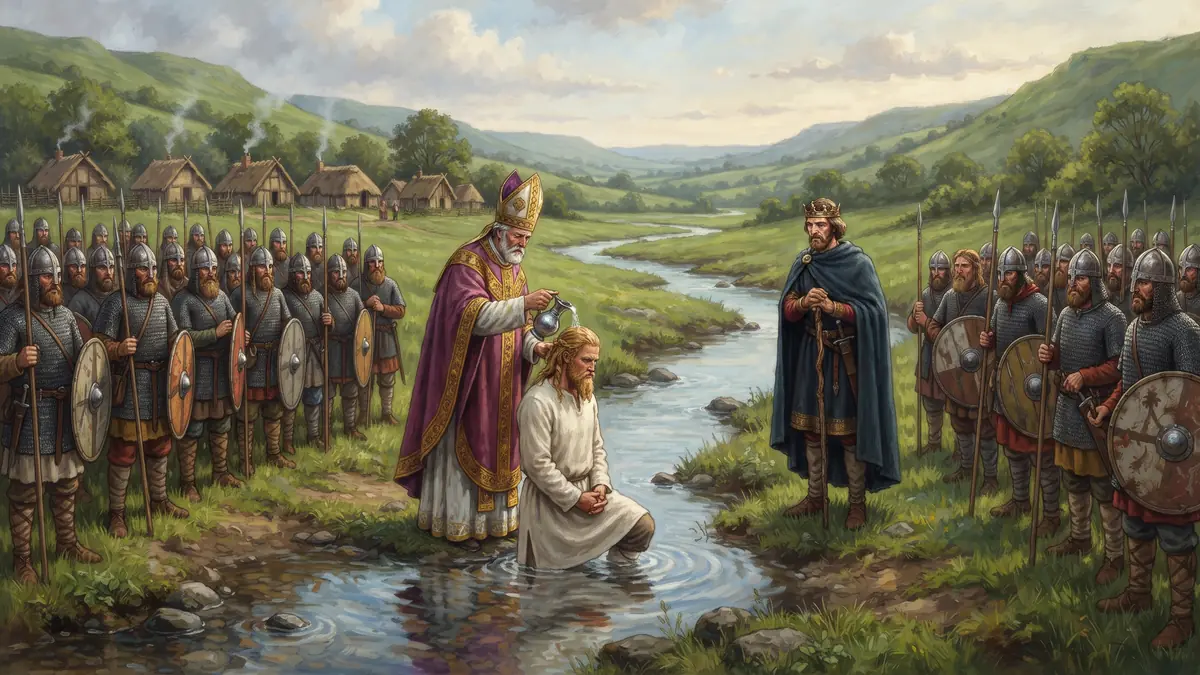
At the beginning of 878, the kingdom of Wessex seemed lost. King Alfred had fled to the marshes of Somerset, and the Danish army, under Guthrum, controlled much of the territory. A few months later, Guthrum himself would accept baptism and become a Christian king of East Anglia. The story of that turnaround is one of the most often told of Anglo-Saxon England.
The attack on Chippenham
According to the Anglo-Saxon Chronicle, Guthrum attacked Alfred’s court at Chippenham by surprise, on the night of 6 January 878, the feast of Epiphany. The date fell on a religious festival, when watchfulness was expected to be lower. The text consulted suggests that Wulfhere, the ealdorman of Wiltshire, may have let the attack through, whether by negligence or on purpose. Alfred escaped and took refuge in the Somerset marshes, where he built a fortress at Athelney and began to wage a guerrilla war.
Edington
In the spring, Alfred gathered an army and defeated the Danish Great Army at Edington. The text does not give the month of the battle, only the year 878. Then he besieged Guthrum’s stronghold for fourteen days, until the Danish chieftain surrendered.
The baptism at Aller
About three weeks after the surrender terms were agreed, Guthrum went to meet Alfred at Aller, near Athelney, accompanied by thirty important men. There he was baptised and took the name Æthelstan. According to tradition, Alfred was his godfather, but the text consulted does not confirm this detail. In the ritual of the time, the newly baptised wore a white cloth for some days, and the removal of the cloth, called chrism-loosing, took place at Wedmore, which is why the agreement became known as the Treaty of Wedmore.
The treaty and the Danelaw
Later, another text, the Treaty of Alfred and Guthrum, fixed boundaries between the two territories and rules for peaceful trade and for weregild, the value paid for a death. Many see it as the basis of the Danelaw, the region of England under Danish law. The exact date of the treaty is not secure.
Guthrum’s reign
Guthrum returned to East Anglia and ruled as a Christian king for more than ten years. He minted coins with his baptismal name, Æthelstan. He died around 889 or 890, and the Annals of St Neots say he was buried at Hadleigh, in Suffolk.
What remains
Guthrum’s conversion shows that war did not always end in death or plunder. Sometimes an agreement was negotiated in which the defeated accepted the victor’s religion. A doubt remains: was the gesture sincere or a form of politics? The sources do not allow us to say, but the fact that he minted coins with a Christian name suggests he took the role of king seriously.
To push, one by one, the crates to the marks on the floor, across three increasingly tight levels, play The crates of Wedmore.
Sources.
- *Anglo-Saxon Chronicle*, entries for the years 878 and 890
- *Annals of St Neots*, for Guthrum's burial at Hadleigh (Suffolk)
- Wikipedia (English), "Guthrum", with the sources it cites