Landvættir: the dragon, the bird, the bull and the giant that protect Iceland, according to the Heimskringla
In the saga of Olaf Tryggvason, in the *Heimskringla*, the Danish king Harald Bluetooth sends a wizard in the shape of a whale to spy on Iceland. He meets four beings that block each coast. See what the saga says and how the scene became a symbol.
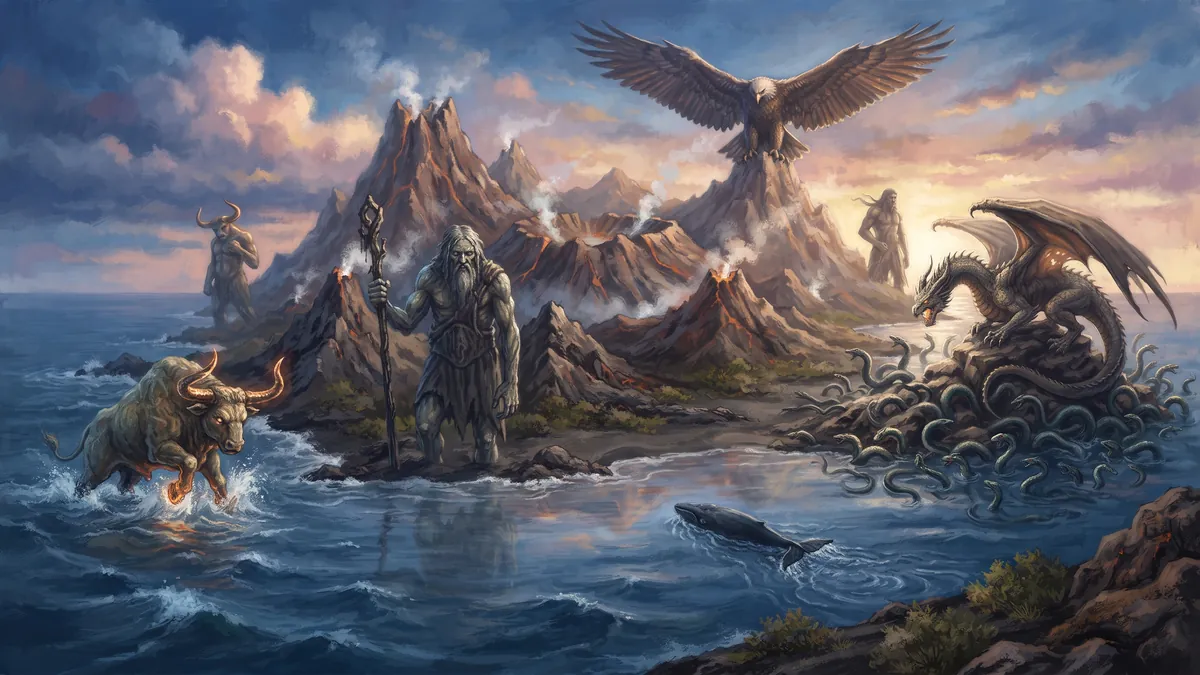
The coat of arms of Iceland shows four figures: a dragon, a bird, a bull and a giant. They are called the landvættir, “land spirits”, and they come from a scene in the Heimskringla, Snorri Sturluson’s great collection of kings’ sagas. The scene appears in the saga of King Olaf Tryggvason and mixes politics, sorcery and the protection of territory.
The king’s request
According to the saga, the Danish king Harald Bluetooth (Gormsson) thought of invading Iceland. To know how the island would defend itself, he asked a sorcerer to go there. The wizard did not go in person: he sent his hamingja, a kind of spirit or luck, in the shape of a whale. That is, what travelled was the wizard’s soul, not the man himself.
The four obstacles
The whale swam around Iceland and saw that the land spirits were “crowding every fell and hollow”. At each point where it tried to enter, something blocked the way.
At Vápnafjörður, in the northeast, a great dragon flew down the valley, followed by snakes, insects and lizards spitting poison. At Eyjafjörður, in the northwest, a bird appeared so large that its wings touched the hillsides, followed by many other birds. At Breiðafjörður, in the southwest, an enormous bull waded into the water, bellowing, followed by land spirits. At Víkarsskeið, in the south, came a mountain giant with an iron staff, taller than the hilltops, followed by other giants.
Faced with this, the king gave up. The south coast, according to the saga, was made of sand, wasteland and high waves crashing on the shore.
From saga scene to symbol
Modern tradition came to see the four beings as protectors of the four corners of the island: the dragon in the east, the bird in the north, the bull in the west and the giant in the south. They appear on the national coat of arms and have also been used on Icelandic coins. There are small differences among popular versions, which sometimes place the giant on the Reykjanes peninsula and call the bird a griffin.
What can be said with care
The scene is a narrative of the saga, written around 1230, well after Harald Bluetooth, who died around 986. Nothing guarantees that the idea of an attack on Iceland, or the spying in the form of a whale, ever happened. The story shows how medieval Icelanders imagined their own land: a place so well guarded that even a powerful king would give up.
What remains
The landvættir are part of a broader belief in the spirits that inhabit the landscape, and modern Iceland turned them into an emblem. The fact that the coat of arms was defined in the 20th century shows how the medieval sagas still feed the country’s identity.
To distribute stones among the pits of the board, in successive rounds, until you keep more stones than your rival, play The sowing of the guardians.
Sources.
- Snorri Sturluson, *Heimskringla*, *Saga of Olaf Tryggvason* (c. 1230), passage on the spying of Harald Gormsson
- Voluspa.org, "Continuation: Iceland and Norway, and Denmark" (excerpt from the *Heimskringla*)
- All Things Iceland, "The Four Protectors of Iceland" (Folklore Friday)