Seville, 844: the Viking fleet that sailed up the Guadalquivir and was beaten by an emir
In 844, a fleet of Vikings, called "majus" by the Arabic sources, sacked Lisbon and sailed up the Guadalquivir river to Seville. See what the Muslim chroniclers say and what historians debate.
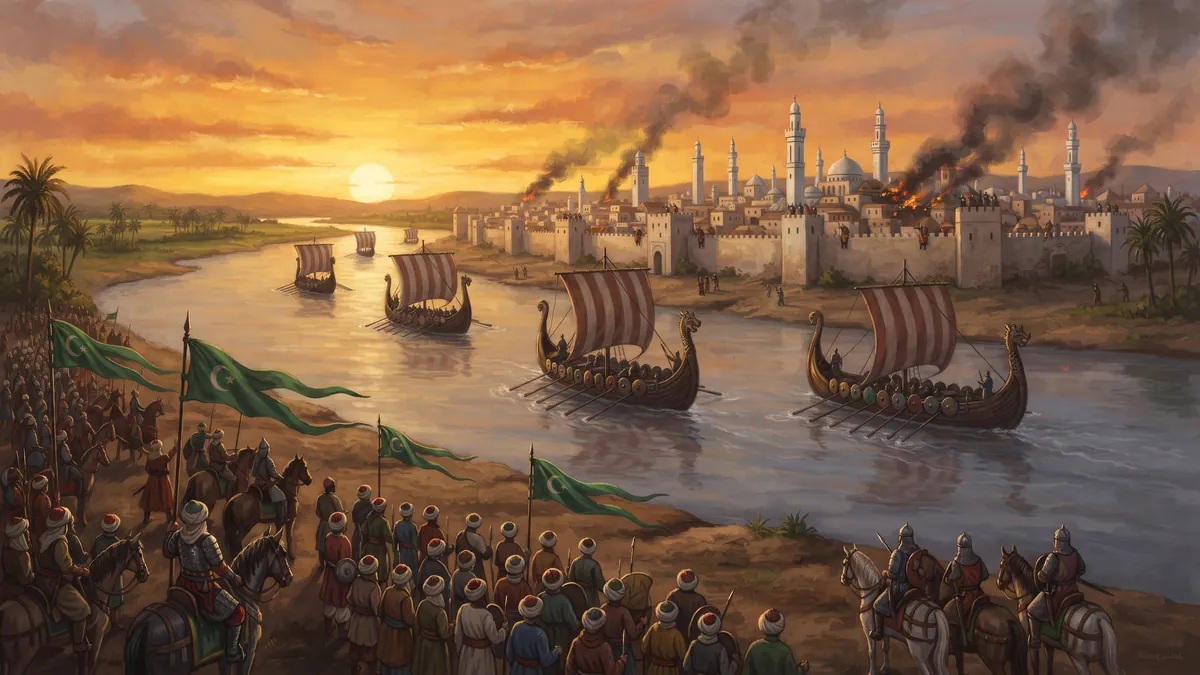
When people think of Viking raids, the names that come to mind are Lindisfarne, Paris and Dublin. But in 844 a Norse fleet reached much farther south, to the Iberian Peninsula, and sailed up a river to attack Seville, at the time a city of the emirate of Córdoba. The episode is one of the few in which the main sources are Arabic.
The fleet’s voyage
According to the earliest Muslim chroniclers, the fleet had eighty ships. The attackers are called majus, a word that once designated Zoroastrians and that Arabic sources came to apply to the pagans of the north. According to the chronicles, the fleet began by attacking Asturias, but suffered heavy losses at A Coruña and was defeated near the Tower of Hercules. It then went south and took Lisbon, in August or September 844. It stayed there thirteen days. Next it attacked Cádiz, Medina Sidonia and Algeciras, and perhaps Asilah, in Morocco.
Seville
The fleet sailed up the Guadalquivir river and settled on Isla Menor. It reached Seville on 25 September. The city had no walls. The Vikings took it on 1 or 3 October, but the citadel remained in Muslim hands. An attempt to burn the great mosque failed.
The emir of Córdoba, Abd ar-Rahman II, sent an army under his chamberlain, Isa ibn Shuhayd. Among those who joined the force was Musa ibn Musa, leader of the Banu Qasi, despite having rivalries with the emir. The decisive battle took place near Talyata, in November.
The outcome
The Muslim sources speak of 500 to 1,000 Vikings killed, thirty ships destroyed, commanders killed and at least four hundred prisoners. Greek fire was used against the ships. According to the account, prisoners were hanged from palm trees. The survivors traded plunder and prisoners for supplies and safe passage, and left the peninsula after a brief raid on the Algarve.
In response, Abd ar-Rahman II ordered the building of a naval arsenal in Seville, walls for the city, new ships and weapons and a network of messengers. According to the sources, later attacks, in 859 and 966, were repulsed.
What is debated
The main accounts come from Ibn al-Qūṭiyya, who died in 977, and from Ibn Idhari, from about 1299, who copies 10th-century material. Christian chronicles also record the attack. The historian Ann Christys argues that some details, such as the names of the Muslim commanders, may have been added later to credit Christian and Muslim rulers with the victory.
There is also a story that the poet al-Ghazal went as an ambassador to the Vikings, but the main evidence is a 13th-century account that may not even speak of Vikings, and the episode may never have happened. It has also been suggested that surviving Vikings converted to Islam and settled near Morón, perhaps giving rise to Sevillian cheese, but this idea is unproven.
What remains
The attack of 844 shows the reach of Norse fleets, which sailed from Scandinavia to the western Mediterranean. It also shows that the Vikings did not always win: there they met an organised state, with cavalry, a fleet and money, which reacted quickly.
To connect, on a map of the river, each pair of same-coloured marks by a path that crosses no other, play The river map.
Sources.
- Ibn al-Qūṭiyya (d. 977), *Ta'rīkh iftitāḥ al-Andalus* (account of the 844 attack)
- Ibn Idhari (c. 1299), *al-Bayān al-Mughrib*, which copies 10th-century material
- Wikipedia (English), "Viking raid on Seville", and Ann Christys, *Vikings in the South* (Bloomsbury, 2015)