Ardnamurchan: the Viking warrior buried in a boat on the coast of Scotland
In 2011, archaeologists found on the Ardnamurchan peninsula, in western Scotland, a 10th-century grave with sword, shield, axe and 213 rivets from a boat. See what the find shows and what is still hypothesis.
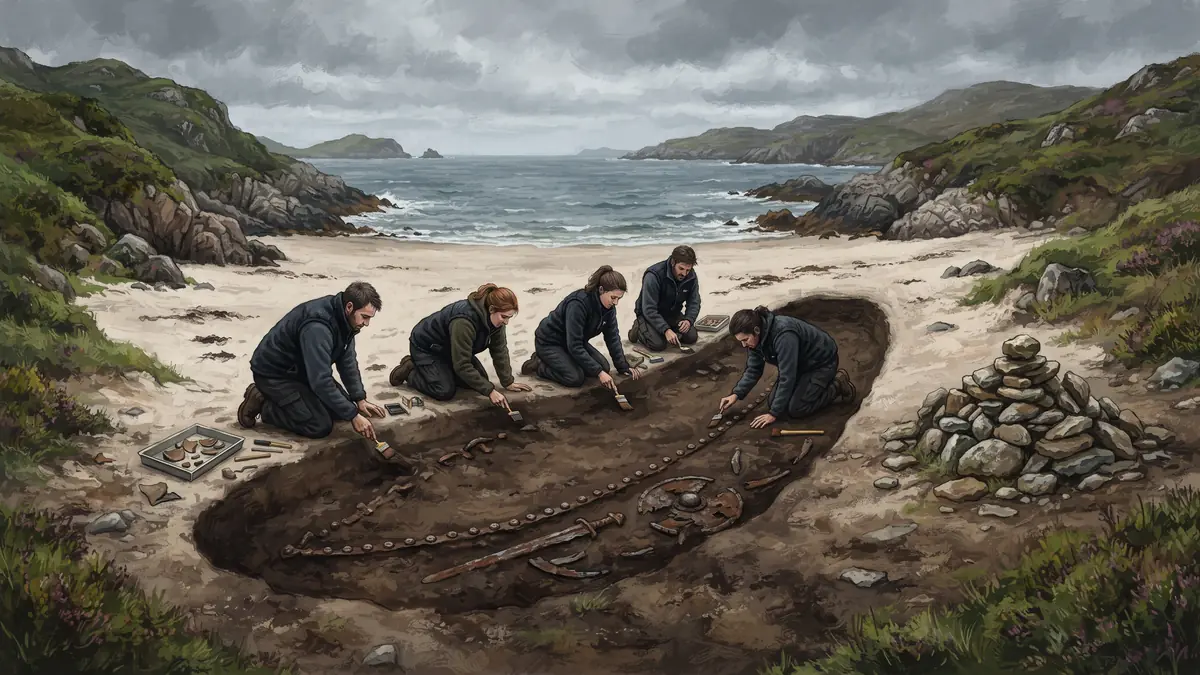
Boat burials are known in Scandinavia, but one turned up, in 2011, at a remote point on the west coast of Scotland, beside a much older site. It is the one at Ardnamurchan, and the description below comes from a news report on the study published in the journal Antiquity.
The place and the date
The grave lies at Swordle Bay, on the Ardnamurchan peninsula, in western Scotland, and was found in 2011. It belongs to the 10th century, about a thousand years before the report. The scientific lead was Oliver Harris, associate professor of archaeology at the University of Leicester, who describes the excavation as the first of an intact boat burial carried out by archaeologists in mainland Britain.
The boat
The wooden boat decayed over time, but 213 metal rivets survived. The report does not give the dimensions of the vessel.
What was buried with him
The man was buried as a “warrior of high status”. With him were a sword, with fabric remains around the blade and a decorated pommel, a broad-bladed axe, a spear, a shield with its boss and the shield box. There was also a whetstone of a rock type found in Norway, a single copper-alloy ringed pin, probably to fasten a cloak or shroud, a hammer and tongs, and items connected with daily life, cooking, farming and food production. Mineralised remains of textiles and wood were also found.
Where the man came from
Isotope analysis of his teeth suggests he grew up in Scandinavia, although he was buried far from home. The objects have Scandinavian, Scottish and Irish origins. The link with Ireland is described as a suggestion based on the objects.
One grave over another
The grave lies near a Neolithic burial cairn, and its stones may have been reused in the Viking grave.
What the set suggests
Hammer and tongs appear alongside items of cooking and farming, and the report treats everything as part of the objects of daily life, without interpreting further. The report’s photographs are credited to Pieta Greaves, of AOC Archaeology, but the text does not say clearly who carried out the excavation.
What can be said with care
The report is a journalistic summary, without the full methodology of the study. The isotopes “suggest”, not prove, a Scandinavian origin. The link between Scandinavia and Ireland is a suggestion. The reuse of the stones is a possibility (“may have”). The report mentions no comb or Frankish objects, and does not give the exact position of the body. So everything beyond this, such as the man’s name, the reason for his voyage or who buried him, remains unanswered.
To connect dots, one line at a time, closing more squares than your rival, play The dots of Swordle Bay.
Sources.
- Live Science, "Viking VIP: Grave Belonging to 'Warrior of High Status' Uncovered" (Laura Geggel, 8 February 2017)
- *Antiquity* (February 2017), study on the Ardnamurchan boat burial, according to Live Science
- Oliver Harris, University of Leicester, quoted by Live Science