Ashdown, 871: Alfred attacks uphill and defeats the Great Army
In January 871, the West Saxons faced two Viking kings and several earls on a Berkshire hill. See what Asser and the Anglo-Saxon Chronicle tell, and where the uncertain parts lie.
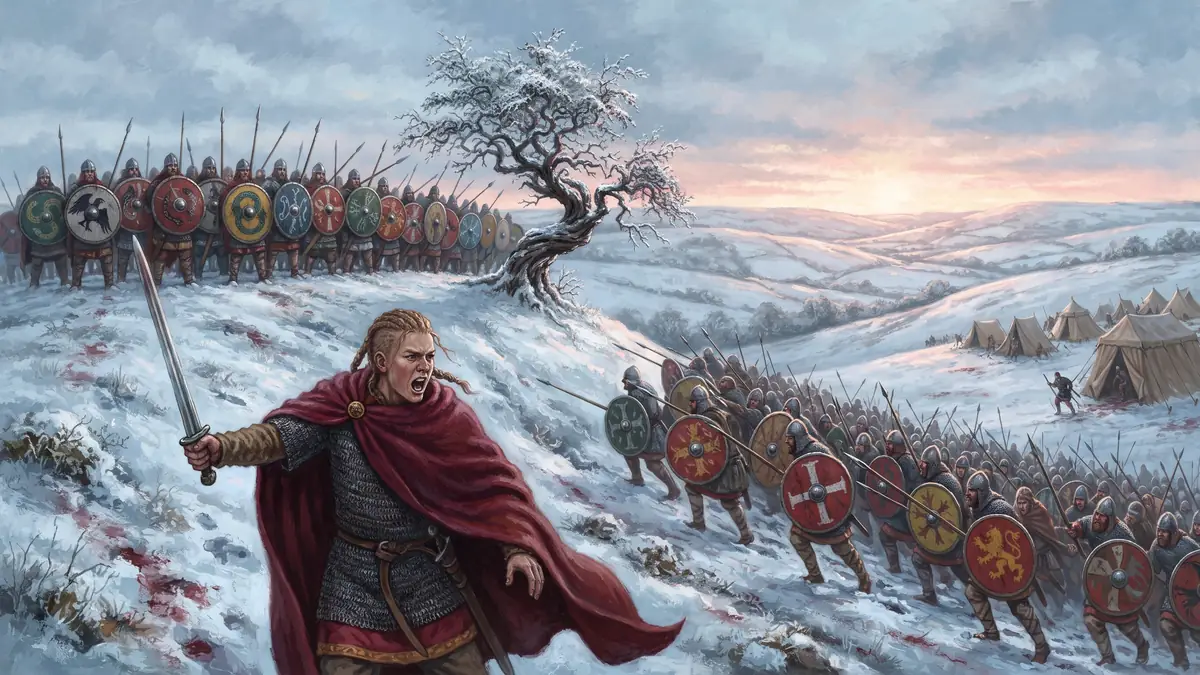
Alfred’s first great victory against the Vikings was not the one that made him famous. It was a winter battle, on a Berkshire hill, in which he was still only the king’s younger brother.
Two sources and an approximate date
The battle of Ashdown was fought around 8 January 871. The page consulted notes that the date of the Anglo-Saxon Chronicle is approximate, since it depends on a two-month interval between Basing and Meretun that is probably not exact. Bishop Heahmund of Sherborne died at Meretun on 22 March 871, and the Chronicle places Basing on 22 January and Ashdown fourteen days earlier. The sources are the Chronicle and Asser’s Life of King Alfred.
Who fought
The West Saxons were commanded by King Æthelred and his younger brother, the future Alfred the Great. On the Viking side were the kings Bagsecg and Halfdan, plus earls such as Sidroc the Old, Sidroc the Younger, Osbern, Fræna and Harold.
The day
The Vikings arrived first and deployed along a ridge top, which gave them the advantage. They split into two groups, one under the kings and one under the earls. The Saxons copied the formation: Æthelred facing the kings and Alfred facing the earls.
Æthelred withdrew to his tent to hear Mass. Alfred, fearing he would be outflanked by the whole Danish army, attacked uphill before his brother had finished his prayers. The fighting centred on a small thorn tree, and the Saxons won.
The outcome
The Danes suffered heavy losses, among them King Bagsecg and five earls. The Saxons pursued the fugitives until night. Both sources stress Alfred’s role, but the historian Richard Abels argues that Æthelred’s attack, when he joined the fight, was decisive, and that he may have planned from the start to surprise the Vikings.
Two readings
According to the page, Alfred attacked because he feared being outflanked by the whole Danish army, and both sources stress his role. Abels, by contrast, sees in Æthelred’s attack the decisive blow and allows that the king may have planned the surprise from the start. The same battle changes protagonist according to the reading, and the early sources do not allow the dispute to be settled completely.
What can be said with care
The site is uncertain. It may have been Kingstanding Hill in Berkshire, near Moulsford, or a spot near Starveall, north of Aldworth and southeast of Lowbury Hill. And the victory was short-lived: the Saxons lost at Basing and at Meretun, and, soon after Easter (15 April 871), Æthelred died and Alfred succeeded him.
To defend the hill against ranks of invaders coming down, firing from below, until you bring them all down, play The hill of Ashdown.
Sources.
- Wikipedia, "Battle of Ashdown" (date, commanders, formation, uncertainties and bibliography)
- *Anglo-Saxon Chronicle* and Asser, *Life of King Alfred* (sources cited on Wikipedia)
- Richard Abels, on the role of Æthelred (cited on Wikipedia)