Fylgja: the "follower", the spirit that accompanies a person in the sagas
In the sagas, certain spirits accompany a person in the form of an animal or a woman, warn of danger and, when someone sees them, announce death. See what the sources consulted say, and where they differ.
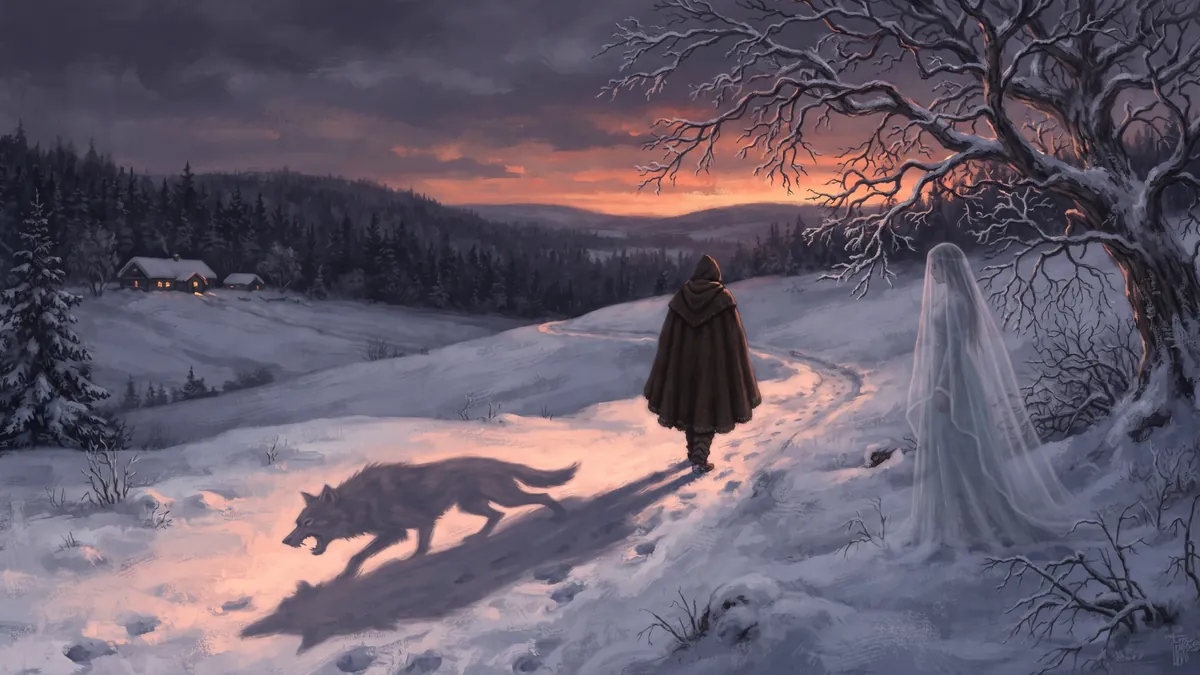
Norse culture had no systematic account of the parts of a person, but the sagas leave traces of spirits that accompany the living. The word most used for them is fylgja, “follower”, plural fylgjur.
What a fylgja is
According to Hurstwic, a fylgja is a personal guardian spirit, usually in the form of an animal, that “follows its human and prevents danger and accidents”. A fearless man might have a brave animal, such as a bear, and a fearful person a hare or a bird. The Norse-mythology.org page adds that the animal reflects the owner’s character and that it is usually seen by people with second sight. The same source notes that human forms are “not unheard-of”.
How it appears
The sources consulted describe the fylgja in ways that complement each other. It may travel ahead of its owner, arrive first at the destination or appear in a dream to someone the owner will meet the next day. It may bang on the door or the wall to warn of a friend’s arrival or an accident. Seeing one’s own fylgja is a sign that death is near. Its well-being is tied to the owner’s: if it dies, the owner dies too.
Saga examples
The 2016 mirror consulted cites, in Hárvarðar saga Ísfirðings, Atli’s dream, with eighteen wolves led by a vixen, which foretells the attack of an army with a sorcerer at the front. In Gísla saga, Gísli is visited by two women, one bringing good fortune and one pushing him toward violence; they may represent female ancestors tied to his family. These examples, at the same time, show that the reading is interpretive.
Fylgja and hamingja
The hamingja, usually translated as “luck”, is described as a quality inherent in the man and his lineage. It may pass to a descendant and, in Víga-Glúms saga (ch. 9), it passes to a relative with no naming. Scholars such as Andy Orchard and Rudolf Simek note parallels between fylgja and hamingja.
Ravens and fylgjur
Anthony Winterbourne, cited on the page about Huginn and Muninn, links Odin’s ravens to shape-shifting guardian spirits, such as the fylgjur. It is one more hypothesis, and the idea fits with the notion that the fylgja marks transformations between human and animal.
What can be said with care
The Hurstwic page does not deal with the hamingja, and the Norse-mythology.org one cites no sagas for the fylgja. The mirror consulted is from 2016 and rests on the interpretations of a few scholars. The origin of the term, which also means “afterbirth”, is described by the source as “mysterious and unclear”.
To lead an attendant spirit across the field, gathering lights that make it grow, without touching itself or the edges, play The spirit that follows.
Sources.
- Hurstwic, "Supernatural Beings" (fylgjur as guardian spirits)
- Norse-mythology.org, "The Parts of the Self" (fylgja and hamingja)
- Wikipedia (2016 mirror), "Fylgja" (forms, saga examples, scholars' hypotheses)