Örlygsstaðir, 1238: the bloodiest battle of medieval Iceland, according to the sagas
On 21 August 1238, the Sturlungs of Sighvatr and Sturla Sighvatsson faced the men of Kolbeinn ungi and Gissur Þorvaldsson. See what is known about the short battle that killed father and son.
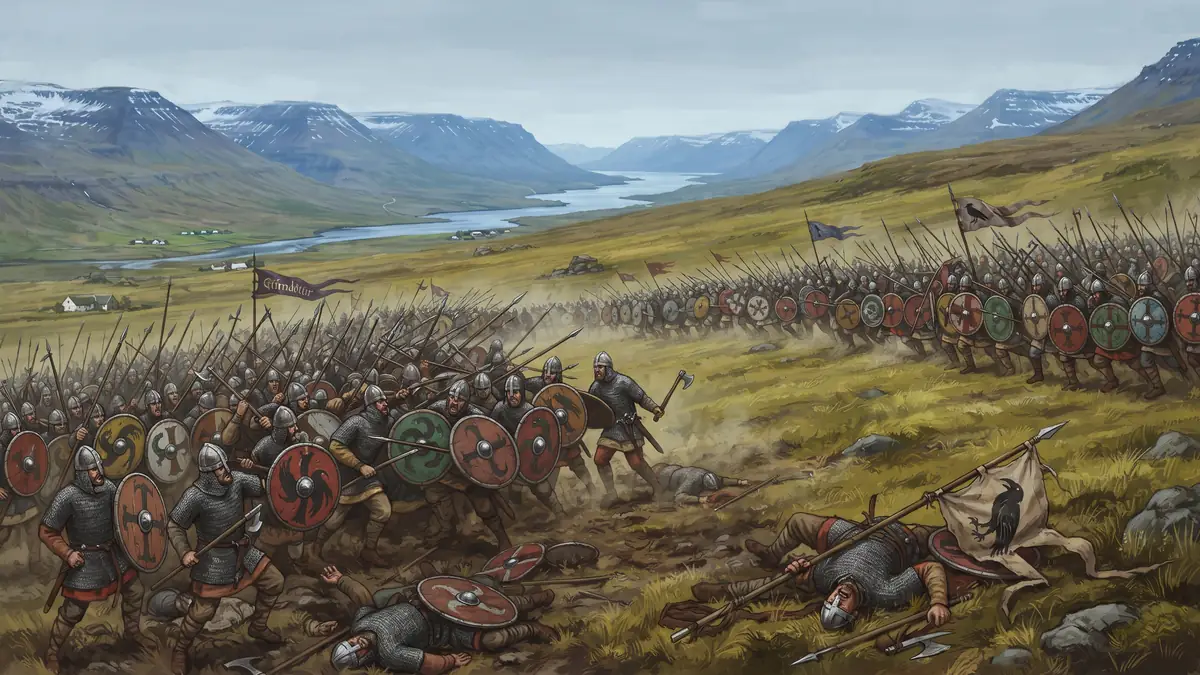
On 21 August 1238 (the traditional date), in a district of northern Iceland called Örlygsstaðir, two coalitions of Icelandic chieftains met in a short battle. It is the high point of the so-called Age of the Sturlungs, a period of conflict between great families.
The two sides
On one side were the Sturlungs, commanded by Sighvatr Sturluson and his son Sturla Sighvatsson. On the other, the Ásbirningar and the Haukdælir, under Kolbeinn ungi Arnórsson and Gissur Þorvaldsson (later Earl Gissur). The page consulted notes that Sverrir Jakobsson considers “clan” an inexact term for the Sturlungs.
The numbers
Historians estimate that the Sturlungs numbered about a thousand men, of whom Sighvatr had nearly five hundred. Sturla’s following is unknown. The other side is put at about 1,700. This is an estimate, and the page itself lists the losses as unknown in its infobox. The gap between a thousand and 1,700 men is large, but the page does not allow us to say how it weighed on the outcome of the fight.
The battle
The page says the Ásbirningar and the Haukdælir emerged victorious “after a short battle”. About sixty men were killed, among them Sighvatr and Sturla. The page does not say how many belonged to each side, but according to the saga Gissur lost seven men and Kolbeinn none. After the fight, five others, among them Þórir Jökull Steinfinnsson, were beheaded.
How it is known
The names of the dead are recorded in the Íslendinga saga, part of the Sturlunga saga. The page consulted does not say who wrote it. Modern works cited include those by Gunnar Karlsson (2000), Jón Viðar Sigurðsson (1999) and Sverrir Jakobsson (2016). In 1988 a memorial describing the battle was erected on the site.
The place and the memory
The page places the field at Örlygsstaðir, in northern Iceland, and records that a memorial was erected there in 1988. The date of 21 August 1238 is given as traditional, a reminder that the sagas and later tradition fixed the day, and that the modern reader should treat it with the caution due to any date handed down by narrative. The victory of the Ásbirningar and the Haukdælir, on this reading, was “short” because the decisive clash lasted little, not because the conflict ended there.
What can be said with care
The page does not deal with Hálfdan Sæmundsson, with Þórðr kakali, or with the role of the Norwegian king Hákon, nor with the end of the Icelandic Commonwealth. These points are therefore not asserted here. What the source supports is the essential: a traditional date, two blocs of chieftains, a short battle, about sixty dead and the death of father and son on the defeated side.
To line up four pieces, in a row, column or diagonal, against a rival, before he does, play The field of Örlygsstaðir.
Sources.
- Wikipedia, "Battle of Örlygsstaðir" (date, commanders, forces, casualties and sources)
- *Íslendinga saga*, part of the *Sturlunga saga* (list of the dead), according to Wikipedia
- Sverrir Jakobsson (2016), Gunnar Karlsson (2000) and Jón Viðar Sigurðsson (1999), cited on Wikipedia