Spillings: the 67-kilo silver hoard found on Gotland during a film shoot
In 1999, archaeologists found under the floor of a Viking outbuilding on Gotland more than 14,000 coins and nearly 500 silver arm rings. See what the find contains, its date and why it matters.
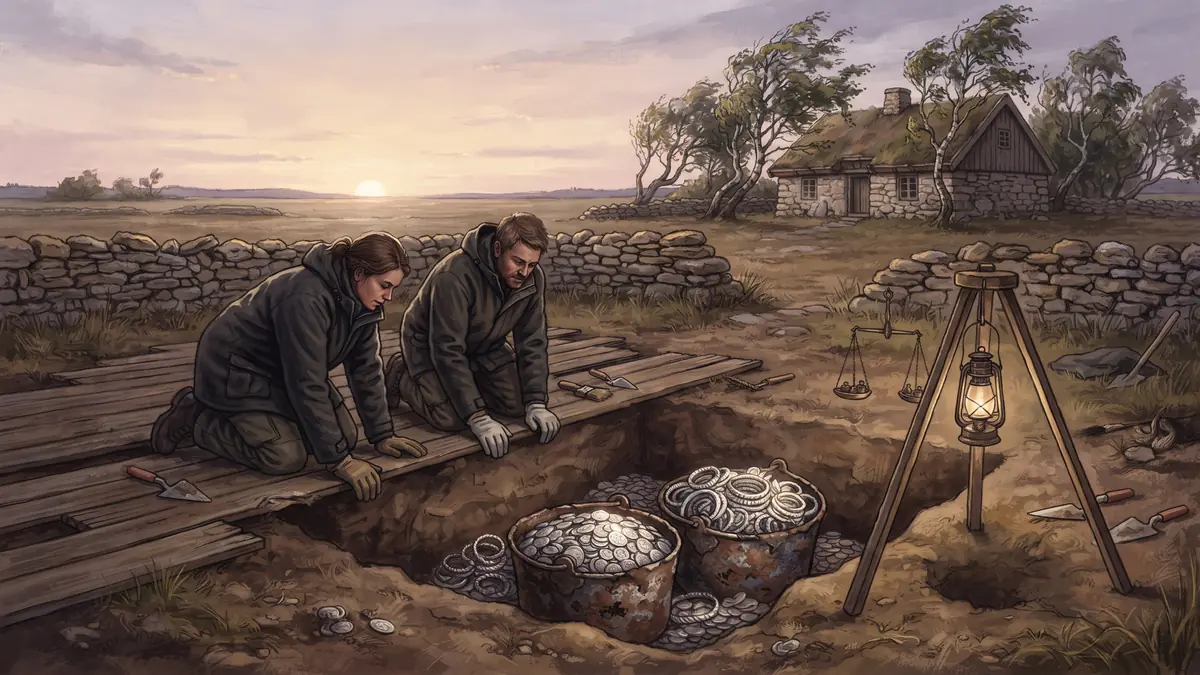
On 16 July 1999, a Friday, the largest Viking Age silver treasure ever found came out of the soil of a field on the island of Gotland, in Sweden. According to the source consulted, the find happened at the farm of Spilling, northwest of Slite, in Othem parish, during the filming of a TV report on looting. After the film crew left, the archaeologist Jonas Ström and the landowner Björn Engström kept on surveying, with Professor of numismatics Kenneth Jonsson.
The find
The first cache turned up about 20 minutes after filming ended. A second lay about 3 metres away, and a third, of bronze, about 1.5 metres from the first. The bronze was only excavated almost a year later. The two silver caches weighed 67 kilos before conservation, 40 kilos the larger and 27 the smaller, and the bronze one held more than 20 kilos of scrap, partly melted into a “cake” about 40 cm across.
What was in it
The hoard held 14,295 coins. The source counts 14,200 Islamic dirhams, 23 Persian, 4 Nordic, from Hedeby, and 1 Byzantine; those figures add up to 14,228, and the source does not explain the difference of 67. Sixty-nine minting places in 15 present-day countries were identified. A Khazar coin from about 800, the “Moses Coin”, bears the inscription “Moses is the messenger of God” in place of the usual Muslim text.
Almost 60% of the find was 486 arm rings or parts of arm rings, the largest silver jewellery find of its kind as of 2015. Most weighed about 100 grams, in the system where 200 grams make a mark, and many were of Gotlandic design, besides British and western Scandinavian pieces and Finnish and British ring money. There were also bars, thread and cut silver.
The date
The hoard was buried after 870–871: the latest coin is from 870, and the earliest, a Persian one, from 539. Carbon dating of the building indicates use between 540 and 1040. The bronze chest, from about 675, is older than what was inside it, and the bronze objects span two to three hundred years, mostly of Baltic origin.
The place
The silver was hidden under the wooden floor of a Viking Age outbuilding of about 10 by 15 metres, probably a warehouse, with no hearth, so not a dwelling. The site was inhabited continuously for more than a thousand years, until the nineteenth century, and yielded more than 700 other objects.
Why it matters
The article describes it as the largest Viking silver treasure in the world. The finder’s reward, 2,091,672 Swedish crowns, was the largest ever paid in Sweden, and the silver would have covered, for five years, the tax of the whole of Gotland to the Swedish king. The nearness of major harbours may explain the scale. The hoard is on permanent display at the Gotland Museum.
What can be said with care
Who buried the silver and why they never came back for it is something the source does not answer. What the find shows, in numbers and coins, is how silver from the Islamic world reached the Baltic.
To add coins until you get as close as possible to 21, without going over, play Spillings’ coins.
Sources.
- Wikipedia, "Spillings Hoard" (discovery, weight, coins, arm rings, dating, farm context)