Víðarr: the silent god, the thick shoe and the end of the wolf Fenrir
At Ragnarök, Odin's quiet son steps on Fenrir's jaw with a shoe made of leather scraps. See what each source says about Víðarr's vengeance, and what the Gosforth cross may show.
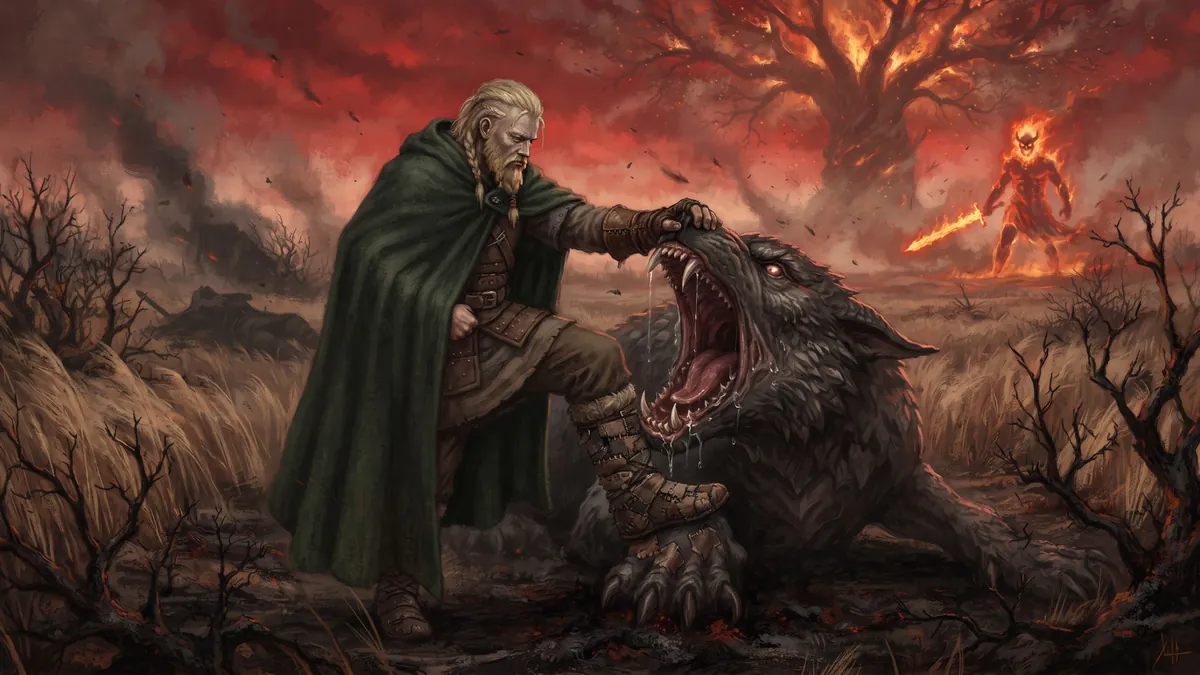
Among the gods who survive the end of the world, one hardly speaks. Víðarr, son of Odin and the giantess Gríðr, is the god of vengeance, and what the sources tell of him fits in one scene: the wolf Fenrir devours Odin, and Víðarr kills him.
What the sources say
According to the source consulted, the Poetic Edda gives three clues. In Völuspá (stanzas 54 and 55), the seeress says Víðarr will avenge Odin by thrusting his sword into Fenrir’s heart. In Vafþrúðnismál (stanzas 51 and 53), it is said he will sunder the wolf’s jaws and that he and his brother Váli will live in the gods’ temples after Surtr’s fire. In Grímnismál (stanza 17), Odin describes his dwelling, a land of brushwood and tall grass, and says he is eager to avenge his father. In Lokasenna (stanza 10), Odin tells him to pour a drink for Loki.
Snorri’s Prose Edda, for its part, calls him the “silent god” in Gylfaginning (ch. 29): he has a thick shoe, is nearly as strong as Thor, and the gods rely on him in great difficulties. In ch. 51, after Fenrir swallows Odin, Víðarr steps on the wolf’s lower jaw, grips the upper one and tears his mouth apart.
The shoe
The shoe is made, says Snorri, of the leather scraps people cut from the toes and heels of their shoes. Whoever wants to help the gods should throw these scraps away. The article records that some mythologists see the shoe as protection against fire, designed by his mother Gríðr, like the iron gauntlet she gave Thor against the giant Geirröd.
After the end
According to Gylfaginning, Víðarr and Váli survive the rising sea and Surtr’s fire and come to live at Iðavöllr, where Asgard stood. In Skáldskaparmál, Snorri places him among the gods at Ægir’s banquet and, in a euhemerised reading, identifies Víðarr with Aeneas, the Trojan hero.
The Gosforth Cross
The Gosforth Cross, in Cumbria, dates from the eleventh century and mixes scenes of the Christian Last Judgement with images of Ragnarök. A figure of a man with a spear, one foot on the tongue and lower jaw of a beast and a hand on the upper one, is read as Víðarr against Fenrir. The article notes that another reading sees Jesus defeating Satan.
Why he is silent
There is more than one theory. One ties the silence to abstentions linked to vengeance, like that of Váli in Baldrs draumar, who neither washes nor combs until he has brought Baldr’s killer to the pyre, and compares it with Tacitus, who speaks of the Chatti going unshaven and uncut until they had killed an enemy. Dumézil sees him as a god tied to space: foot and hand span the vertical axis, and the wide step and the shoe, the horizontal. The article presents all of this as hypotheses.
What can be said with care
The sources do not agree on how Fenrir dies: heart pierced, in the Völuspá poem, and jaw torn apart, in Vafþrúðnismál and Snorri. What they all say is that Víðarr kills him to avenge Odin and that, after the end, he lives.
To stop the marker at the right point five times and force the jaw apart before you miss three, play Víðarr’s shoe.
Sources.
- Wikipedia, "Víðarr" (Poetic Edda, Prose Edda, Gosforth Cross and theories)
- *Völuspá*, *Vafþrúðnismál* and *Grímnismál*, in the Poetic Edda, as reported by Wikipedia
- *Gylfaginning* (chs. 29 and 51) and *Skáldskaparmál*, by Snorri Sturluson, as reported by Wikipedia