The Áhkká: the Sámi goddess of birth and the three daughters who guarded the fire, the door and the bow
For the Sámi, Máttaráhkká and her three daughters, Sáráhkká, Juoksáhkká and Uksáhkká, looked after birth: the fire, the bow and the door of the tent. See what the source consulted gathers on each one, the offerings, the naming rite and what remains in doubt.
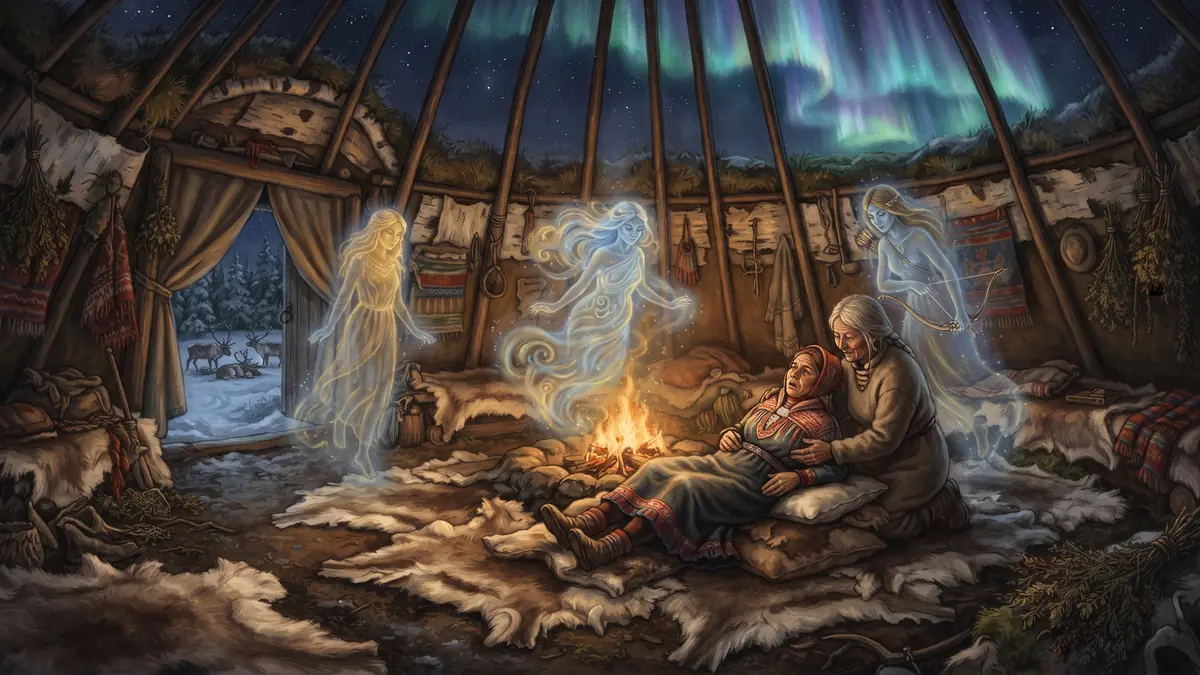
In the traditional religion of the Sámi, the birth of a child was looked after by four female figures called Áhkká, “grandmother” or “woman”. According to the source consulted, the eldest was Máttaráhkká, “origin woman”, who lives under the goahti, the tent, and has charge of childbirth and fertility. Drinks were offered to her.
The three daughters
In western Sápmi, Máttaráhkká had three daughters: Sáráhkká, Juoksáhkká and Uksáhkká. They are not known in eastern Sápmi, and some researchers see in them a later Scandinavian influence. According to Ganander, in 1789, the god Radien-attje gives the child to Máttaráhkká, who gives it life and hands it to Sáráhkká, who places it in the woman’s womb. In Christian sources, Máttaráhkká was equated with the Virgin Mary, and a husband, Máttaráhttje, may be a late addition. Krohn argued she might be an ancestor, linked to Kola.
Sáráhkká, the fire
Sáráhkká is the most important and most worshipped of the childbirth goddesses. She protects women and reindeer in labour and was also worshipped during menstruation. Before the birth, “Sáráhkká’s booze” was offered, and afterwards “Sáráhkká’s porridge”. To ease the birth, wood was split, and some women buried a dog alive. After the birth, a female domestic animal was sacrificed. The offerings usually went into the fire, below which she lives. The naming rite, laugo, gave the baby the name of an ancestor and dedicated it to her. One proposed explanation of the name links it to the verb sárrit, “to split”. Today there is a Sámi women’s organisation called The Sarahkka, from 1988.
Juoksáhkká, the bow
Juoksáhkká has a bow, could change the fetus from girl to boy and protects children from shots and from falls. A small bow was put in Sáráhkká’s porridge, and a bow was kept by the cradle of boys. The offerings were abundant because sons were preferred. According to Holmberg, she is distinct from Uksáhkká, perhaps of foreign influence, and some say they are the same.
Uksáhkká, the door
Uksáhkká, “door woman”, lives under the door of the goahti, protects stepping in and out, receives the child, protects it as it learns to walk and keeps it from getting lost. Drinks were poured out for her under the door. Holmberg compares her to the Swedish dörrkäring.
What remains uncertain
Ganander blurs the daughters’ roles, and different sources disagree on whether Juoksáhkká and Uksáhkká are the same. Nor is it known how much of this system is old and how much comes from contact with other peoples, and the sources, as summarised in the articles, do not settle the matter.
To tap in time with the drum, at the instant the ring reaches the centre, play The Áhkká’s drum.
Sources.
- Wikipedia, "Máttaráhkká" (name, daughters, Ganander 1789, Virgin Mary, Krohn)
- Wikipedia, "Sáráhkká" (childbirth, offerings, laugo, fire, The Sarahkka organisation)
- Wikipedia, "Juoksáhkká" and "Uksáhkká" (bow, door)