Jarlshof in Shetland: four thousand years of stacked houses and a Norse longhouse
At Jarlshof, in southern Shetland, a storm exposed layers of occupation from the Bronze Age to the Middle Ages. See what the source consulted gathers on the Norse longhouse, the loom weights, the stone drawings of ships and the name invented by Walter Scott.
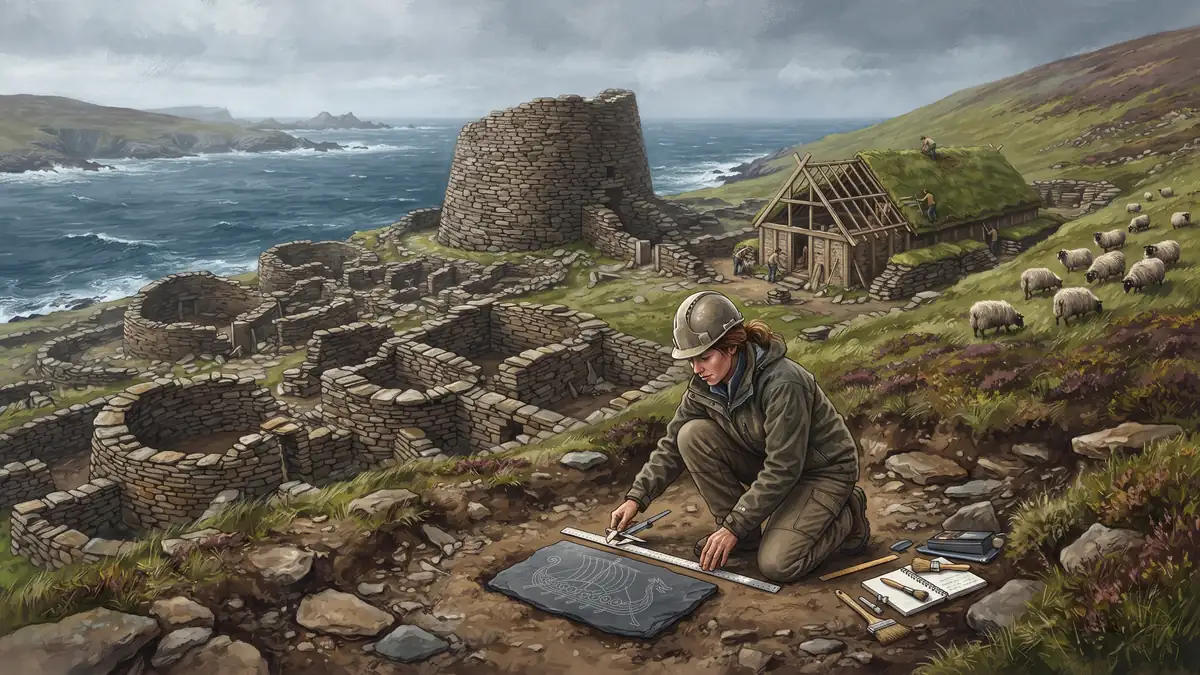
Jarlshof lies at the southern tip of the Shetland Mainland, near Sumburgh Head. According to the source consulted, it is one of the most important archaeological sites in Scotland, because it brings together four thousand years of human occupation, one on top of another. The storm that revealed it happened in the late nineteenth century, and formal excavation began in 1925.
Layers of time
The earliest occupation is from the Bronze Age, from about 2500 BC: oval houses, a smithy and a bone plaque whose function is unknown. After that came an Iron Age round tower, a broch at least 13 metres across, and wheelhouses, around 200 BC. From the Pictish period there is a bone pin from AD 500 to 800, a painted pebble and one of the two Pictish symbol stones in Shetland.
The Norse settlement
From the ninth to the fourteenth century there was Norse occupation, with seven houses, at most two at a time, the largest 20 by 5 metres. In the 1930s, Alex Curle’s excavation found the first confirmed Norse longhouse in the British Isles. About 150 loom weights were found, iron tools made from bog iron, and a gilded bronze harness mount from Ireland of the eighth or ninth century. Slate drawings of dragon-prowed ships also turned up. The diet included cod, saithe, ling, cattle, sheep and seals.
From name to fame
The name Jarlshof, “the earl’s house”, was coined by Walter Scott, who visited the site in 1814 and used the name in The Pirate, of 1821. There is no known earl there. In the Middle Ages, a farm was fortified in the sixteenth century by Robert Stewart, Earl of Orkney, and his son Patrick renamed it, in the early seventeenth century, the Old House of Sumburgh. It was abandoned in the late seventeenth century.
Today
Jarlshof has been on the tentative World Heritage list since 2012, in a group called “Zenith of Iron Age Shetland”, with Mousa and Old Scatness. There has been no excavation since the early 1950s.
How to read the layers
Each age built on the remains of the one before, and that is what gives Jarlshof its layered reading: the archaeologist descends from the medieval floor to the Bronze Age floor, passing the Picts and the Norse. The finds of the Norse period, loom weights, bog iron, fish and meat from herds, show a life of farming and fishing. A piece of slate with a ship drawn on it is a reminder that these people also saw themselves as seafarers.
What remains uncertain
The article leaves open the interpretation of one structure as a sauna, and the ship drawings on slate may be older than the Norse. Coastal erosion also threatens the site, but the extent of the risk is not detailed.
To stack sliding blocks, dropping each at the right moment, until a tall tower is formed, play The tower of Jarlshof.
Sources.
- Wikipedia, "Jarlshof" (Shetland, layers, 1925 excavations and Alex Curle, Norse settlement, finds, Walter Scott's name, provisional World Heritage)