The Scandinavian Yule goat: from the last sheaf of grain to the great straw goat
The julbock, the Yule goat, appears in Scandinavia as a sheaf of straw, a masked figure and later a giver of gifts to children. See what the source consulted says about the origin, what is only theory and today's straw goats.
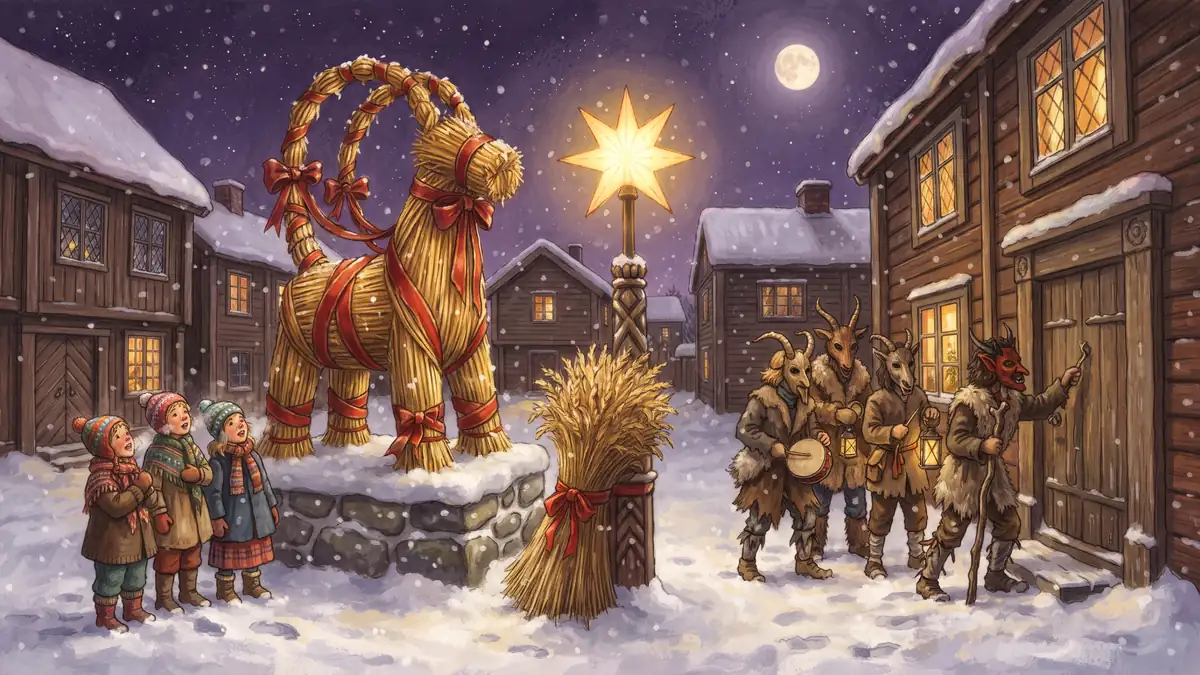
The Yule goat, julbock in Swedish, is one of the year-end symbols of Scandinavia. According to the source consulted, its origin “may be” pagan Germanic, but there is no evidence of that. It is a figure that has changed a great deal over the centuries.
The Thor theory
The most popular theory ties the Yule goat to Thor’s goats, Tanngrisnir and Tanngnjóstr, which pulled the god’s chariot. The article treats that as speculation, without proof. What exists is a tradition of saving the last sheaf of the harvest for Yule, called the Julbocken, but with no known date.
The oldest dated figure
The first dated item is an eleventh-century reference to a man-sized goat figure, at Childermas, led by a man dressed as St Nicholas. That is already Christian, and does not prove a pagan link.
The goat that demanded gifts
In the seventeenth century, in Scandinavia, the goat was a rowdy and demanding character: young men dressed as goats, at Christmas or Epiphany, went from house to house asking for gifts, as in English wassailing. There was also the idea of an invisible goat, a Yule spirit, that checked whether the preparations were in order.
The goat that gave gifts
In the nineteenth century, the goat became a gift-giver: a family member dressed as a goat and handed out the presents. Later it was replaced by the Swedish jultomte and the Norwegian julenisse. In Finland, the Joulupukki, “Yule goat”, remains the name of Santa Claus.
Straw goats
Today, straw goats with red ribbons are a common Christmas decoration. There is a prank of leaving a straw goat in a neighbour’s house. The large straw goats, according to the article, “started with the Gävle goat in the 1960s”. The article does not give the exact year. These goats show how a tradition, old or only imagined as old, renews itself in every generation with new materials and new uses, from a family prank to a town landmark.
Documented and theoretical
What the article documents is a sequence: a goat figure of the eleventh century tied to Childermas, a rowdy goat that asked for gifts in the seventeenth century, and a goat that gave gifts in the nineteenth. What is theory is the link with Thor and the pagan origin. Keeping the two apart helps avoid repeating as fact what are only popular hypotheses, and shows that today’s goat is the result of centuries of change.
What remains uncertain
The pagan origin is not proven, and the link with Thor is only a guess. Nor is it known when the harvest sheaf took the name Julbocken.
To discover a code of straw colours, with clues after each attempt, play The straw goat code.
Sources.
- Wikipedia, "Yule goat" (origin, Thor theory, harvest sheaf, eleventh-century figure, goat that demanded gifts, goat that gave gifts, straw goats, Gävle)