The Mästermyr chest: more than two hundred tools of a Viking craftsman found in a Gotland mire
In 1936 a Gotland farmer ploughed a field and struck an oak chest wrapped in chains. Inside were more than 200 tools, the largest Viking Age tool find in Europe. See what is known and what nobody knows.
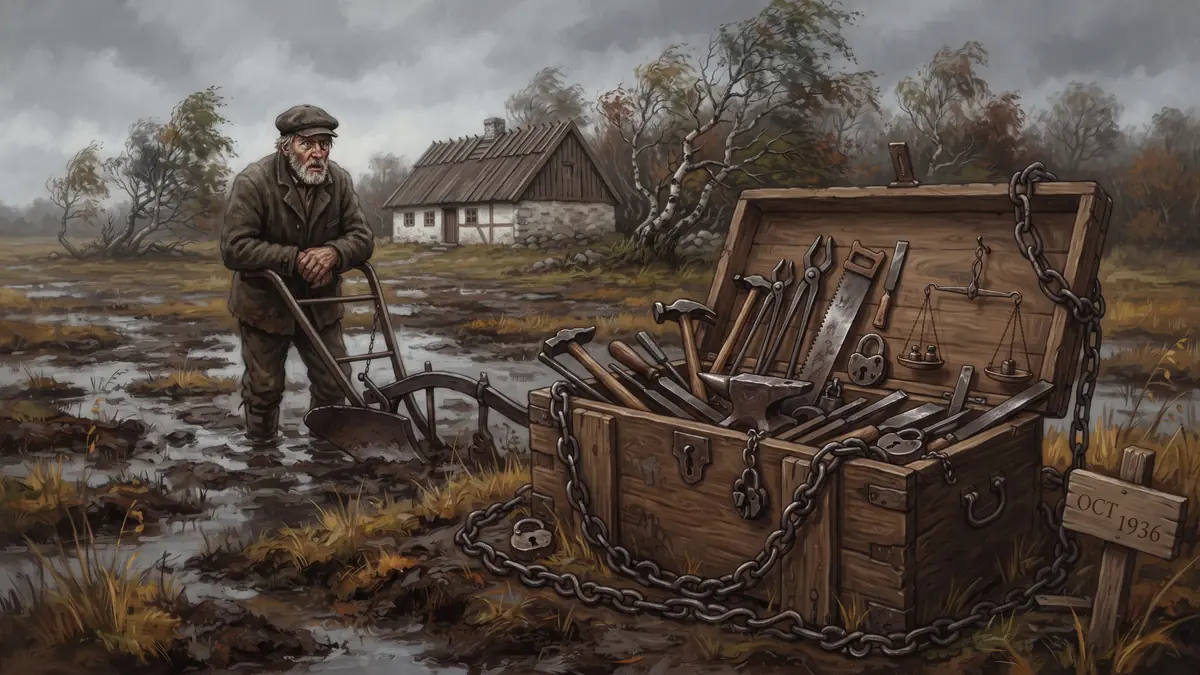
In October 1936, the farmer Hugo Kraft ploughed for the first time a field belonging to Emil Norrby, at Snoder, in Sproge parish, near Hemse, on Gotland, and struck a hard object. It was an oak chest. According to the source consulted, it was the largest Viking Age tool find in Europe, with more than 200 pieces.
The mire
The field is what is left of a lake of Viking times, the Mästermyr, drained between 1902 and 1910. The chest was bound by a chain of 26 figure-of-eight links, and nearby were three bronze cauldrons, three bells and an iron fire-grid. The oak chest measures 90 by 26 by 24 centimetres and was made with mortise-and-tenon joints.
What was inside
The list is that of a complete workshop: three padlocks and two keys, three sledgehammers, tongs, snips, anvils, nail-making tools, axes, a broadaxe, an adze, saws, augers, chisels, files, knives, sharpening stones, a steelyard balance, clamps, rasps and drawknives. The padlocks resemble Roman models and match types found at Birka. The set serves a smith and a carpenter.
When and whose
There were no coins, and so there is no exact date. The estimate hovers around the year 1000. The owner was probably a smith and carpenter, perhaps a travelling craftsman, but that is inference from the contents, not something the chest says. The find is in the Swedish History Museum, in Stockholm, and the standard studies are by Arwidsson and Berg, of 1983 and 1999.
How it got there
There are two explanations. In one, the chest sank with a boat crossing the lake. In the other, someone hid it in the water on purpose. The article does not choose between the two.
What they were for
The tools tell the trade: sledgehammers and tongs are for the forge, augers, adzes and drawknives for carpentry, the steelyard is for weighing, and the padlocks and keys guarded something valuable. The mix shows someone who made and mended everything, from iron point to wooden handle. Because it is a closed set, the chest lets us see what a complete workshop needed in that age, something the loose pieces of an excavation rarely show.
What remains uncertain
It is not known who the owner was, why the chest ended up in the water, or whether anyone came back for it. Nor is it known whether the whole set belonged to the same craftsman. The absence of coins and of writing prevents going beyond hypothesis, and any story about the owner stays a guess until something new turns up.
To move a stack of tools of different sizes between three pegs, one at a time, never putting the largest on a smaller one, play The Mästermyr tools.
Sources.
- Wikipedia, "Mästermyr chest" (discovery in 1936, chest, chains, cauldrons, tools, dating, probable owner, deposit hypotheses)