Olaf Tryggvason: the king of Norway who imposed Christianity and vanished at Svolder
Olaf Tryggvason ruled Norway from 995 to 1000, converted the country by force and died, or vanished, at the battle of Svolder. See what the source consulted gathers on his childhood as a slave, the raids on England and the late sources.
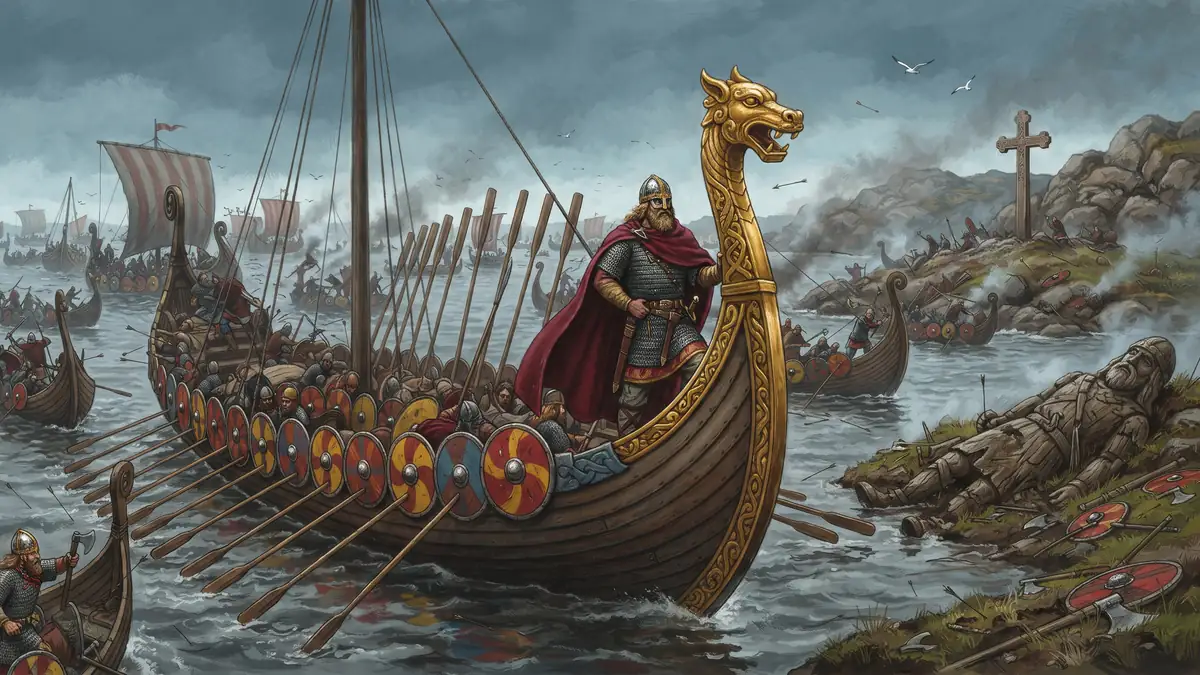
Olaf Tryggvason was king of Norway from 995 until September of the year 1000. According to the source consulted, he was born in the 960s, and the proposed dates run from 964 to 969. The sources that tell his life were written long after him, and modern historians do not assume they are accurate.
Origin and childhood
He was the son of Tryggvi Olafsson, a chieftain in Viken, and of Astrid Eiriksdottir, and was said to be a great-grandson of Harald Fairhair, which is doubtful. His father was reportedly murdered in 963. The Historia Norwegiae says Olaf was born in Orkney, the Heimskringla on an islet in the lake Fjærlandsvatnet. His mother fled to Sweden and then to Gardarike, Kievan Rus. On the way, Estonian vikings captured him and enslaved him. An uncle, Sigurd Eiriksson, bought him back, and Olaf grew up in Novgorod, at the court of Vladimir the Great. The Heimskringla says he killed a man named Klerkon there.
Raids and baptism
Around 982, a storm took him to Wendland, where he married Geira. After that he raided from Friesland to the Hebrides. There are several versions of his baptism: a seer on the Isles of Scilly, perhaps near St Lide, or Bishop Ælfheah, near Andover, in 994. According to Leyser, the confirmation was tied to a Danegeld treaty. In 991 he was a commander in an attack that harried Ipswich and won at Maldon.
The king
Earl Haakon of Lade, who ruled Norway, sent Thorer Klakka to Ireland against Olaf, but was killed by his slave Kark, whom Olaf had executed. By 997 the seat of government was at Trondheim. The Christianisation was forced: there was exile, hostages, mutilation, torture and execution, and temples were destroyed. Thorlief the Wise and Raud the Strong are named opponents. Olaf also baptised Leif Ericson. He had the wives Geira, Gyda of Dublin and Tyra, sister of Sweyn Forkbeard, and the story of the glove of Sigrid the Haughty may be apocryphal.
Svolder
On 9 September of the year 1000, Olaf faced, at Svolder, Danes, Swedes, Wends and the Jarls of Lade. His flagship was the Ormrinn Langi, the “Long Serpent”. Adam of Bremen and Saxo say he jumped overboard, while the Ágrip speaks of a flash of light, and there are versions in which he swam ashore or was rescued by a Wendish ship. Sources report sightings of him in Rome and Jerusalem until the 1040s. There is only one coin type of his, four specimens, imitating the Crux coin of Æthelred. The legend that he ran across the oars does not appear in the article consulted.
What remains uncertain
His birth date is not known for certain, nor where he was born, nor how he was baptised. Nor is it known how he died. The earliest accounts, such as Adam of Bremen’s, date from about 1070, and the Heimskringla from about 1230.
To cross a row of oars that rise and fall, at the right moment, without falling in the water, play Olaf’s oars.
Sources.
- Wikipedia, "Olaf Tryggvason" (origin, childhood, England, baptism, reign 995–1000, Christianisation, Svolder, sources)