Bragi, the god of poetry: what the Eddas and the court poems say about him
Bragi is the god of poetry in Norse mythology, husband of Iðunn. See what the source consulted gathers on the sources, the historical poet Bragi Boddason, the runes on the god's tongue and what remains in doubt.
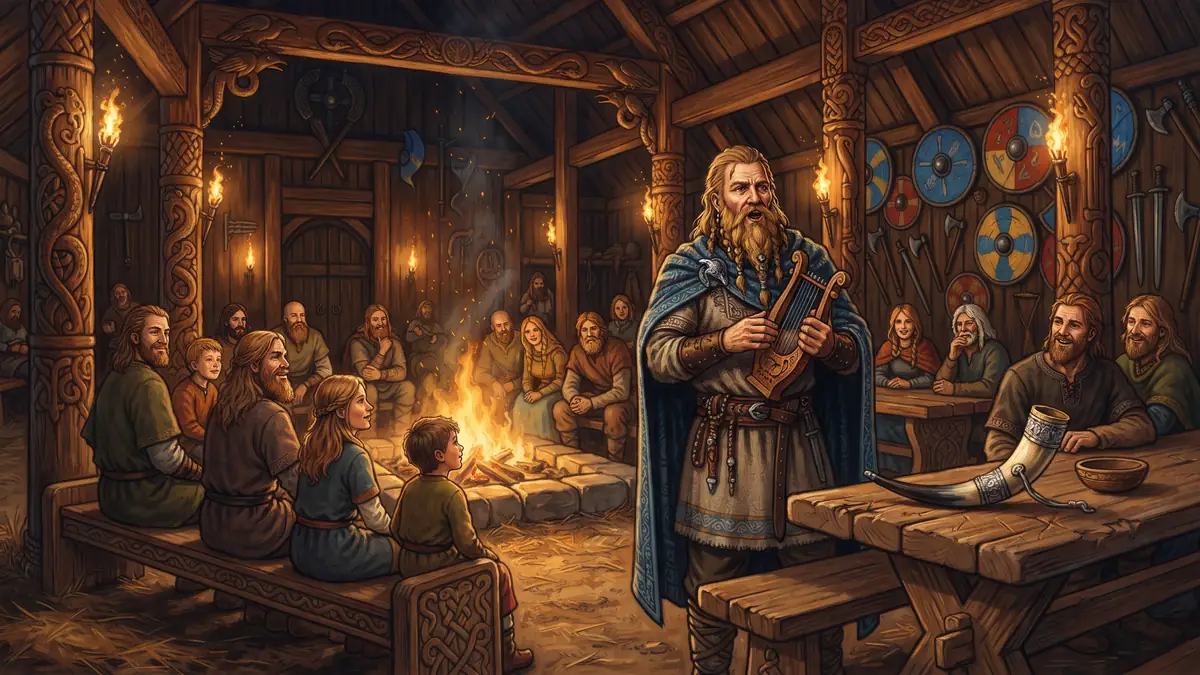
Bragi is a figure of Norse mythology tied to poetry. According to the source consulted, Snorri Sturluson’s Prose Edda presents him as a god of poetry, known for wisdom and eloquence among the Æsir, and says that poetry is named after him.
What the sources say
In Snorri, both the Gylfaginning and the Skáldskaparmál describe him as Iðunn’s husband, and the second calls him the first maker of poetry. In the Poetic Edda he appears little. The Grímnismál calls him the most pre-eminent of poets, but it is not clear whether it speaks of the god or of the historical poet. In the Lokasenna, Bragi trades insults with Loki at Ægir’s feast, and Iðunn defends him. Grettis saga also treats him as Iðunn’s husband. The poem Höfuðlausn, by Egill Skallagrímsson, alludes to Bragi and Odin’s eye, but the authorship of that verse is disputed, and there Bragi may simply be another name for Odin.
Runes on the tongue
In the Sigrdrífumál, runes are carved on many things, among them Bragi’s tongue. The article says the meaning of the passage remains obscure, so the game of this batch uses the image without claiming to explain it.
Welcoming dead kings
In the court poems Eiríksmál and Hákonarmál, both of the tenth century, Bragi welcomes dead kings to Valhalla. In Hákonarmál, Odin sends Hermóðr and Bragi to greet Hákon the Good. In Eiríksmál, Bragi asks how Odin knows that the arrival is Eiríkr Bloodaxe.
The man of flesh and blood
There was also a Bragi Boddason, a Norwegian poet of the ninth century, traditionally remembered as the first skald. Snorri quotes his Ragnarsdrápa, which describes images on a shield given by Ragnar. Most scholars think the god grew out of the poet’s posthumous elevation, but the article treats this as the current view, not as settled fact. The dates proposed for that passage vary: Eugen Mogk speaks of the late ninth century, Heinz Klingenberg and Margaret Clunies Ross of the late tenth, and others doubt it happened in the last pagan decades.
The name
The name is usually linked to Old Norse bragr, which may mean “poetry” or “the first, the noblest”. Snorri went the other way and derived “poetry” from the god’s name, which Rudolf Simek considers secondary. The bragarfull, a cup used for oaths, would come from the same word.
What remains uncertain
Klingenberg noted that Bragi is securely attested as a god only in sources after paganism. Jan de Vries saw in him the poetry of praise, regulated and life-affirming, and linked him, through Iðunn, to fertility cults, which Klingenberg found speculative. In other words, the god may always have been a man remembered in verse.
To read runes on a grid, on a god’s tongue, play Bragi’s runes.
Sources.
- Wikipedia, "Bragi" (Eddic and skaldic sources, Bragi Boddason, etymology, scholars' interpretations)