The jötnar, the giants of Norse mythology: kin and rivals of the gods
The jötnar are the beings translated as giants in Norse mythology, and several gods descend from them or married them. See what the list consulted gathers on Bestla, Fárbauti, Jörð, Skaði, Gerðr, Mímir, Hrungnir and others.
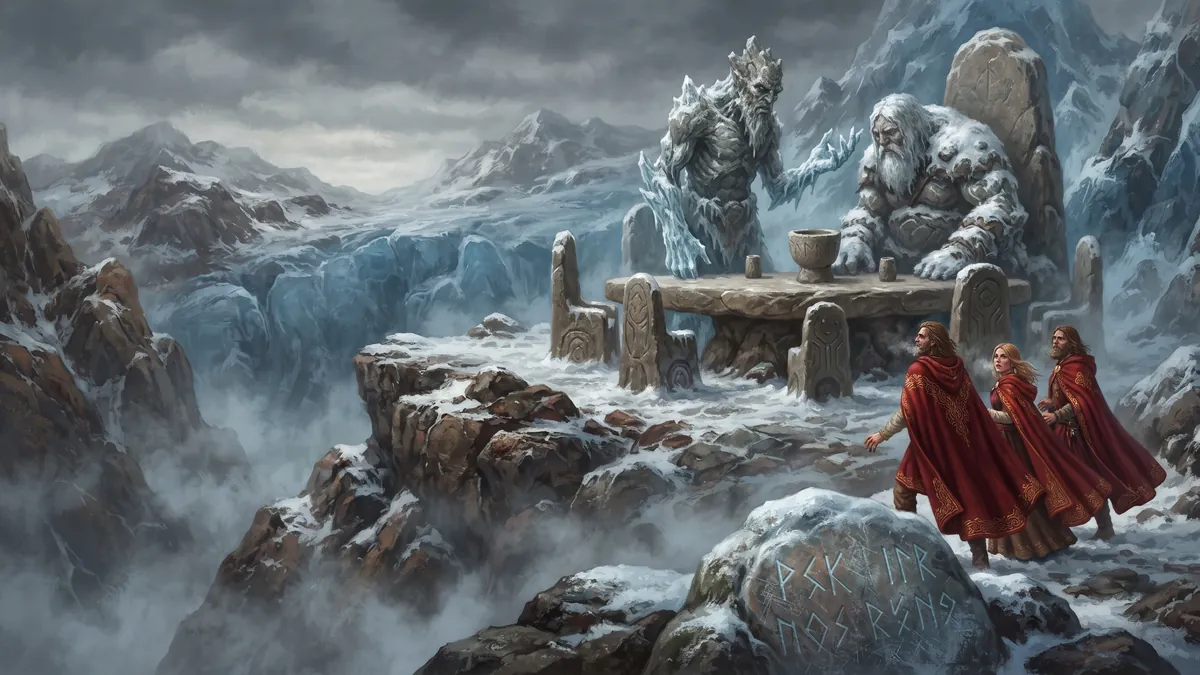
The list of jötnar consulted opens by saying that jötnar and gýgjar are often glossed as giants and giantesses. Many are known only from name lists made for skalds in the Middle Ages, and are included “for the purpose of completeness”. That already warns of something: what is known of them is uneven, and the image of a single people of giants is a simplification.
Kin of the gods
What stands out in the list are the family ties. Bestla, daughter of Bölþorn and sister of Mímir, is the wife of Borr and mother of Odin, Vili and Vé, according to the Hávamál and the Gylfaginning. Fárbauti, husband of Laufey, is father of Býleistr, Helblindi and Loki, according to the Gylfaginning and the Skáldskaparmál. Jörð, whose name means “Earth”, is Odin’s partner and mother of Thor and Meili, and also appears as Fjörgyn and Hlóðyn.
Marriages
Skaði, daughter of Þjazi, is the wife of Njörðr, according to the Grímnismál, the Gylfaginning and the Skáldskaparmál. Gerðr, daughter of Gymir and Aurboða and sister of Beli, is the wife of Freyr and mother of Fjölnir, according to the Gylfaginning, the Skírnismál and the Lokasenna.
Names that remained
Mímir, son of Bölþorn, appears in the Gylfaginning, the Völuspá and the Skáldskaparmál. Hrungnir, “Brawler”, is attested in the Skáldskaparmál and in name lists. Þrymr, “Uproar”, has a son, Bergfinnr, and appears in the Þrymskviða. Útgarða-Loki, “Loki of the Outyards”, appears in the Gylfaginning and the Gesta Danorum. Ymir, “seething clay”, has a son Þrúðgelmir and a grandson Bergelmir, and is also called Aurgelmir, Bláinn, Brimir and Ogelmir. Ægir, “Sea”, is the husband of Rán and father of nine daughters. Surtr, “Black”, is listed in several sources.
How to read the names
Many names on the list state a quality: Hrungnir is “Brawler”, Þrymr is “Uproar”, Ægir is “Sea”. The list translates these meanings, and it is worth remembering that translating a name is already interpreting it. A name on a list, by itself, does not tell a story.
What the list does not say
The article, being a list, does not describe Jötunheimr, does not tell the origin of Ymir and does not give a total of jötnar. It would be a mistake to draw from it a general rule about enmity: the same texts show gods marrying them and having children with them.
What remains uncertain
Since many are names on a list only, it is not known how many of these beings had stories of their own. Nor can this list alone tell whether the ancient Norse saw giants as a separate group or as distant relatives. What the cited sources show is that the divine family is mixed with them. That is why the list serves better as a map of kinship than as a portrait of a people.
To take three gods and three jötnar from one bank to the other without anyone being outnumbered, play Gods and jötnar at the river.
Sources.
- Wikipedia, "List of jötnar in Norse mythology" (definition, kinship and sources: Hávamál, Gylfaginning, Skáldskaparmál, Skírnismál, Lokasenna, Þrymskviða)